Thurpunsich May 14, 2010
"True, thousands of poorly dressed, ill-fed, sick and confused-looking villagers trucked in from various parts of Nepal could have been brainwashed and coerced or paid to be in Kathmandu."
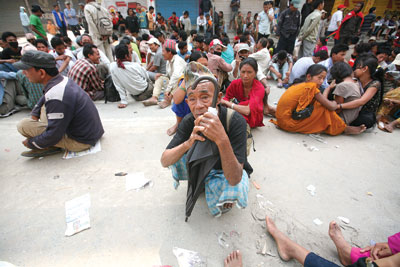
Of course they were brainwashed, but it was hardly surprising. This kind of "herd mentality" among the mass can be best explained philosophically with the political theory of Principal-Agent problem. The theory describes a relation, largely dictated by the Principal who pays for the service of the Agent or misguides the Agent with little, no or wrong information, for the sole purpose of benefiting the Principal. Maoists trucked in the "mass" to Kathmandu from the hinterland with both asymmetric information strategy (which kept the mass blind and deaf to the real intent of Prachanda et al). The trucked in "mass", in this context, can best be described as Emile Durkheim's "bheda".
"Given our large and growing population base of unskilled youth, and given the visible disparity between Kathmandu and the rest of Nepal, business promotion bodies and business leaders should come out of their narrow confines, and start playing a more positively influential role rather than leaving it in the hands of narrow-minded politicians. After all, to paraphrase John F. Kennedy, if our society cannot help the many who are poor, it cannot save the few who are rich."
I'm not so sure that it is the best use of the time and entrepreneurial talent of the business leaders to be doing things that are not central to their business, the things that they are good at going -- creating business opportunities for themselves; creating jobs; generating revenue profits for themselves and their shareholders and tax revenue for the government while working within the confines of the law of the land. My opinion is that business people should be left alone to do that, because that's what they do best; that's how they help grow the country's economy. And it is the responsibility of the government to create safe, secured and conducive environment for businesses to thrive.
Oohi,
Thurpunsich
jange May 14, 2010
... business promotion bodies and business leaders should come out of their narrow confines, and start playing a more positively influential role rather than leaving it in the hands of narrow-minded politicians.
And do what? Apart from run their businesses in the best way they can?
If you have nothing to say then don't say it.
npasl May 14, 2010
why don't these biz houses just learn from those in other places and make powerful lobbying groups that dictate the politics, and not the other way around.
Arthur May 15, 2010
Private enterprise in Nepal has been a spectacular failure under NC and UMLs.
The private sector will thrive when the crushing weight of landlordism, corrupt bureaucrat capital and its NGO counterparts is removed.
I have to agree with Thurpunsich and jange that "entrepreneurs" would do better for both themselves and Nepal by taking advantage of the opportunities that will be opened up than by offering sound-bites to the poor.
Sunita Tiwari May 15, 2010
Thanks to the public display of poverty by the maoist, harvard affiliated people:1) who are strictly interested in business
2) who believe that when you do your business, adam-smith's-invisible-hand-whatever benefits the society as a whole
3) who believe that business greed is good, and
4) who are absolutely certain that maximizing shareholders wealth is the primary task of manager;
are starting to talk about businesses 'playing a more positively influential role' to 'help the many who are poor'.
But Mr. Tiwari, just to state your argument as you did, you don't need to waste half of the article trying to convince your reader that you are not supporting Maoist. If you write, talk, or advocate in any way that the haves of Kathmandu should do something for the have nots, then you will be labelled as Maoist.
To be a better columnist, be brave and just write your heart out, either you are for or against the maoist or any other ists' for that matter. If you write to please your reader, compromising your inner conscience, you are not only betraying them but yourself too.
Just my two cents.
Sargam May 15, 2010
In Support of #Ashutosh Tiwari and #Thurpunsich, let me add the following reflection to enrich this debate:
Made mistake? Own it.
The study of social interaction amongst the individuals and groups of persons becomes more plausible and decisive while making decisions in our business life, and such a scrutiny of human behaviors is recognized as the Social Sciences.
Obviously the Social Sciences incorporate human beings and their overall individual and collective behaviors, of the past and the present to be synthesized so as to take into consideration the kind of character-building experiences that prepare them to take on a leadership role in the business world; enabling them to focusing the attention on bringing out the very best in each individual.
Some of our past decisions could offer us a wonderful insight into the way the impact of our future decisions could be felt and approved of. Such experiences are very common occurrence to reinforce the certitude in our doings.
Most of the time in big Societies thanks to the team management, decisions are taken under the direct influence of the team and sometimes we could take relatively bad decisions collectively.
Often the botched invasion of Cuba (1961) by the anticastrists or the Bay of Pigs fiasco is cited as the definite example of "groupthink". Plus one day "the Iraq invasion scheme" would be held up as "the bad decision."
If we look into the research of Gary Klein and his so called "naturalistic decision-making" what we notice is that "people with experience do most of their decision-making subconsciously". He further adds that "people assess the situation by matching it with an experience in their memory of past actions. This also happens subconsciously."
"Finally they test the practicability of this course of action by imagining what will happen if the action is taken. This imagining activity is the main conscious work that happens during a decision … We mostly make decisions subconsciously using experience, intuition and imagination. We do not normally do much analysis, such as identifying options and comparing them."
The Harvard Business Review in its recent issue noted down that decision-making should be divided into three parts:
a) preparation
b) "call"
c) execution,
and by letting time to "redo" or adjust that decision as we proceed further.
Conversely, our bad decisions or blunders of the past should serve as lessons to be more efficient in future. The following "little dialogue" should always remind us to be cautious while we're about to deliver decisions:
Q. What is the secret of your success?
A. The two words.
Q. What are they?
A. Right decisions.
Q. How do you make right decisions?
A. One word.
Q. What is that?
A. Experience.
Q. How do you get experience?
A. Two words.
Q. What are they?
A. Wrong decisions.
It should not be neglected "the sociological determinism" or the philosophical conception that determines the nexus between the cause and effect concerning two or several phenomena, amongst them the political and economic upheaval of a country.
Nonetheless there are reasons to think that the experience of even partial contentment should be observed as one more positive achievement in keeping with our demand to be always ready for improvement in making shift in our attitude toward our fellow beings.
The pedagogy of "first know thyself" could be the philosophical underpinnings to emphasize upon the saying, "Every body judges (if not gauges) others after himself." And once more let us envisage the effect of the following renowned Chinese adage:
"When the wise man shows the moon to somebody the imbecile fixes his eyes on the finger of the wise man."
Slarti May 16, 2010
"politically charged Nepali language in which you get to make all the right noises and mean absolutely nothing! "
This is the sign of times, evident in the cacophony generated by the media. We are now required to be hypocrites, expressing hollow platitudes, rather than do something real to make life better.
Slarti May 17, 2010
"Given our large and growing population base of unskilled youth, and given the visible disparity between Kathmandu and the rest of Nepal, business promotion bodies and business leaders should come out of their narrow confines, and start playing a more positively influential role rather than leaving it in the hands of narrow-minded politicians. After all, to paraphrase John F. Kennedy, if our society cannot help the many who are poor, it cannot save the few who are rich."
I agree with the spirit of your conclusion but there is something wrong with it, maybe the way you have put it. I am not immediately certain but I have a feeling that this is because nobody seems to have a clear understanding of poverty, i.e. at a human/personal level.
What I have written here is a bit disjointed and longish, sorry about that. I will improve on it some other time.
Poverty is not the same everywhere, all poor are not same. Poor are individuals as different as you and I, their needs are as different as yours and mine and, expectations are equally different. The poor you talk of, the ones below poverty line, need urgent intervention to improve their lot. They will not benefit from what you suggest.
The basics required urgently are - more efficient management of food supplies, easy transportation networks, maintenance of law and order, and an effective/accessible judiciary. None of this is for the private sector to provide.
Now, not being an academic or a journalist, the only thing I can hope for is that someone from these two fields would actually investigate the "true" nature of poverty, removed from the rhetoric of politics, and hypocrisy and laziness of the communists.
It is in this particular field that business grants and encouragement from the private sector would be most useful. Because what is sorely needed is an "honest", "clear", and "factual" study of social contracts, social values and expectations that people have. The need is for all of this to be free of hypocritical terms, only then should someone design any solution for "this" society and "this country". This, by the way, is also what the "people" of Nepal truly want, once you take out the hypocrisy from a conversation.
Given the nature of Nepal's politics, don't expect anyone to deal with this effectively.
Arthur May 17, 2010
Slarti, Sargam has taken your advice to stop threatening to hang opponents. Neither Sargam nor anybody else is required to express hollow platitudes instead. They do it because of who and what they are. What else could Sargam do?
Sunita Tiwari, you were proved right about the reaction to C K Lal, but I don't think Ashutosh Tiwari has any reason to feel a danger of being seen as a Maoist. His call for business to promote more convincing sound-bites to use against the Maoists seems to be sincerely anti-Maoist. The "enrichment" of this call with hollow platitudes from Sargam just shows what he's up against.
I suspect the FNCCI will eventually sponsor a party that can deliver 21st century pro-capitalist sound-bites against the Maoists. There will be space for that sort of pro-capitalist party when the parties of semi-feudal hollow platitudes have largely disappeared. But I hope the capitalists put most of their energy into running their businesses rather than trying to run the state once there actually is a functioning state under which they can run their businesses.
Arthur May 18, 2010
Slarti #8,
"The basics required urgently are - more efficient management of food supplies, easy transportation networks, maintenance of law and order, and an effective/accessible judiciary. None of this is for the private sector to provide."..."Given the nature of Nepal's politics, don't expect anyone to deal with this effectively."
Ok those bits are not disjointed or longish and provide a clear response to the article.
While agreeing on those basics, we disagree on what has to be done about "the nature of Nepal's politics". You (in other posts) include the Maoists as the same, or worse than the other parties and incapable of effective solutions but only hollow platitudes (and much worse).
As I understand it the Maoists cannot implement effective solutions without winning control of the state apparatus - and politics in Nepal is mainly focussed around how to prevent them winning control of the state apparatus.
What is your proposal for "maintenance of law and order and an effective/accessible judiciary". Anti-Maoist parties sell police and judicial jobs for bribes. This is "traditional" and results in a corrupt police and judiciary that cannot maintain law and order. Maoists propose to end that, including judiciary subordinate to legislature so corrupt judges can be removed. Anti-Maoists are most united on opposing that.
Maoists when in office also proposed a ban on bandhs. Other parties refused.
What is your proposal for "more efficient management of food supplies, easy transportation networks"? You agree that this requires government action, not just private sector. Doesn't it also require a bureaucracy that is responsible to the local people instead of a corrupt bureaucracy full of people looking for ways to rip off development projects to pay back the bribes with which they bought their jobs?
You can find their concrete proposals on these matters in part C on Economic Basis of the new Nepal of the Maoist election commitment. What are your alternatives?
Nepali Times Reader May 18, 2010
Great Article Mr. Tiwari! truly impressed. I dont think any more words are required really. As you said, lead by action and they speak louder than words or 'bandhs' for that matter. Totally agree with you.
Slarti May 19, 2010
I am sorry I don't have time right now to go into the details of that document you have posted here. Suffice to say that it would be worth every minute of my time to smash that document into pieces; I promise to do that on Thursday.
What I have said about the Maoists are facts that you have been ignoring or sidestepping with mere insinuations.
Meanwhile, in response to your question about what is my model, I am not sure how many times I have to say this, but there is no single cure all for problems faced by any economy, much less of Nepal. Secondly, it is the framework that trumps the detail. I have laid out what I believe would be the appropriate framework earlier. When I have more time, I will do that again.
More about your comment, no we do not agree on the basics either. My basic argument is that the present level of poverty in Nepal is a result of a prolonged and unnecessary conflict, or at least that the level of poverty has been accentuated by it.
If not for the conflict, a reflective and flexible state apparatus and a business community operating in less fearful environment would have adapted to changes far more easily in a changed regional economic landscape. So would the people of Nepal.
Further, I also stress, and have repeatedly said, that poor - despite suffering from a common consequence - have multiple reasons to be in that state. This requires careful understanding, removed from political rhetoric and communist skulduggery. Corruption had a role to play in it, I will try and address that as well.
Maoist proposal to ban strike was a useless charade when they, as opposition, would not stop it themselves – unless, of course, they spotted the surprise in their surprise party, or the white elephant in the room.
About the proposal to implement law and order etc, it is akin to a thief shouting theft, (I am not sure what the correct English saying is). Again I will include this in my response on Thursday.
Meanwhile, a judiciary subordinate to legislature is not cleaner but far more corrupt; we have seen glimpses of that recently. Instead, an independent judiciary has proved to be far more effective in handing out justice. Reform is required, in everything - from time to time, but not of this nature.
Bureaucracy is a complex animal and much like in everything else I am no expert on it. Nevertheless, for the purpose of discussion I will try and respond later.
jange May 19, 2010
# 12. Suffice to say that it would be worth every minute of my time to smash that document into pieces; I promise to do that on Thursday.
Hardly worth the effort. It's not worth the paper it's written on.
Arthur May 19, 2010
Slarti, the Maoist election commitment was published for elections two years ago. Why rush to refute it by Thursday? Surely somebody has already done so?
Or did their opponents promptly sign up for a "Common Minimum Program" in which they pledged to carry out much the same economic proposals as those in part C?
Nevertheless, it would be interesting to discuss part C and your response to it in this "strictly business" column. There will be another issue of Nepali Times on Friday and another much less concrete "business" oriented article then, so we could continue the discussion there. Perhaps it would be better to take an extra day and keep the discussion in one place.
Concerning your "basic argument" that the present poverty of Nepal is due to the conflict, the fact is that Nepal was going backwards and had become one of the poorest countries in the world when the People's War was launched. The poverty has become more visible since the conflict. Certainly ending the conflict is necessary for moving forward. Clinging to the status quo would end up with renewed conflict.
On judiciary, everyone knows it has been completely corrupt. Sacking corrupt judges is part of having an independent judiciary. A corrupt legislature would not sack corrupt judges. A legislature with a Maoist majority would. That is what others are afraid of. This is not "independence" but corruption throughout the society depending on a corrupt judiciary and corrupt politicians.
But lets concentrate on concrete economic policies. I will read your response to those in part C carefully.
Thurpunsich May 20, 2010
#10: "What is your proposal for "maintenance of law and order and an effective/accessible judiciary". Anti-Maoist parties sell police and judicial jobs for bribes. This is "traditional" and results in a corrupt police and judiciary that cannot maintain law and order. Maoists propose to end that, including judiciary subordinate to legislature so corrupt judges can be removed. Anti-Maoists are most united on opposing that."
Judiciary subordinate to legislation? Maoists can dream on, but that's not going to happen.
The new constitution has all but been written. There is reportedly near consensus on most all socioeconomic issues. Where there is no consensus, the issues have reportedly been said to be negotiable (even direct election of a prime minister through adult franchise and presidential system).
But, and this is a big, fat BUT, there are five political issues that Maoists want in the constitution that no one else will agree with:
1. Judiciary subordinate to legislature.
2. Upper ceiling on wealth accumulation.
3. "Pratigami" (reactionary), "rashtraghati" (antinational), "janabirodhi" (anti-people's republic), and "dakshinpanthi" (non-leftist) political parties will be banned. (Note: Maoists use all these labels to refer to Nepali Congress)
4. There will be multi-ethnic society, but there will be not be more than one ideology (Note: Marx said there can be only one ideology in a society at one time).
5. "Bahulbad" (majority) will not be accepted.
I didn't make this up. Watch it for yourself:
http://www.dailymotion.com/video/xd99sk_fireside-part-2-may-10th_news
Arthur appear to speak of Maoists' "proposal" to put judiciary under the legislature as if that is going to solve the problem of "corrupt" judges, yet conveniently ignore to point out the one single pitfall: blatant politicization of judiciary.
Arthur May 21, 2010
Thurpunsich #15, unfortunately since I cannot speak Nepali I do not know who is in the video or what they say. I will be very interested to read an english translation of the Maoist draft when it is published on May 29.
Lets stick to just the one item - judiciary subordinate to legislature.
I believe you are correct that anti-Maoists are very opposed to this. They are also very corrupt.
Subordination to legislature means that the legislature can reject nominations to be appointed a judge and can dismiss a judge for misconduct. This is normal and is consistent with "judicial independence" including tenure until retirement age (no dismissal by executive government, nor without finding misconduct) and not subject to directions from the government.
You say it leads to "blatant politicization of judiciary". Would you say the US has a more politicized judiciary than Nepal? The US legislature has to confirm appointment of every judge and can impeach (dismiss) any US judge. In Nepal most of the legal profession are Kangresi.
In a country where the judiciary is already corrupt, how do you get rid of corrupt judges. Do they dismiss themselves?
If not, somebody else has to have power to dismiss them.
If the government has that power it undermines judicial independence. If the legislature has the power it can only be done very publicly so it is much easier to resist any misuse of the power.
Slarti May 21, 2010
You keep at your obstinate effort to lie in the hope that nobody would refute it because they would be tired. No the judiciary was not completely corrupt, and yes, everybody knows that. For something this silly, I don't have to "rush".
Anyway, at purchasing power parity, if you wish to increase the per capita income from $1000 currently to $3000 in ten years, that would require an annualised growth rate of 11.6%. If you wish to take it up to 6000, that is a growth rate of 19.62%, p.a. This is possible, but not with the plan that you have because it is anything but simple and practicable.
Which also leads me to wonder if this actually is the Maoist manifesto or you are working as deep cover to thoroughly discredit them?
Most of the document is a mere amalgamation of slogans to combat false impressions.
Slogans supersede actual action points, which whenever mentioned, are directed at imaginary problems anyway. However, it is understandable, because unless false impressions are made conventional wisdom, the revolution would be nothing but a criminal enterprise to grab power, which it actually is.
1. End of feudal relationship � hocus pocus primus
Feudal relation � whichever way you define it � is not a hindrance in production, it is a consequence of the level of development. Industrial societies are not feudal because they need not be. End of a feudal pattern of production is possible by a turnaround in economic conditions, not the other way round.
It is your kind of voodoo economics which keeps most of the world poor. Meanwhile, the widespread prevalence of claptrapology masquerading as revolutionary speak incorrectly assumes that the rural relations in Nepal are classic feudal; they are not.
But of course with denial the dominant form of commie communication - that is not yet debated clearly. I would still expect that you would enlighten me on exactly how feudalism dominates in Nepal�s agricultural economy and why. It would be interesting to see how a party of warlords which extorts wealth by threatening violence treats this subject.
The problem with agriculture in Nepal is multi-faceted; tenancy exists because owners have moved out of villages, and also because of land fragmentation etc. The rent, wages and prices are economic problems which need to be dealt with by economic incentives and disincentives.
Hope, that the problems resulting from small land holdings and subsistence farming would be solved by co-operative movement is na�ve. Merely stating a plan does not make it real unless you have the right mechanism to make it function. Co-operative movements have failed too often in too many societies, in too many countries to raise optimism in them aiding a swift turnaround for the rural economy.
2. Economic Growth along with employment
I have no idea what they are talking about here. Employment is a result of economic activity, economic activity cannot be started for employment. In an economy where human resource is poorly trained development is constrained till that situation turns around. It is also within this context that the insurgency cost this nation dearly. Several thousand who would otherwise have acceptable levels of education, are not educated enough because of this madness.
3. Public-private partnership
Simply because you have the right term does not mean you have the right solution. Nobody needs to be encouraged to invest, people invest because of a reasonable expectation that they would benefit from such an investment. The job of the government is to ensure that the regulatory environment is robust enough for individuals to confidently make such investment, and the right to property is ensured.
Attracting investment is not a problem; the problem is establishing the right regulatory framework. Based on crime, the Maoist party cannot bring in such changes.
I will discuss other points some other time but the basis of that discussion would be the same. So I will stop on this CMP issue for now.
Meanwhile, I promised I would also discuss bureaucracy and corruption. First, let me assure you that corruption would increase during Maoist rule. Corruption was extremely blatant during the conflict period, because conflict does that to all societies. As the central government increases its effort to combat terrorism under the false assumption that it is caused by poverty, the terrorists siphon off that money, and bureaucrats submit false reports etc to pocket that money. There were several examples of that happening in Nepal and in other countries suffering from terror.
Another factor which aids corruption is the tendency to allocate money towards �development� (in the hope that it will miraculously change the economy of the target region) in areas which do not have payment systems which can absorb that outlay. More often than not this results in siphoning off of funds by petty government agents, and their local partners.
To make bureaucracy effective one needs to ensure a strong feedback mechanism. This cannot be �people oriented�, instead this mammoth organization needs to be trimmed and designed to make it result oriented. Most failures emanate from processes, not people.
#13, you are right. #15, thanks for saving my time.
Arthur May 21, 2010
Slarti #16, in #10 I asked you:
"What is your proposal for "more efficient management of food supplies, easy transportation networks"? You can find their [Maoist] concrete proposals on these matters in part C on Economic Basis of the new Nepal of the Maoist election commitment. What are your alternatives?
That question was because I agreed with some words from your #8 in reply to the article.
"The basics required urgently are - more efficient management of food supplies, easy transportation networks, maintenance of law and order, and an effective/accessible judiciary. None of this is for the private sector to provide."
Here for example are the Maoists concrete proposals concerning just one of those three topics, transportation networks:
5. Physical Infrastructure and Urbanization The slogan 'Modern physical infrastructure - a basis for a new Nepal' shall be the catchphrase of economic development. Roads, railways, rope-ways, water supply schemes, housing and urbanization shall be given prioritized because without a well-developed physical infrastructure the vision for a new Nepal shall remain a dream. Emphasis shall be placed on linking the east with the west and the mountains and hills with the Tarai, for unified and balanced development, whereas in the past, emphasis was only on linking Kathmandu with the Indian borders. Moreover, emphasis shall be on linking the capital of each autonomous state of the federal structure with each other, and on systematic urban development. For unified development of the entire country along with land utilization plan, formulating short term and long term plan, an extensive network of road, railway, tunnel way, rope-way and urbanization in such a way that the look of the country shall be changed within twenty years. Firstly, the road way to link mid-hills with east-west shall be completed. In Tarai, electric railway linking east with west shall be built. In inner Madhes, roads that link east with west shall be completed. Five or six north-south road shall be constructed in the east, centre and west in such a way that it would function as a mobile bridge between India and China. Extension of the railway road from Lhasa to Lumbini via Kathmandu shall be initiated. (see map) Special attention shall be paid to rural infrastructure development. Priority shall be given to extend road network, mainly, in the backward hilly districts of the Far West, the Karnali region and mid and eastern hilly districts. Greenery along the roads shall be emphasised while constructing roads in hilly regions. Transportation can supply fruits of development to common people only after it is linked to production; attention will be paid to this fact. Provision shall be made to distribute pure drinking water to everyone within five years. A model city will be developed in each of the ethnic and regional autonomous states and a unified model development program shall be implemented in all of the 75 districts. By doing this, the model shall be expanded throughout the country. Dense settlement shall be developed by uniting and (providing) modern facilities to scattered villages. Provision shall be made to provide permanent residence to squatters. Contemporary uncontrolled urbanization shall be organized by forming a united development plan for Kathmandu valley. By developing satellite cities outside Kathmandu valley and constructing Kathmandu-Hetauda fast track (tunnel way), the pressure of in-migration to Kathmandu shall be controlled. A lasting solution for the drinking water problem shall be sought by completing Melamchi project within five years. Better supply of drinking water shall be facilitated by appropriate management and mobilization of alternative sources as well as the existing sources. Special priority shall be given to airways and rope-ways that connect remote districts. Air travel to hilly districts shall be made easy and accessible. In reply you say nothing concrete about transportation networks whatever. Likewise they have concrete proposals about management of food supplies and you say nothing concrete at all about food supplies.
You do say something about law and order and effective/accessible judiciary. Your response is to say that the present judiciary is not completely corrupt and to claim that bureaucratic corruption generally is a result of conflict with Maoists and will increase with Maoist rule. That is not an alternative proposal for establishing law and order and an effective/accessible judiciary.
Instead of any concrete alternative proposals on any one of the issues you correctly singled out as important you do the usual general ideological "smashing the document into pieces" by just shouting against it.
In particular you shout against the very idea that there are feudal production relations in agriculture.
But your inability to focus on concrete analysis to actually resolve any concrete problem is itself a product of a semi-feudal mindset. Your whole way of looking at the world is oriented around preserving the collection of rent. You are simply incapable of considering such matters as how to develop transportation networks, but can only mimic the words.
There is something a bit similar in the article's proposal to counter Maoists with sound-bites in support of private enterprise.
I doubt that this will prove an effective counter to actual concrete proposals for developing transportation, food supplies etc etc.
Slarti May 22, 2010
#18, Arthur, if you don't know what to say it's better to say nothing.
"Here for example are the Maoists concrete proposals concerning just one of those three topics, transportation networks:"
"5. Physical Infrastructure and Urbanization The slogan 'Modern physical infrastructure - a basis for a new Nepal' shall be the catchphrase of economic development."
There is a difference between action and a wish list what you have pasted here is a wish list. This is an example of what I said in #17 "slogans supersede actual action points, which whenever mentioned, are directed at imaginary problems anyway."
"In reply you say nothing concrete about transportation networks whatever. Likewise they have concrete proposals about management of food supplies and you say nothing concrete at all about food supplies."
If you expect me to write a manifesto that is not going to happen, your copy paste work is proof that Maoist have no plan of action, but a bunch of "catchphrases" on the basis of which they murdered.
"Instead of any concrete alternative proposals on any one of the issues you correctly singled out as important you do the usual general ideological "smashing the document into pieces" by just shouting against it."
Read comment #17 again
"In particular you shout against the very idea that there are feudal production relations in agriculture."
You can call my comment shouting or whatever you please, but I asked this in reference to point 1 of that manifesto – "I would still expect that you would enlighten me on exactly how feudalism dominates in Nepal's agricultural economy and why. It would be interesting to see how a party of warlords which extorts wealth by threatening violence treats this subject."
"But your inability to focus on concrete analysis to actually resolve any concrete problem is itself a product of a semi-feudal mindset."
Answer the question above and, read my analysis in #17 again.
"Your whole way of looking at the world is oriented around preserving the collection of rent. "
Read comment #17 again
"You are simply incapable of considering such matters as how to develop transportation networks, but can only mimic the words."
Read comment #17 again
"I doubt that this will prove an effective counter to actual concrete proposals for developing transportation, food supplies etc etc."
Read comment #17 again. The action points are as follows -
- [Bureaucracy] …..needs to be trimmed and designed to make it result oriented. Most failures emanate from processes, not people. Call to action, build a system where performance of bureaucrats can be evaluated based on evidence because they are the ones ensuring the delivery of services.
- Another factor which aids corruption is the tendency to allocate money towards "development" (in the hope that it will miraculously change the economy of the target region) in areas which do not have payment systems which can absorb that outlay. Call to action – when designing outlays, collect the right kind of data so that you can ensure that the funding would be utilized to develop system which would boost the local economy.
Other points are
- Establishing the right regulatory framework.
- [Design] simple and practicable solutions, not slogans.
- The rent, wages and prices [in the rural as well as urban areas] are economic problems which need to be dealt with by economic incentives and disincentives.
- Merely stating a plan does not make it real unless you have the right mechanism to make it function. Therefore, develop the correct mechanism within which each solution would function.
A Again read #17, #8, and several other comments for information and solutions.