
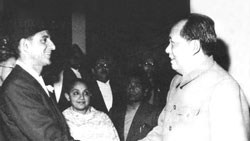
 These excerpts from Mao Zedong's Little Red Book-from sections on the armed struggle to capturing political power, surrounding the cities from "base areas" in the hinterland, and the formation of the People's Liberation Army-all show how closely Nepali Maoists follow Mao thought, and where they see fit to diverge. The excerpts also indicate which way the Maoists
are headed, and give us a glimpse of their ultimate destination.
. . .
Historically, all reactionary forces on the verge of extinction invariably conduct a last desperate struggle against the revolutionary forces, and some revolutionaries are apt to be deluded for a time by this phenomenon of outward strength but inner weakness failing to grasp the essential fact that the enemy is nearing extinction while they themselves are approaching victory.
. . .
If they [the Kuomintang] fight, we will wipe them out completely. This is the way things are: if they attack and we wipe them out, they will have that satisfaction; wipe out some, some satisfaction; wipe out more, more satisfaction; wipe out the whole lot, complete satisfaction. China's problems are complicated, and our brains must also be a little complicated. If they start fighting, we fight back, fight to win peace.
. . .
If anyone attacks us and if the conditions are favourable for battle, we will certainly act in self-defence to wipe him out resolutely, thoroughly, wholly and completely (we do not strike rashly, but when we do strike, we must win).
. . .
As far as our own desire goes, we do not want to fight even for a single day. However, if circumstances force us to fight, we can fight to the finish.
. . .
In the revolutionary war as a whole, the operations of the people's guerrillas and those of the main forces of the Red Army complement each other like a man's right arm and left arm. In concrete terms, especially concerning military operations, when we talk of the people in the base area as a factor, we mean we have an armed people. That is the main reason the enemy is afraid to approach our base area.
. . .
The object of war is "to preserve oneself and destroy the enemy" (which means to disarm him or "deprive him of the power to resist", and does not mean to destroy every member of his forces physically). Destruction of the enemy is the primary object of war and self-preservation the secondary, because only by destroying the enemy in large numbers can one effectively preserve oneself.
. . .
Every war exacts a price, sometimes an extremely high one. Is this not in contradiction with "preserving oneself"? There is no contradiction at all; sacrifice and self-preservation are both opposite and complementary to each other. All military operations-from the principles of shooting (taking cover to preserve oneself, and making full use of fire-power to destroy the enemy) to the principles of strategy-are permeated with this spirit. All technical principles and all principles concerning tactics, campaigns and strategy represent applications of this basic principle.
. . .
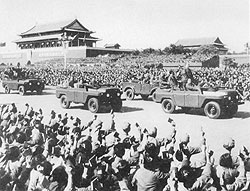 Our principles of operation are:
(1) Attack dispersed isolated enemy forces first; attack concentrated strong enemy forces later.
(2) Take small and medium cities and extensive rural areas first; take big cities later.
(3) Make wiping out the enemy's effective strength our main objective; do not make holding or seizing a city or place our main objective. This is the outcome of wiping out the enemy's effective strength, and often a city or place can be held or seized for good only after it has changed hands a number of times.
(4) In every battle, concentrate an absolutely superior force (two, three, four and sometimes even five or six times the enemy's strength), encircle enemy forces completely, strive to wipe them out thoroughly and do not let any escape from the net. In special circumstances, use the method of dealing the enemy crushing blows, that is, concentrate all our strength to make a frontal attack and an attack on one or both of his flanks, with the aim of wiping out one part and routing another so our army can swiftly move its troops to smash other enemy forces. Strive to avoid battles of attrition in which we lose more than we gain or only break even.
(5) Fight no battle unprepared, fight no battle you are not sure of winning; make every effort to be well prepared for each battle, make every effort to ensure victory in the given set of conditions between the enemy and ourselves.
(6) Give full play to our style of fighting-courage in battle, no fear of sacrifice, no fear of fatigue, continuous fighting (fighting successive battles in a short time without rest).
(7) Strive to wipe out the enemy when he is on the move. At the same time, pay attention to the tactics of positional attack and capture enemy fortified points and cities.
(8) Concerning attacking cities, resolutely seize all enemy fortified points and weakly defended cities. As for strongly defended enemy fortified points and cities, wait until conditions are ripe and then take them.
(9) Replenish our strength with all the arms and most of the personnel captured from the enemy. Our army's main sources of manpower and materieal are at the front.
(10) Make good use of intervals between campaigns to rest, train and consolidate our troops. Periods of rest, training and consolidation should not be very long, and the enemy should as far as possible be permitted no breathing space.
. . .
"War is the continuation of politics." In this sense, war is politics and war itself is a political action; since ancient times there has never been a war that did not have a political character.... However, war has its own particular characteristics and in this sense, it cannot be equated with politics in general. "War is the continuation of politics by other . . . means." When politics develops to a certain stage beyond which it cannot proceed by the usual means, war breaks out to sweep the obstacles from the way. Politics is war without bloodshed while war is politics with bloodshed.
. . .
History shows that wars are of two kinds, just and unjust. All progressive wars are just, and all wars that impede progress are unjust. Not only do we Communists not oppose just wars; we actively participate in them. World War I is an instance in which both sides fought for imperialist interests; therefore, the Communists of the whole world firmly opposed it. To oppose a war of this kind do everything possible to prevent it before it breaks out and, once it breaks out, to oppose war with war.
. . .
Every Communist must grasp the truth; "Political power grows out of the barrel of a gun."
Seizing power by armed force, settling the issue by war, is the central task and the highest form of revolution. This Marxist-Leninist principle of revolution holds universally.