
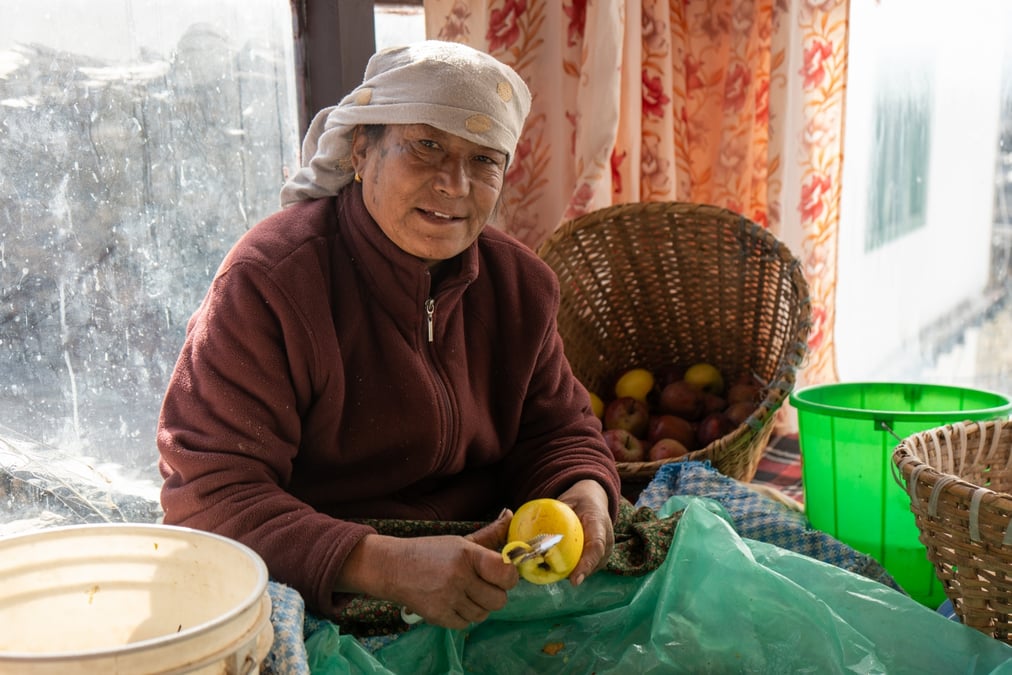
Quantity is no longer the problem with Mustang’s apple economy, quality is. And that is what a project in the scenic village of Thini is trying to achieve.
The slopes below the icy peak of Nilgiri is bright yellow with autumn foliage, and here the Ward Chair of Thini Pradeep Thakali is working on a project to produce high-quality apples that fetch a higher price in city markets.
Thini’s orchards have seen an increase in apple production in recent years. Demand from Pokhara and Kathmandu has helped farmers sell the fruit, but Thakali worries that the oversupply may outpace consumer demand and lower prices.
The project, Syaaũ-Grahm (apple village) would push farmers to prioritise quality over quantity and protect the apple economy. Farmers here sell their apples mainly to apple brokers, who purchase the fruit in bulk and sell them to retailers.
Apples bought in bulk are usually inconsistent in quality, so middlemen may struggle to sell their entire purchase, leaving farmers without full payment and consumers paying prices that do not accurately reflect the quality of apples they receive.
“Right now, farmers are paid per kilo of apples, but with Syaaũ-Grahm they would also be paid based on the quality of the apples,” he said, “it would encourage the farmers to produce higher-quality products which would benefit them and the consumer as well.”
The project will purchase apples directly from farmers, sort them into quality grades, package, and market them under a consistent brand. Higher-quality A, B, and C are sold directly to consumers, while low-quality grades can be used to produce juice or the apple brandy that the region is famous for.
Syaaũ-Grahm will also store unsold apples in a cold-store, allowing them to be marketed past the harvest season and extend the period in which farmers would earn income. Any surplus revenue from Syaaũ-Grahm will be reinvested into community education, healthcare, farmer training, and fertilisers.
Thakali says this year has shown the need for a project like this. Apple production in Thini has doubled or tripled compared to last year, but post-monsoon landslides blocked the Kali Gandaki Highway, disrupting transportation to Pokhara and Kathmandu.
Apple brokers could not reach Thini and other orchard towns and as a result, many farmers still have apples hanging on their trees. Thakali says his project would protect farmers from similar disruptions in future by buying the apples and storing them for dispatch to markets later.
Mandana Thakali is the manager of Thini’s homestay committee. Her family has also been apple farming for 45 years and she is happy about the prospects for her produce.
“I think the project will make good use of all our apples,” she said, “it will also enhance the marketing for us and we will sell more.”
Another apple farmer, Batti Thakali has been farming apples since she was a child, and considers the project to be good for the family. “I like Syaaũ-Grahm because it will help us distinguish between good and bad apples,” she says.
The project has been underway for nearly five years, and Thakali estimates it could take another 10 to 15 years to see results. After initially allocating funds for the cold-store and water access, he secured the project’s selection for further development through the National Planning Commission in Kathmandu last year.
Although the project will require time and sustained support, Thakali believes it is necessary for the long-term economy of Thini.
“It’s a long-term project,” he explains, “and it has to have community support to happen slowly over time, but this is the best thing we can do going forward.”