
Myths and legends about the birth of Kathmandu Valley speak of the deity Manjushri cutting the hill at Chobar into half with a mighty sword, letting out the water of a primordial lake and opening the fertile vale for habitation.
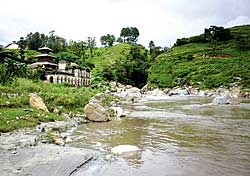
The more things change, the more they remain the same: Chobar Gorge in 1855 in a watercolour painting by Dr HA Oldfield (below), who was a surgeon at the British Residency in Kathmandu between 1850-1863. A picture of Chobar Gorge taken from the same spot this week (top).
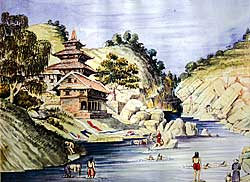
The scar of Manjushri's sword can still be seen at Chobar. This is where legend meets science: the hill is actually made of limestone and the lake was drained when water seeped through the soft rock and created a gaping cleft. Either way, Chobar has always been regarded as a holy spot, just like Pashupati and Gokarna where there are similar gorges. The elegant Jalbinayak Ganesh shrine is located at the base of the gorge and the devout used to throng here by the thousands.
About 8km south of the Ring Road, Chobar gorge today shows signs of the malignant intent of modern planners. Thirty years ago, they decided to locate a cement plant near the holy site. The factory-owners were drawn here by the same limestone ore that allowed geology to carve the gorge. Thankfully, the factory was closed down two years ago.
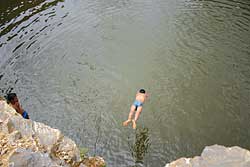
Eleven-year-old Binod Majhi jumps off a cliff into the artificial lake created by the cement factory.
The picturesque Chobar village on top of the adjoining hill could be one of the most desirable residential areas in Kathmandu Valley, but the stench of the river now makes it unbearable in the dry season. Chobar was always a favourite picnic spot and fishing area for Valley residents, but today, it gets few visitors. On Saturdays the occasional student driver practices on the hairpin bends. Otherwise, there isn't much happening.
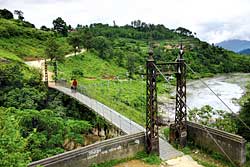
The Scottish-built suspension bridge (below right) from which there is a striking view of the gorge (below). 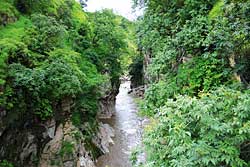
The holy Bagmati itself is now an unholy mess. The water is black, with detergent foam building up on the eddies between boulders, and the smell drives away all but the most zealous pilgrims.
"There was a time when we could see the coins in the water, it used to be so clean. I even used to drink from the river," says the Jalbinayak priest, Pursattam Tuladhar. He misses the crowds of pilgrims and the only money he gets for upkeep is Rs 500 each year from the Guthi Sansthan. "It is sad," says Tuladhar, shaking his head.
Chobar still figures significantly in all tourist guides. Websites for Nepal travellers still advise tourists not to miss it, especially since it makes a good day trip from Kathmandu. But many will be disappointed. Things will be even worse when a proposed bridge across the Bagmati to Bhaisepati is built because it is sure to harm the spiritual and aesthetic values of Chobar.