
On 18 May 2022, Sundar Harijan, a 20-year-old Dalit inmate at Rolpa jail died under suspicious circumstances in prison where he was serving a sentence for organised crime in place of another prisoner. A subsequent investigation into Harijan’s apparent suicide pointed towards police corruption, but the probe yielded no report or punishment for those involved.
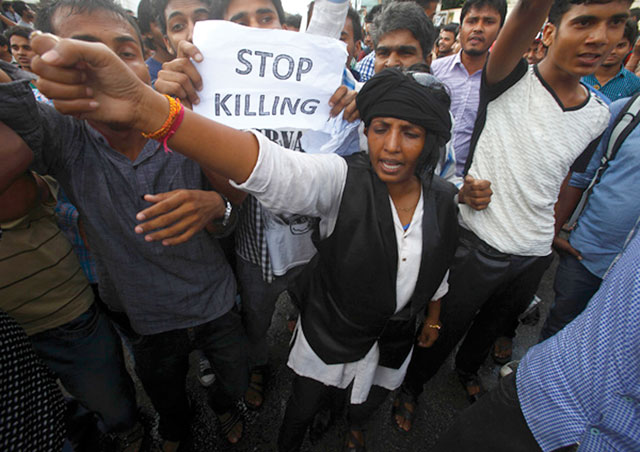
18-year-old Nabina Tharu was killed in June last year when police opened fire on protesters demanding protection of locals from wildlife in the nearby Bardia National Park. A committee formed to investigate Tharu’s death did not come to any conclusion.
These are notable instances of human rights abuses in Nepal highlighted in Human Rights Watch’s (HRW) World Report 2023, —which reviewed human rights practices in close to 100 countries— published this week.
The report emphasised the Nepal government’s failure to pursue due process and justice for conflict-era rights abuses including cases of torture, enforced disappearances, extrajudicial killings, and abuse by law enforcement.
“Lack of justice for conflict-era violations has contributed to a general state of impunity in post-conflict Nepal, undermining respect for human rights and governance across the board,” said Meenakshi Ganguly, South Asia director of Human Rights Watch.
In August, an amendment to the 2014 Act on the Commission on Investigation of Disappeared Persons, Truth and Reconciliation was presented before Parliament. However, the amendment threatened to narrow the scope of criminal accountability for injustices committed during the decade-long armed struggle.
The amendment classified torture as humane and inhumane, categorised murders in a way that would make it possible for perpetrators to bypass criminal accountability for war crimes, made it so that verdicts from a new special court would not be subject to judicial appeal, and included provisions that would exempt or provide immunity to perpetrators.
The bill was ultimately not brought to vote, and Nepal’s parliament was subsequently dissolved to make way for the November general election.
“The newly elected government should amend the transitional justice bill to address its shortcomings, bring it back to parliament, and finally move forward with delivering truth, reparations, justice, and guarantees that the abuse will not recur,” added Ganguly.