

Over the past 70 years, Nepal's elderly population (aged 60+) has grown 7.3 times while the total population grew only 3.5 times. In 2023, Nepal quietly crossed the international threshold of an ageing society defined as when 7% of the population is aged 65 and above, and is projected to be an aged society, 14% of population over 65, by 2049. In one of Nepal's more pointed historical ironies, the country is now older than it has ever been, while being governed by the youngest leadership it has ever seen.
Development economists have long worried about countries growing old before growing rich, where the costs of an ageing population arrive before a country has built the wealth to meet them. Nepal sits squarely in that conversation.
And yet the same shift that creates the cost also creates the opportunity. The silver economy, the economic activity generated by older populations, reached $45 trillion globally in 2020, roughly one-third of global GDP. It encompasses the growing demand for geriatric care, home-based services, pharmaceuticals, age-friendly housing, financial services, wellness, tourism, assistive technologies and a wide range of products tailored to older consumers.
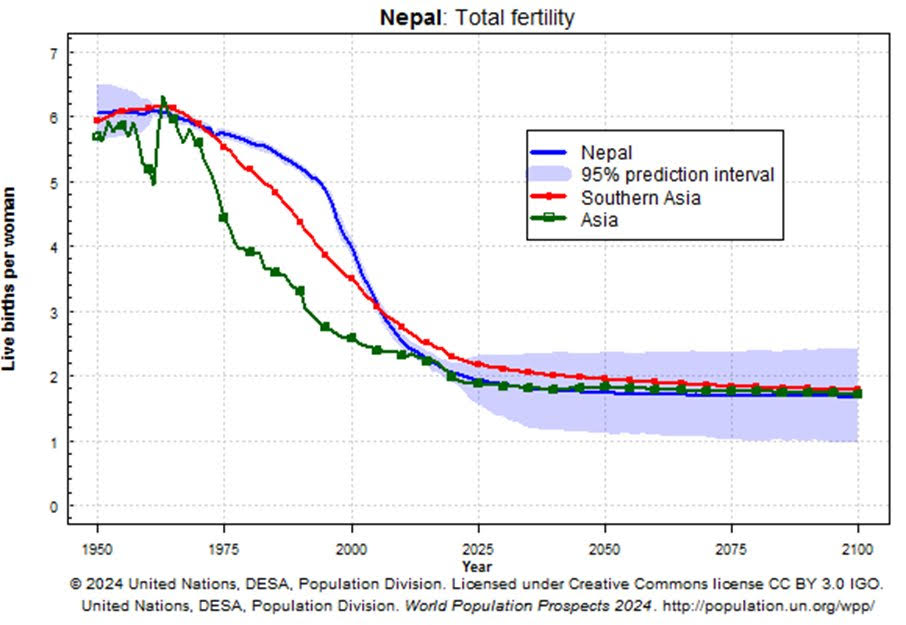
Three forces have driven this demographic shift in Nepal over decades: a dramatic fall in fertility, rising life expectancy, and the outward migration of millions of working-age Nepalis. For years, Nepal banked on its youth dividend, the economic boost that comes from a large, young working population. That dividend is narrowing. But something else is coming into view, call it the silver dividend, and it may be Nepal's next economic chapter.
How we got here
For generations, Nepal was a country of children. In 1961, the average Nepali woman had more than six children. Today that number has fallen to 1.9, below the replacement rate of 2.1 and among the lowest ever recorded in South Asia. The UNFPA’s 2025 State of World Population report points to the reasons: economic pressure, rising costs of living, and the migration of young couples abroad are all suppressing family size.
At the same time, Nepalis are living longer and the old are outpacing the young at double speed. Life expectancy has risen from 62.5 years in 2000 to 71.3 years today. According to the 2021 Census, 10.2% of the population, nearly three million people, are now aged 60 and above, up from 8.1% in 2011. Some provinces are already well ahead: Bagmati records 21.9% of its population as elderly.
Migration adds another dimension to this shift. More than 3.5 million Nepalis work abroad, sending home roughly $11 billion in 2023, more than a quarter of GDP. The young are in Doha, Dubai and Seoul, and the families they left behind are growing older.
Nepal is not alone in these trends. South Korea’s fertility rate has collapsed to 0.72, the lowest ever recorded for any nation. Closer to home, Sri Lanka’s 2024 Census recorded 18% of its population as aged 60 and above, a clear signal of where we are heading.
From cost to opportunity
The global conversation about ageing is shifting. What was once framed almost entirely as a fiscal burden is increasingly being recognised as an economic frontier.
By 2050, people over 50 are projected to account for approaching half of consumer spending in many advanced economies. In Asia-Pacific, the silver economy is already the fastest-growing in the world, projected to exceed $4 trillion in 2025 with 7% compound annual growth forecast through 2032. China elevated its silver economy to a national strategic priority in 2024, issuing its first dedicated policy document on the sector. The IMF’s April 2025 World Economic Outlook observed that demographic differences across countries create cross-border investment opportunities, with capital from older, high-savings economies flowing toward younger economies building care infrastructure.
Nepal's new budget reflects this shifting demographic picture. Social security spending has risen steadily from Rs96 billion in 2021/22 to Rs109 billion in 2025/26, with more than 3.8 million Nepalis now receiving some form of support.
For decades, Nepal's development story centred on its young and mobile workforce, the millions who built homes, sent remittances, and kept the economy afloat from Doha to Kuala Lumpur. That story is not over. But a new one is beginning to take shape alongside it.
Nepal has formally sought to defer its graduation from least developed country status to 2029, with its longer-term sights set on middle-income status by 2043. A large and expanding older population, with growing purchasing power supported by pensions, remittances and accumulated household assets, together with rising demand for care and age-related goods and services, need not be a detour from that ambition. Rather, the emerging silver economy may well prove to be one of the engines of Nepal's next economic chapter.