
Editor’s note: The ouster of Labour Minister Dipak Kumar Sah last week by the RSP government, stemming from a case involving his wife’s role in the Health Insurance Board has spotlighted challenges in ensuring universal health insurance. There is hope that the new government will have the political will to make the insurance system workable and equitable. International health expert Barune Thapa pinpoints the problems, and offers solutions.
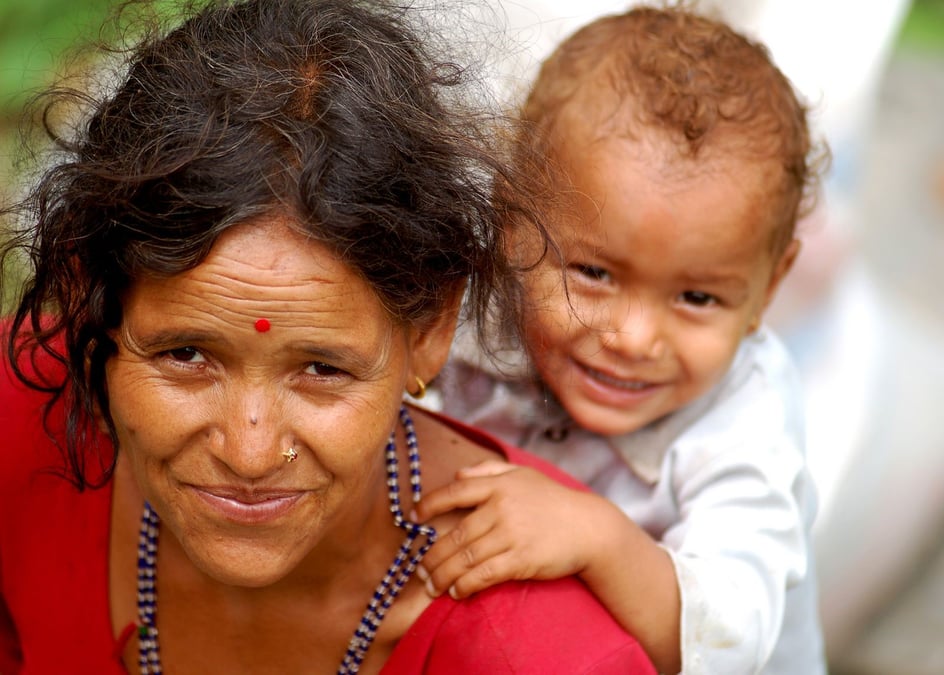
Sukumaya has the health insurance card. She pays the annual premium of Rs 3,500 for her family. She was told that her coverage of one lakh rupees per year would protect her. For a woman who rebuilt her home on loans after the 2015 earthquake, who took out a second loan to pay the first when the COVID-19 pandemic erased her family's income, the card promised that her health would not cause further impoverishment.
When a scooter struck her near her village in Sindupalchowk and injured her abdomen, the insurance did not work. She ended up at a private hospital that had no connection to the program. The total bill for her emergency surgery and care came to five lakh rupees — five times the annual insurance ceiling, with every rupee out of pocket. She paid with what savings she had and borrowed the rest.
Sukumaya still believes in health insurance. She has paid the premium for three years. Her complaint is that the insurance has never fully done what it promised. When her family members have needed care at hospitals that accept the card, she has watched the same pattern. Every time, she says, the cheaper medicines are covered, but the “better” ones—the ones the doctor would order—are not.
Then, in early 2026, even that partial coverage disappeared. On Magh 1, 2082 BS (mid-January 2026) Tribhuvan University Teaching Hospital (TUTH), the oldest and largest public hospital in the country, suspended all insurance-based services. Gangalal Heart Centre, Nepal’s premier cardiac facility, followed. Within weeks, more than fifty hospitals across the country had stopped accepting insurance cards. The government owed them billions in unpaid claims. The hospitals were not refusing care out of malice—they had been absorbing the cost of a program the state had failed to properly fund, and they were crumbling under this burden. Subash Acharya, the executive director of TUTH, had cautioned the Health Ministry warning that this moment was coming. “We cannot sustain it,” he told me. “I have written about ten letters to them in the last six months. We cannot sustain it.” Nobody listened.
“They said it would work in any hospital throughout Nepal, any in Kathmandu,” Sukumaya said. “But it didn’t happen. Now, it is closed.”
Nepal’s National Health Insurance Program (NHIP) was the most ambitious attempt in the country’s history to materialize the constitutional right to health. Launched in 2016, and codified in the Health Insurance Act of 2017, it promised universal coverage for a premium that families could afford. Eight years later, the program is in crisis—hospitals absorbing billions in unpaid claims, patients paying five times their coverage out of pocket, and the architects of the system watching it fail in exactly the ways they had warned it would.
Nepal’s Road to Universal Health Coverage
Nepal's 2015 Constitution enshrined health as a fundamental right. Article 35 declared that every citizen has the right to free basic health services, equal access to health services, and that no one shall be deprived of emergency health care. The NHIP was instrumental for fulfilling this promise. By paying an annual premium, every family would receive equal health coverage. The program would cover outpatient and inpatient services, surgery, medicines, and ambulance services at facilities nationwide. Enrollment was mandatory for all under the Act. The government would pay premiums entirely for the ultra-poor, senior citizens, people living with HIV, and the severely disabled. The principle was that the healthy would cross-subsidise the sick, the wealthy would cross-subsidize the poor, and the state would cover those who could not pay. It was a system built on principles of equity. 8.3 million individuals had enrolled through a network of 485 service providers across all 77 districts by October 2024, per the Insurance Reform Advisory Committee's 2024 report. On paper, universal health coverage—what the World Health Organization has called the “single most powerful concept that public health has to offer”—appeared within reach.
But the insurance program did not emerge from the blue. It was built on decades of advocacy and progress; and on a specific moment when Nepal’s health system was gaining ground faster than ever before.
The most consequential precursor came in 2006–2007, in the aftermath of the second Jana Andolan that overthrew the monarchy. The scene that followed—with a new interim constitution being drafted and the health minister holding the simultaneous rank of deputy prime minister for the first time—created conditions for a generation of health policymakers and advocates to advance health as a fundamental right. Mahesh Maskey, then at the center of these efforts, described the moment: “There was already a critical mass who were receptive about health as a fundamental human right,” he told me. “The slogan had already started,” dating it back to the 1990s. A ten-point program for free basic healthcare was launched. The health budget jumped from under 5% of the national budget to 7.2%. Patients returned to health posts that had sat nearly empty under the old cost-sharing model. And it worked. Per data from the World Bank Group, over the following years—built also on decades of investment in female community health volunteers, safe motherhood programs, and primary care infrastructure—life expectancy jumped from 55 years at the start of the 1990s to 68 by 2016. Maternal mortality plummeted. Nepal was invited to join the International Health Partnership as one of seven exemplar countries.
Yet even during this period, there was ongoing debate among the international donors and agencies that funded much of Nepal’s health infrastructure. The World Bank and GIZ (Germany’s development agency) pushed for insurance as the financing mechanism going forward. UK aid (then DFID), with its country’s experience in managing a universal health care program (the NHS), cautioned the opposite: insurance carried enormous administrative challenges, high corruption potential, and bureaucratic inefficiency. “The main argument was: if you go for insurance, the intermediaries would take such a large role that actual people may not receive the intended services,” Maskey recalled.
For the time being, free basic healthcare had won the argument. It worked for primary care at village health posts, covering vaccinations, basic maternal care, and essential medicines. But the model did not and could not address the deep health inequities that killed and further impoverished families—the catastrophic health expenditures that struck when someone needed surgery, cancer treatment, extended hospitalization, or management of chronic diseases like diabetes and hypertension. When rural families needed care beyond what a health post could provide, they traveled to district centers and cities where private facilities had grown rapidly due to liberalization policies. By 2020, the private sector was delivering roughly 40% of all health services in Nepal, and out-of-pocket payments accounted for over 54% of total health expenditure according to the National Health Accounts from 2019/20. There was a growing gap between the basic care the state could provide for free and the secondary and tertiary care that people needed. A national insurance program was identified as the mechanism meant to fill that gap.
The critical question was how. Maskey and others proposed a two-stream model: free basic services for everyone, delivered by local governments; insurance for secondary and tertiary care beyond the basics. The political force behind the legislation was Gagan Thapa, who as Health Minister from August 2016 to May 2017 championed the insurance bill through its development before leaving office. The Act passed parliament that October under his successor, Giriraj Mani Pokharel. This framework was codified in the National Health Policy of 2019. And the Act contained many of the right provisions—a mandate that premiums be set based on annual income, mandatory enrollment for all citizens, targeted subsidies for the vulnerable, and an autonomous Health Insurance Board to administer the program. On paper, the policy was sound. What went wrong was not in the law, but that the government never implemented it.
The Failures of Implementation
Section 7 of the Health Insurance Act contains a proviso that could have prevented everything that followed. The clause is specific: “contribution amounts shall be prescribed on the basis of annual income.” This was not suggested, but prescribed. Maskey remembers fighting for that line during the drafting process. “It doesn’t make sense that the laborer on the street pays 3,500 and I pay 3,500,” he told me. “I can easily pay 10,000 or 15,000.” Many of the health experts interviewed shared similar remarks.
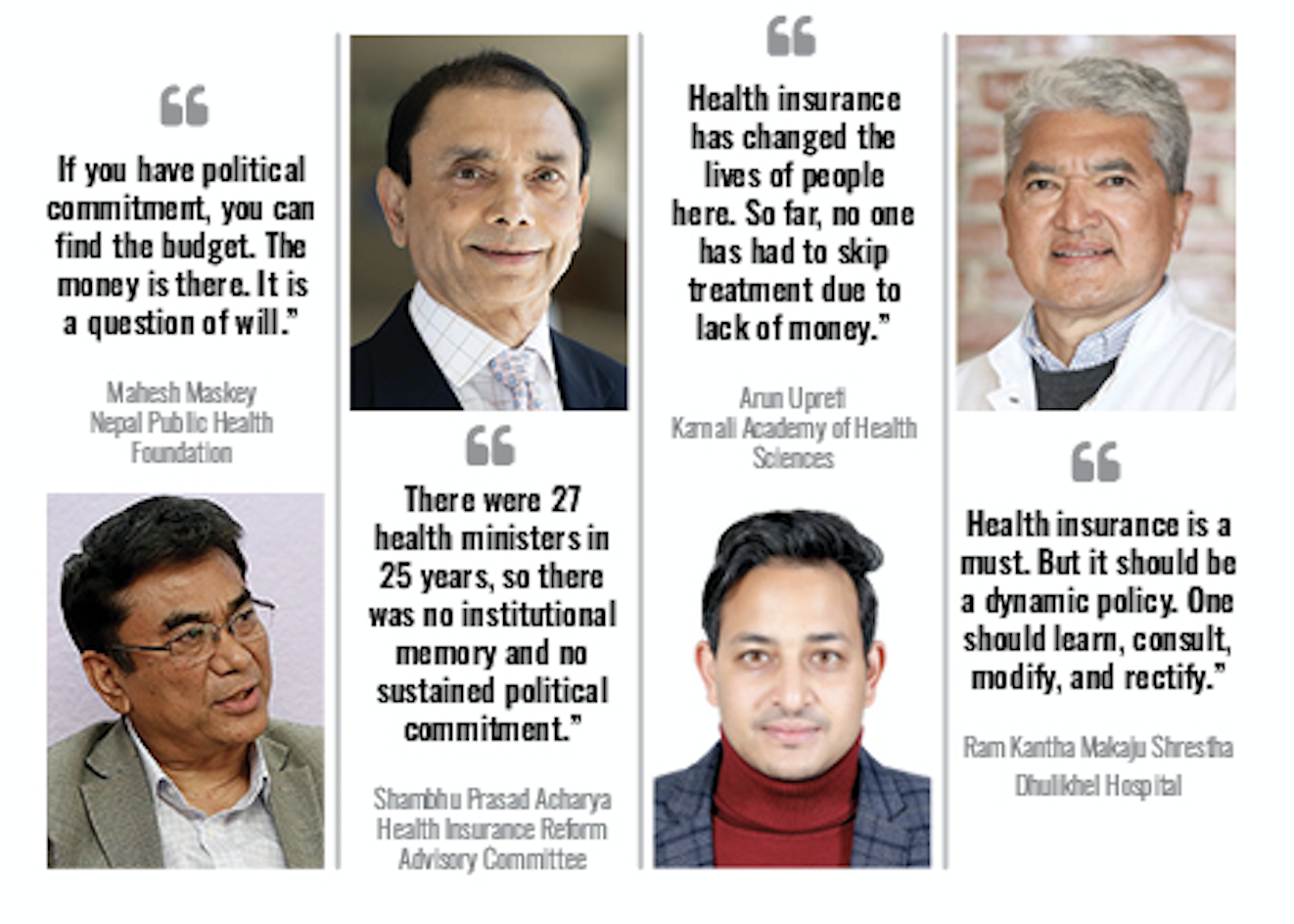
The proviso survived parliamentary review. It had become law. Maskey and his team had envisioned a system of color-coded poverty cards — red, blue, yellow — that would identify each household's economic status and automatically link to insurance coverage tiers. But when the Health Insurance Board drafted the implementing regulations, it collided with a problem nobody had solved—most of Nepal's workforce is self-employed in the informal economy. "What is their income?" Maskey told me. "How are they surviving?" There was no national income registry and no reliable tax records for the vast majority of the population. A parallel initiative to identify and register poor households stalled after covering only about 26 districts. Shambhu Prasad Acharya, who spent three decades at the WHO and coordinated the government's 2024 Health Insurance Reform Advisory Committee, put it plainly: "It's hard to identify who is poor, who is not poor." Faced with the mandate to roll out the program but lacking the data infrastructure to understand the means of the population, the Board defaulted to a flat rate. Rs 2,500 for every family, later raised to Rs 3,500. There was no income verification, no sliding scale, and neither figure was grounded in any published actuarial analysis. The proviso was simply never operationalised. Maskey calls it an implementation failure. Shambhu Acharya states: "Nobody took it seriously." A rough tiering system, which Shambhu Acharya's reform committee would later propose at Rs 7,000 to Rs 15,000, would have satisfied the legal requirement even without perfect data. But building that infrastructure required a health minister who stayed in office long enough to see it through. "Twenty-seven health ministers in twenty-five years," Shambhu Acharya told me. "No institutional memory. No sustained political commitment."
Today, Sukumaya pays the same Rs 3,500 as many families in Kathmandu who may never have to set foot in a government hospital. This is not equity, but a tax on the poor for their right to health.
***
What followed was an unraveling of the system, each failure compounding the last. Because the premium was flat, the program could not generate enough revenue. The second implementation failure was lack of enforcement of mandatory enrollment. Because enrollment became essentially voluntary, only those who anticipated needing expensive care signed up—the chronically ill, the elderly, those already sick. In health economics, this is called adverse selection. Wealthier Nepalis had even less reason to join, as they used private hospitals where insurance was not accepted anyway, and they could afford to pay out of pocket. The formal sector—civil servants, the army, the police—stayed out entirely, each maintaining parallel schemes. Civil servants could draw up to Rs 1 million from their provident fund. The army and police had their own hospitals. Nepal’s health financing landscape had become, in the words of Shambhu Acharya, “a nightmare”—at least eight major subsidy programs under the Ministry of Health alone, with provincial and local governments layering their own programs on top. “I told the Prime Minister: you are promoting this insurance, but you are not insured in it,” he said. “None of the Ministry of Health employees are enrolled. So how do you expect other people to do it?” Nepal enforces mandatory insurance for vehicles. It does not enforce it for human beings.
According to the reform committee, seventy percent of enrollees were targeted groups—not the healthy, working-age contributors the system needed to finance itself. The dropout rate was severe—people enrolled when sick, exhausted their one lakh ceiling, and did not renew. In remote areas, patients did not even know when their coverage had expired. "You have to remember and do it yourself," Arun Upreti in Jumla told me. "The government doesn't tell them when to renew."
Without mandatory enrollment, the program never built the stable risk pool it needed to survive. The logic of social health insurance is straightforward—a young, healthy person pays into the system today not because they need it now, but because one day they will. They will age. They may develop hypertension, or diabetes, or need surgery. When that day comes, the premiums of millions of other healthy contributors are what pays for their care. It recognizes that health and wealth are not permanent, nor are they chosen. Any person's status can shift at any moment, and an equitable system protects people through those shifts. This is not merely an actuarial principle—it is a moral one. A system that protects only those who can pay is not insurance but commerce, and a state that enshrines the right to health in its constitution but builds a program only the sick and the poor use has not created a safety net but a trap.
Compounding this was a third implementation failure—a governance structure that ensured none of these problems could be corrected quickly. The Health Insurance Board was autonomous in name but captive in practice. The executive director of the Board was appointed on the Health Minister's recommendation, its budget routed through the Ministry, its staff borrowed from it as well. "There's a huge control of the board from the Ministry of Health," Shambhu Acharya told me. "Yet the Ministry of Health is not able to see it comprehensively, because they don't also have authority to decide everything." The board had no direct line to the Prime Minister’s office. It had no coordination with the Ministry of Finance for funding or the Ministry of Labor for enrollment—the ministries whose cooperation the program required. The entity purchasing healthcare and the entity regulating it were the same—what Shambhu Acharya called, simply, a conflict of interest. It lacked quality assurance mechanisms, cost containment tools, treatment protocols, pricing standards. "Completely absent," he said. "There wasn't even some small audit or anything. Nothing." Nearly a decade after its establishment, the Board still had no permanent organizational structure. "It is all economics," Subash Acharya of TUTH told me. "It has nothing to do with service delivery." He argued the Board belonged under Finance or the Prime Minister's Office. Shambhu Acharya envisioned a different model—an independent body answerable not to one ministry but coordinating across Health, Finance, and Labor, the way Thailand had built its system. Instead, Nepal's Board sat captive inside a single ministry that lacked the authority to manage even the program's budget.
Because the Board could not pay hospitals what care actually cost, it set fixed-rate packages instead—Rs 15,000 for pneumonia, Rs 9,000 to 10,000 for a urinary tract infection. It offered the same rate whether the hospital receives a government salary budget or earns every rupee from the patients it treats. Subash Acharya had warned the Board for years—"The system you are trying to implement was a failure in North America and Europe in the early 2000s. You are trying to implement here what failed in other countries twenty years ago." He advocated event-based reimbursement—where actual treatment costs determine the claim—arguing that because government hospitals make up 70-80% of claims, it would significantly reduce the processing burden. The Board ignored him. When TUTH began accepting insurance, the Board had defined 160 procedures. TUTH performs 3,000. The Board created an "others" catch-all. Hospitals filed under it, the Board rejected the entire category, and then deleted it after services had already been rendered.
What patients experienced was the downstream result of all of this—a system that promised coverage but did not deliver quality care. Biraj Man Karmacharya, administrative director at Dhulikhel Hospital who has studied the insurance program across multiple districts, found a consistent pattern among those who dropped out or never enrolled: "People who don't enroll and people who don't renew cite quality. Unavailability of medications, lack of timely care. If we need to go to private clinics anyway, then why should we spend time and money for this?" Sukumaya saw the quality problem at the pharmacy counter—cheaper medicines were covered but effective ones were not. "They only give a little bit of medicine," she told me. "For the slightly better medicines, they say it doesn't fall under insurance. They do this and take a lot of money." This was not an isolated complaint. Karmacharya described this practice of two separate pharmacy counters as one he’d found across Nepal's hospitals—one for insured patients, one for those paying out of pocket. The insured get the cheapest available drugs. The paying patients get the better ones. "Almost every hospital does that," he said. There were no quality metrics anywhere in the system—no way to measure whether patients were getting better, no composite index of outcomes or experience, nothing to distinguish good care from bad.
There was also the question of overconsumption. The program had been promoted as a transaction—pay 3,500, receive the benefit of one lakh, and unused funds vanished at year's end—creating an incentive to use as many services as possible before the reset. "The patient family thinks, I have paid 3,500, I have the right of one lakh rupees," Subash Acharya said. At inception, there were no user fees (fees at the point of care delivery) at all. This can lead to what health economists call moral hazard, and it existed. But the evidence on the other side is just as strong—a systematic review by Nguyen et al. (2018) of user fee policies across low- and middle-income countries found that introducing fees at the point of care consistently reduced utilization, and that the reduction fell hardest on the poorest populations. But the deeper design failure was that in a country where 54% of health spending was already out of pocket and generations of families had gone without adequate care, the program was built with financial margins so thin that any meaningful utilization would break it. What the system called overconsumption was, in significant part, a sick population finally accessing care. The real problem was not overuse—it was that the program was never funded to serve the people it enrolled.
Shambhu Acharya's reform committee quantified the cumulative damage. The average premium collected per family was Rs 3,800 and the average claim paid was Rs 8,350. The Medical Loss Ratio—the proportion of premium revenue spent on claims, and a standard measure of insurance viability—stood at 220%. In a well-functioning system, that figure sits between 80 and 85%. Premiums covered only 24% of the Board's expenditure on health care. Without reform, his committee projected, the government would need Rs 32 billion in subsidies by 2025. Rs 62.8 billion by 2030. The 2019 National Health Policy had also proposed sin taxes on tobacco, alcohol, and unhealthy food. Maskey estimated that redirecting 25% of tobacco and alcohol tax revenue to health (up from the current 5%) would generate Rs 42 billion. None of it happened. The health budget fell from 7.2% in 2016 to 4.9% in 2026. Out-of-pocket spending rose to 54%.
The program designed to protect families from financial ruin had failed. “[The] government doesn't appear serious enough,” Karmacharya told me, about the fact “that these delays can actually destroy institutions.” In January 2026, they did.
Three Hospitals, Three Fractures
By late 2025, the Board’s arrears to hospitals had crossed Rs 11 billion. Some estimates put it closer to 19 billion. Claims went unpaid for months, sometimes over a year. For three consecutive fiscal years, the government had paid nothing toward premiums for the targeted groups it was legally required to cover—an accumulated debt exceeding Rs 13 billion, according to the reform task force’s accounting. The Board was expected to serve hundreds of thousands of vulnerable citizens whose care the government had mandated and then refused to fund. Fraudulent business tactics only compounded the crisis. Some private facilities had begun to sign up patients, pay their premiums, order unnecessary diagnostics, and bill the Board. Some paid commissions of 5 to 10% to Board staff to ensure claims cleared. Rather than separate fraud from honest error, the Board’s response was to have blanket suspicion and delay payment for all hospitals. “Teaching Hospital, Bir Hospital, Civil Hospital—why would we make fake claims?” Subash Acharya said. “We are government institutions.”
When TUTH suspended services, it was treating 500 to 600 insurance patients a day and claiming Rs 20 to 30 lakh daily. But the Board rejected Rs 1 to 2 crore of those claims every month, or Rs 20 to 25 crore per year. They were rendering services to patients who were already treated and discharged but received no reimbursements. "The patient was treated and sent," Subash Acharya told me. "The patient has gone home. And it's not in the Health Insurance Board's accounts either." TUTH had no choice but to give fifteen days' notice of suspension and they continued treating every admitted insurance patient until the last one was discharged. The government's response was to cap outpatient care to Rs 25,000 for cost containment and introduce user fees at the point-of-care. This discourages the preventative care that lowers costs long-term and abandons patients whose chronic conditions cost multiples of that ceiling annually. Shambhu Acharya's task force had recommended increasing coverage to Rs 500,000. Instead, the government cut it.
In the meantime, Dhulikhel Hospital did not stop.
The government owed it Rs 600 million. Eight months without a single payment and Rs 15 lakh claimed daily. Ram Kantha Makaju Shrestha, the executive director who left a career in Vienna thirty years ago to build a community hospital in the hills east of Kathmandu, put it simply: “Life has no cost. It is precious. To be sick is not a choice. No one wants to be sick.” Karmacharya told me the hospital had roughly one month of financial runway left. The burden had shifted to suppliers of medicine, equipment, and consumables, who were extending credit on trust in a hospital they believed in. “Suppliers are also barely surviving,” he said. “It keeps me awake at night.” Insurance accounted for 40% of Dhulikhel’s revenue. Survival now rested entirely on the other 60% of paying patients, and on the goodwill of creditors betting on a hospital that had never broken its word.
Dhulikhel is not a government hospital and not a private one. It is community-owned, with every staff member insured from day one, a school built for staff children, 20% of patients receiving charitable care. In thirty years, Makaju Shrestha says, not a single patient has left because they could not pay. When Karmacharya found in his research that hospitals across Nepal were running two separate pharmacy counters—cheap drugs for the insured, effective drugs for paying patients—Dhulikhel refused to follow. “When I am giving medication, it’s supposed to do its job,” he said. “We cannot have third-class care for our cleaners and first-class care for our professors.” The reimbursement rates made that refusal financially irrational. Rs 15,000 for a pneumonia package whether the hospital receives a government salary budget or earns every rupee itself. “If a government hospital gets 10,000 for an appendectomy and you give the same 10,000 to a hospital like us,” said Balaram Malla, the medical director, “how can we run the hospital?” Dhulikhel continues to absorb the losses. “We bear these challenges,” Karmacharya said, “because we want the government to succeed.”
The crisis looked different from Jumla.
Arun Upreti is an orthopedics lecturer at Karnali Academy of Health Sciences—one of a handful of specialists in the entire district. There, a helicopter evacuation costs Rs 13 to 14 lakh. An ambulance ride to the hospital may take ten to twelve hours. “Health insurance has changed the lives of people here,” he told me. Insurance arrived in Karnali before Kathmandu, and the response was overwhelmingly positive. One lakh of coverage—inadequate in the capital—is genuine protection where that is the difference between treatment and nothing. “So far, no one has had to skip treatment due to lack of money,” Upreti said. His hospital was owed around Rs 1 crore from the Board. It never considered stopping. “If that stops, patients don’t have any other options. In the entire Jumla district, this is the only hospital.” But insurance covers only 40 to 50% of the services his facility provides. Many procedures and tests are excluded entirely. Staff salaries have not increased in eight years. Doctors spend significant portions of their own pay buying medicines for patients. The gap between what the program promises and what the system can deliver is widest in the places where the need is greatest.
“Starting insurance without properly ensuring that health facilities are strong enough to run it,” Karmacharya said, “is more like putting the cart before the horse.” Malla argued for what should have existed from the start—real-time digital claims processing that would flag errors immediately instead of months after the service was rendered. “[The] government is happy to announce dialysis coverage,” Karmacharya said, “but in a country where there’s not even proper screening of hypertension and diabetes—which are the major reasons for chronic kidney disease—that itself is a paradox.” The question is not just how to patch the insurance program, but it is how to build a health system that makes universal health care through insurance work.

The Way Forward
Every expert I spoke to was in resounding agreement—the program must be saved. The alternative—a return to fully out-of-pocket healthcare where 54% of health spending already comes from citizens’ own pockets—would devastate the poorest and sickest, and in doing so, devastate the nation. “There is no going back,” Karmacharya told me. “It is an imperative now for government and all stakeholders to make this successful.”
Other countries have built what Nepal may one day achieve. In Japan, everyone pays into the mandatory public system, even citizens with private supplemental insurance. There is no opting out. If you want a private room instead of a shared ward, that is your cost, but the baseline contribution is non-negotiable. South Korea deducts premiums automatically from salaries; for the informal sector, the government pulls them directly from bank accounts if not paid within six weeks. Rwanda achieved over 90% coverage through a community-based wealth classification that assigns households to tiers and sets contributions accordingly. They exemplify the income-based premiums, mandatory enrollment, and political follow-through that Nepal mandated in law but never built.
Across several health experts, the recommendations for reform that emerged from this reporting fall into three categories: financing the system, building the risk pool, and ensuring strong management. All are means toward the end that Article 35 of the Constitution committed to as law—that every citizen of Nepal has the fundamental right to health.
First, a social program like this cannot work without proper financing. In the long run, the Act’s proviso on income-based premiums must finally be activated, replacing the flat Rs 3,500 with a progressive scale of Rs 7,000 to Rs 15,000, as the reform task force recommended, with full subsidies for the ultra-poor. Next, the coverage ceiling must be raised from one lakh to five lakh rupees—the task force’s central financial recommendation, and the level at which insurance begins to protect against catastrophic expenditure. And in the period of transition to a more stable system, funding can be achieved through earmarked revenue—redirecting 25% of tobacco and alcohol “sin taxes” to health, up from the current 5%, would generate Rs 42 billion annually, which is enough to cover the program’s entire deficit and then some.
Second, the risk pool must be rebuilt. Enrollment has to become mandatory in practice, not just in law, starting with automatic payroll deductions for every civil servant, soldier, and formal-sector employee. Enrollment should be linked to government services that people cannot avoid such as driving licenses, land registration, passport renewal. Parallel schemes—those of the army, police, and civil service—must be consolidated into a single national program that ends fragmentation of health insurance schemes.
And third, the governance and management of the program itself must change. The Board needs genuine independence from the Ministry of Health, restructured as an autonomous body coordinating across Health, Finance, and Labor, as Shambhu Acharya proposed. Claims should be digitalized so payment happens in real time, not months after the service is rendered. Fixed-rate packages should be replaced with event-based reimbursement where actual treatment costs determine claims, and differentiate rates by hospital type, as a facility that receives nothing from the government cannot be reimbursed at the same rate as one that receives everything. Proper fraud detection infrastructure should be built, Subash Acharya demanded, with mechanisms that distinguish fabricated claims from honest errors, rather than punishing every hospital for the abuses of a few. To do this, there must be proper staffing in the Health Insurance Board to assess claims, rather than just enough to retroactively audit.
Karmacharya framed the deeper challenge around three questions. The first was equity— who genuinely needs insurance most, and what happens when you promise everything to everyone? The second was quality—there are no metrics anywhere in the system to measure whether patients are getting better, no composite index of outcomes, nothing to distinguish good care from bad. The third was speed—as the cycle of identifying problems and implementing solutions must move faster than it does now. But his deepest argument cut past the mechanics of insurance entirely. The system generates tens of millions of data points, and nobody is analyzing them for continual improvement. Insurance without upstream investment in prevention, screening, and primary care quality guarantees expensive downstream costs. The conversation is stuck on financing alone when it should be about strengthening the health system at large.
Nepal has cycled through 27 health ministers in 25 years. Shambhu Acharya’s committee delivered a comprehensive reform roadmap a full year before the crisis. The government had twelve months to act. It has not. But for the first time in years, Nepal now has a government entering office with a parliamentary majority and a full five-year term ahead of it. Whether that stability translates into the sustained commitment health insurance demands—the unglamorous, technically difficult work of building administrative infrastructure, enforcing mandates, and keeping a health minister in place long enough to see reforms through—is the question this government will be measured by. Every month of delay carries a cost that does not appear in arrears figures or actuarial projections—families borrowing against their homes for surgery, patients rationing medication, people in Jumla and Sindupalchowk choosing between treatment and food. To finally establish universal health coverage for all in Nepal would be a generational success. The roadmap exists, the expertise exists, the people who built the law and the people who can fix the system are still here. What has never existed is the political will to let them.
Maskey sees reason for cautious hope. “We are closer to universal health coverage in the sense that we have taken this step,” he said. “If you have political commitment, you can find the budget. We increased from 4% to 7.2%. Now it has gone down to 4.9%. The money is there. It is a question of will.”
In Jumla, Upreti offered an observation. “Big issue in Nepal [is that] patients don’t trust doctors,” he said. “The patient thinks, is this doctor taking commission? Is he getting some benefit? That completely gets eliminated if we can reduce the patient’s out-of-pocket expenses.” He paused. “Insurance is very important. We have to do it somehow.”
In Dhulikhel, Makaju Shrestha continues to treat patients regardless of whether the government pays him back. "Health insurance is a must," he told me. "But it should be a dynamic policy. One should learn, consult, modify, and rectify." He paused. "In Germany, [for] two hundred years, insurance—it functions, but not yet in the way the German management team want it to function. So how can we expect within five or ten years that [ours] functions perfectly?"
And in Sindupalchowk, Sukumaya continues to pay cash for her thyroid checkups at a Kathmandu hospital that has never accepted insurance. She does not need actuarial analyses or reform committee reports to understand what is broken. She needs affordable, quality healthcare for her family. The question is whether Nepal’s leaders will have the stability and the sustained commitment to provide it.
Barune Thapa is with the Department of Clinical Science Kaiser Permanente Bernard J. Tyson School of Medicine in Pasadena, California. He graduated from UC Berkeley in Public Health and Molecular and Cell Biology (Immunology) and did his masters in Global Health and Population at Harvard T H Chan School of Public Health.
This article was originally published on Himalkhabar.com.