
The Bell that rang in the new
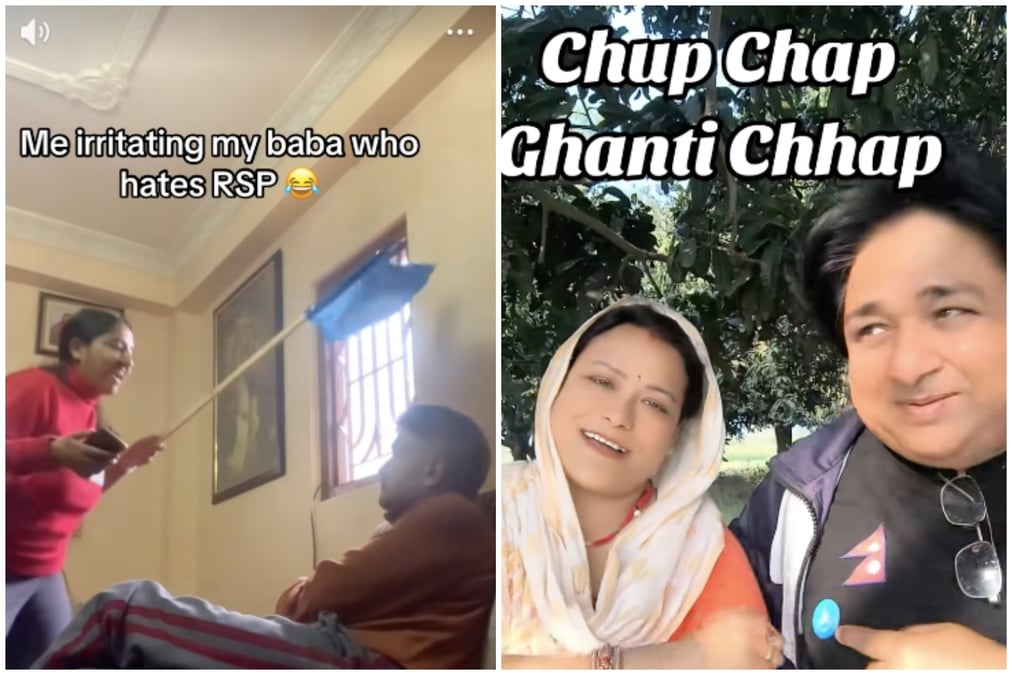
A daughter stands in her family's living room, frantically ringing an actual घण्टी at her father. He is a lifelong Nepali Congress (NC) voter. She tells him his party loyalty is as humiliating as a daughter eloping.
He looks visibly defeated, and because of RSP’s landslide sweep in this election, he has no reply. She is not a party member. Nobody told her to do this.
Multiply this actual family scene by hundreds of thousands of households across Nepal and you find the reason for the RSP tsunami. Children ringing bells at parents over dinner. Aunties shaking bells at legacy party candidates on their morning walks. Taxi drivers, lifelong UML supporters, cheerfully announcing they have switched.
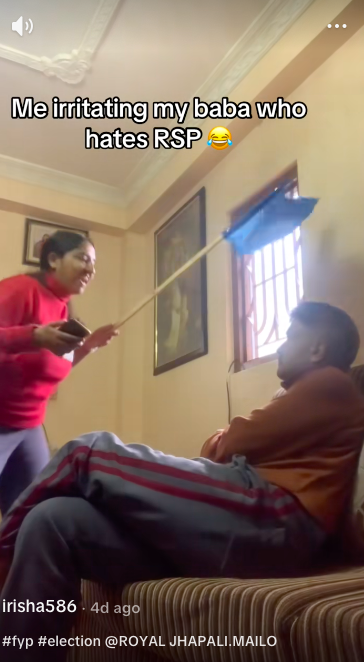
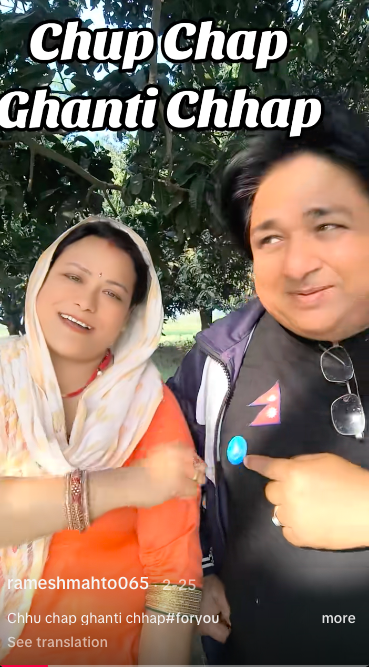
And overseas, Nepalis in Dubai and Doha, Sydney and Seattle, calling home to deliver just one instruction: “चुपचाप घण्टीमा छाप”।
How did an election symbol like the Bell jump off a ballot paper and become weaponised for generational shame?
The RSP's 2026 campaign is a case study in how a symbol becomes so participatory and instinctive, that citizens start campaigning on behalf of a party they never formally joined. It may look like a cult, but it is a phenomenon no political party in Nepal has ever pulled off.
The ghost in the machine
The 3-year-old RSP entered the 2026 race without the campaign infrastructure that legacy parties considered essential. It has no sister organisations, no vanguard student unions, no established cadre networks.
In a country where ground reach and organisation wins elections, this looked like a fatal handicap. Established parties had spent decades building a top-down machinery: youth wings that mobilise on orders and unions within government. But it was all hollow and manufactured.
That is why when the NC or UML posted a policy manifesto, it got barely 200 shares. When a 19-year-old posts an AI video on TikTok of Balendra Shah swinging a bell like a Kung Fu Hustle weapon, it gets 5 million views.
The RSP’s very absence became its strategic advantage. Without a chain of command for content, every post felt peer-to-peer. Supporters built communities instead of following orders. Network effects took over: one person posts, three friends remix it, their followers adapt it for their own local context, and the message multiplies without a single directive from party headquarters.
A TikTok from Kathmandu featuring Balendra Shah gets remixed by someone in Birganj who dubs it in Bhojpuri. A supporter in Pokhara takes the same “अबकि बार बालेन सरकार” audio and films it over footage of the city’s broken road.
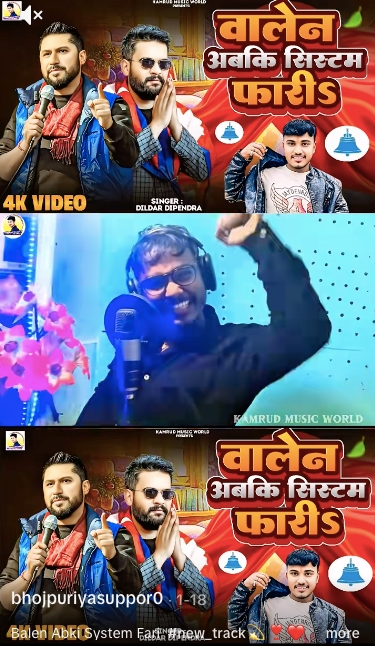
A Nepali worker in Dubai films himself shaking his phone at the camera, captioning it “I can't vote but my family can”. The content stays structurally the same (bell + emotion) but the surface changes every time. The format is the constant. The context is the variable. A single post multiplies into a thousand pieces of local content without anyone coordinating it.
Legacy parties spent money on reach. RSP's strategy built reach for free, because participation itself was the product.
The Bell, blazer and brand
Run the sensory test. The UML's Sun symbol is only visual. You see it on a ballot, on a flag. You cannot hear a sun. You cannot perform a sun. Nobody walks into a room and ‘suns’ at an opponent.
The NC’s Tree symbol is also only seen. It communicates nothing as a verb. Nobody ‘trees’ the father across the dinner table. Ujyalo Nepal's lightbulb was the most passive symbol of all, it just sits there being always on.
The Bell had rare resonance as an election symbol. It is a verb (to ring), a sound (tintinnabulation), a physical action (shaking), and a metaphor (wake-up call). घण्टी is participatory by design. You do not just see it, you perform it.
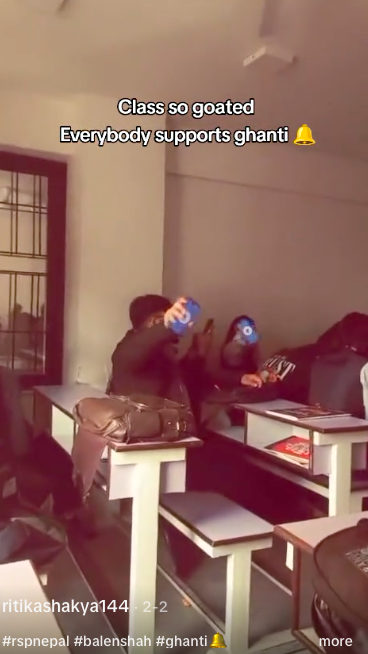
It works as a metaphor: wake up. It works as a taunt: we are coming (“हामी आयौँ”). It operates across sensory channels a meme can travel through. The other party symbols are logos. The घण्टी is a multimedia verb in active voice.
Poets on the frontline
Politics has always been about performance. Murray Edelman wrote decades ago that political actions are symbolic acts: what politicians do matters less than what their actions represent.
Guy-Ernest Debord argued that spectacle replaces lived experience. But the stage has changed. The social media feed is the new stage, and the algorithm is the casting director. It does not select for policy depth, but for recognisability, emotional charge, and remix potential.
Poets have always been at the frontlines of political rupture. The French Revolution had its pamphleteers. The Bolsheviks had Mayakovsky. The Black Panthers had Gil Scott-Heron. Nepal's own political history is full of writers who paid for their words with prison or exile.
Rap is rhythm and poetry. Balen Shah did not cross from entertainment into politics, his art was always political. “सडकबालक" in 2012 was already a protest song. The diss tracks against corruption were manifestos set to beat.
So, if घण्टी was the sound, Balen was the voice. Supporters rang Bells to perform, projecting their hopes on Balen. One is participatory (anyone can ring it), the other is aspirational (representing what you want the country to become). Together, they form a complete symbolic system: an action and an icon, a thing you do, and a person you believe in.
Both are algorithm-native. The sunglasses are instantly recognisable in a thumbnail at any size. The bell sound action is identifiable within half a second of a video starting. The confrontational attitude generates the emotional charge that the algorithm rewards.
Balen was already trained in the language of the algorithm: hooks, rhythm, timing, and audience retention. While legacy politicians are just now trying to learn the language of the algorithm, Balen grew up speaking it. The folk song brand kit: The slogans wrote themselves. While legacy politicians are just now trying to learn the language of the algorithm, Balen has grown up speaking it.
The folk song brand kit
The slogans wrote themselves. “चुपचाप घण्टीमा छाप” spread through tea shops and bus parks like a folk proverb. AI-generated Mahabharat edits positioned Balendra Shah as a warrior-hero fighting K P Oli in golden armour.
The entire package, partly by accident, partly by instinct, was built to be remixed. Every element is modular: the bell, the sunglasses, the slogan, the attitude. Take any piece and make your own version.
Like a ‘Deusi re” song, the melody is fixed, everyone knows it, but anyone can change the words to fit their occasion and mood. It survives across generations precisely because no one controls it.
The घण्टी ecosystem works the same way. The melody is fixed: the bell, the sound, the slogan, the sunglasses, the attitude. But the lyrics can be anyone’s. Shoot it in your neighborhood. Dub it in your language. Film your grandmother's reaction. Set it to your local context. That's why it spread faster than any IT cell could manufacture.
The generational pincer
The standard narrative is that digital movements stay digital, and that memes are a GenZ thing. RSP broke both assumptions. Its content operation executed a pincer movement across generations, capturing not just the youth vote but used youth as a delivery mechanism into households where no party organiser could reach.
The Generational Pincer Flowchart
Three vectors of pressure, all converging on the same target: the living room and the dinner table, where votes in Nepal are actually decided.
Downward: children trolling parents by ringing bells at dinner, turning family meals into campaign arenas. A bell rings as a prank, then as a joke, then as a political statement. By the third night, it's not funny anymore. It's a conversation.

Lateral: the diaspora pipeline. Nepalis in Australia, the Gulf, Japan, could not vote, but they turned every Viber call home into a campaign touchpoint.
Upward: the bell pressured power itself. No RSP organiser gets a meeting with a UML ward chairman or a NC MP. But those people go home. And at home, they have teenagers, nieces, nephews, and staff whose kids are on TikTok.
A party boss's son rings a bell at dinner and asks uncomfortable questions. A NC donor's daughter shares RSP content on her Instagram story, visible to her father's entire social circle. No political structure, no matter how hierarchical, is sealed off from its own household. The bell did not need to breach the gates of Singha Durbar, it walked in through the kitchen window.
The result crossed every demographic line analysts thought was fixed. Memes didn't just stay in the feed. They colonised the living room, the kitchen, the long-distance phone call, the taxi ride.
Content nobody commissioned
What the RSP's organic content looked less like a political campaign and more like a football fan club. People were not posting because they were told to. They were posting because they belonged.
Trace the trends as they accumulated:
- “चुपचाप घण्टीमा छाप” started as a TikTok post, then showed up on motorcycle stickers, WhatsApp statuses, AI-remixed songs, and in tea-shop conversation as a folk proverb.
- Original songs composed by supporters, not the party, gained millions of views. People danced to them at rallies and in the streets. People at polling booths created TikToks to RSP anthems to show their support.
- AI spectacle videos of Balen as a Mahabharat hero, filmy dialogue, stylised Nepal flag. Slapstick clips hitting 200K+ likes and 5M views. All made by random accounts, none traceable to party infrastructure.
- Supporters built Bell apps and websites on their own. One site, ghanti.website, was registered by a random supporter in January. Open it on your phone, shake it side to side, and it rings. Within weeks, crowds of supporters were walking through neighborhoods shaking their phones in unison, producing a wall of digital bell sound.
- The intimate content. A husband-wife vlog filmed inside a car, casually discussing what a lawmaker should actually do. Just two people talking, and it resonated more than any campaign ad.
None of this was centrally coordinated. Parties across Nepal spent money on polished graphics that looked like professional advertisements. RSP supporters spent nothing and made content that felt like conversation. The algorithm doesn't reward production value, it rewards emotional resonance. And nothing resonated more than the feeling that you, personally, could participate in this movement without anyone's permission.
Now what?
The RSP has a supermajority. The Bell rang louder than anyone predicted. But a movement built on open-source energy now has to deliver closed-source results: budgets, legislation, diplomacy, institutional reform.
Balen built his brand by bypassing institutions, Prime Minister Balendra Shah has to run them. He communicated through Facebook posts and rap lyrics. Now he needs to communicate with India, China, and multilateral lenders.
His midnight F-bomb post, deleted within 30 minutes but screenshotted by thousands, showed both his appeal (unfiltered authenticity) and his risk (unfiltered impulsiveness).
The question is not whether the bell rang loud enough. It obviously did. The question is what happens when the supporters who posted without being asked start expecting results they did not specify. When the meme energy that won living rooms has to translate into parliamentary committees.
For decades, the promise of democracy was that people choose their leaders. What RSP's campaign revealed is something more uncomfortable: in the age of the algorithm and remixable content, people do not just choose their leaders.
They build the campaign, write the slogans, produce the content, convert their own families, and then show up to vote for the movement they made with their own hands. The party becomes a container for energy it didn't create and can't fully control.
That's either the most democratic thing that's ever happened in Nepal, or the most dangerous. It might be both.