

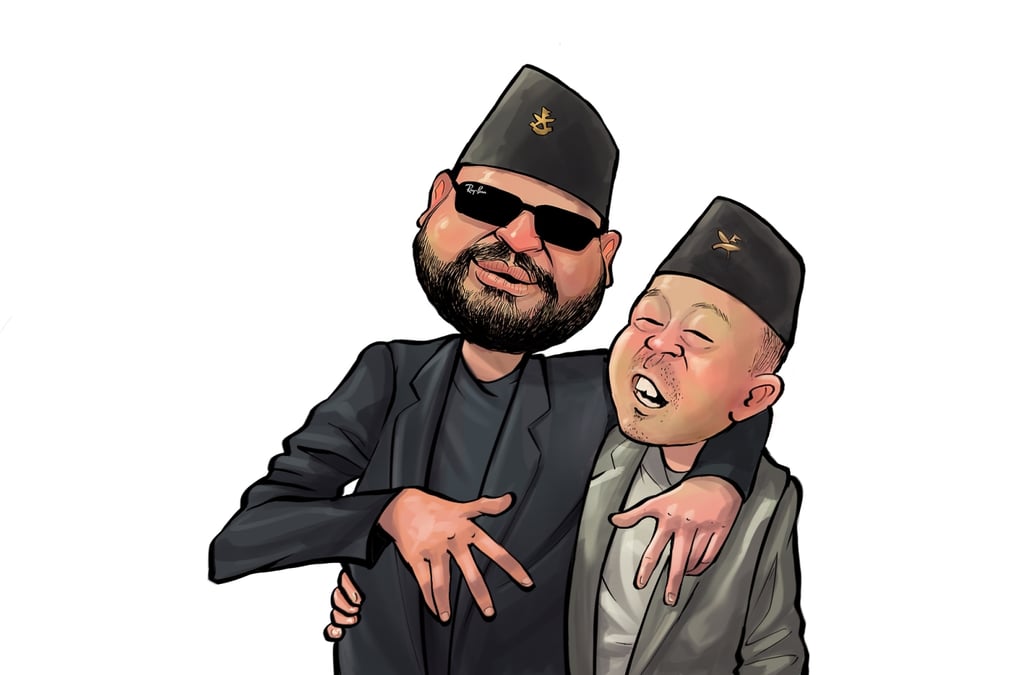
Sudan Gurung is dancing. It is 2009. He has an emo fringe falling over one eye and is spinning on a polished floor. His dance shows dedication — moves that take years of bruised elbows to land.
The clip is 16 years old, and had been sitting in the dead archives of YouTube and old Facebook pages, watched by almost nobody. This month it has 1.9 million views.
Gurung became Home Minister on 27 March and resigned on Wednesday, barely a month into office. His pre-political life had been put back into circulation at industrial speed -- the b-boying, the DJ sets, and the YouTube video of him dancing in a music clip.

The youth of Nepal, well-versed in snappy TikTok edits and aura compilations, turned the archive into a meme economy almost overnight. TikTok remixed the footage to trap beats. The comments settled on a nickname that crossed into everyday speech within days: 'Homie Minister'.
As Home Minister, Gurung was in charge of the Nepal Police, Armed Police Force, Department of Immigration, and the country's internal security apparatus. Calling him 'homie' collapsed the distance between that office and the Discord server where the movement that brought him into power had organised itself.
What is harder to explain is why the nostalgic clips did the narrative work for Gurung's political standing right up until the moment the paperwork did not. A teenager on a dance floor in a Thamel club, filmed before smartphones had decent cameras, was functioning as political currency for a powerful home minister, while a share registry was quietly filling the other column.
The footage was not an argument. Gurung was not doing anything in it that related to home affairs. He was just dancing. The comments compared him to Korean film heroes. A separate 48,000-like edit was captioned 'Our New Home Minister Aura'. The replies were full of people saying they got chills listening to him speak. Even after his resignation, most comments on his Facebook page were supportive, saying he had been punished for pursuing truth and justice.
Political legitimacy in Nepal has been built out of many things over the last 70 years, but it has never been built out of this. The question was always: what happens when the job starts demanding things his style, boldness, and swag cannot provide. Political aura in Nepal used to be a slow harvest, now it isn't.
B P Koirala spent eight years in prison under the Panchayat. He wrote fiction at Sundari Jal. The writing survived, the prison sentences survived, and that experience became the template for what a serious Nepali politician looked like: someone the state had tried to break and failed. Legitimacy was accumulated by having their lives taken away, and refusing to bend the knee.
The old mechanics of legitimacy produced politicians who could be audited. The record was made of words, dates, votes, and years behind bars. A voter who wanted to know what a leader stood for read his writings. A journalist digging for inconsistency could find it. The system was slow, often corrupt, and frequently boring.
But boring was part of the job description. A minister was supposed to be slightly dull — evidence that the person was doing the unglamorous work of reading files and sitting through committee meetings.
Today, boring is a disqualification. The attention economy rewards velocity and visual charge, and a politician who cannot generate either does not exist in the feed, and that means does not exist at all.
The legacy parties are still issuing press statements criticising the new guard in the grammar of paper trails and procedural failure. But the audience has stopped reading, users scroll for their next viral bite. Sudan Gurung, unlike the old parties, understood exactly which grammar the feed rewarded.
On his first evening as Home Minister, he posted a photo of himself sleeping on a sofa inside the ministry. Caption: creation cannot be greater than the creator, government is not above the people. The image travelled further in 12 hours than any ministerial press release has ever done.
A minister napping on a sofa, phone-shot, zero production, read by the public as evidence of a minister who had skipped the motorcade and got straight to work. Gurung used Facebook to announce the names of former ministers and businessmen he intended to arrest. The feed was used to pre-announce state security action.

INFLUENTIAL INFLUENCER
This is not how the Ministry of Home Affairs has ever operated. It is how a YouTuber releases a series. Sudan Gurung was a political content creator. As home minister, he was an influential influencer kinetically doing something in the visual medium.
Much like Prime Minister Balendra Shah's sunglasses, Gurung's aura, authenticity and swag were a brand asset, instantly recognisable at thumbnail size. Balen's rap career supplies a pre-political archive that authenticates him the same way Gurung's DJ sets and b-boying clips authenticated him.
The aesthetic is doing the work a manifesto used to do. The work is authenticity, and the strategy is auramaxxing. The emo fringe predates the ministry. The DJ sets predate Hami Nepal. The b-boying predates the earthquake, the NGO, the September uprising, the interim cabinet, all of it.
Whatever Gurung is now, he was already that person before the office existed. This was the real spectacle of the Homie Minister: authenticity. Nepal's youth have grown up watching heavily-polished, talking-point ministers speak in a language aimed at nobody in particular. But that grainy archival clip of the Home Minister from 2009 was honest.
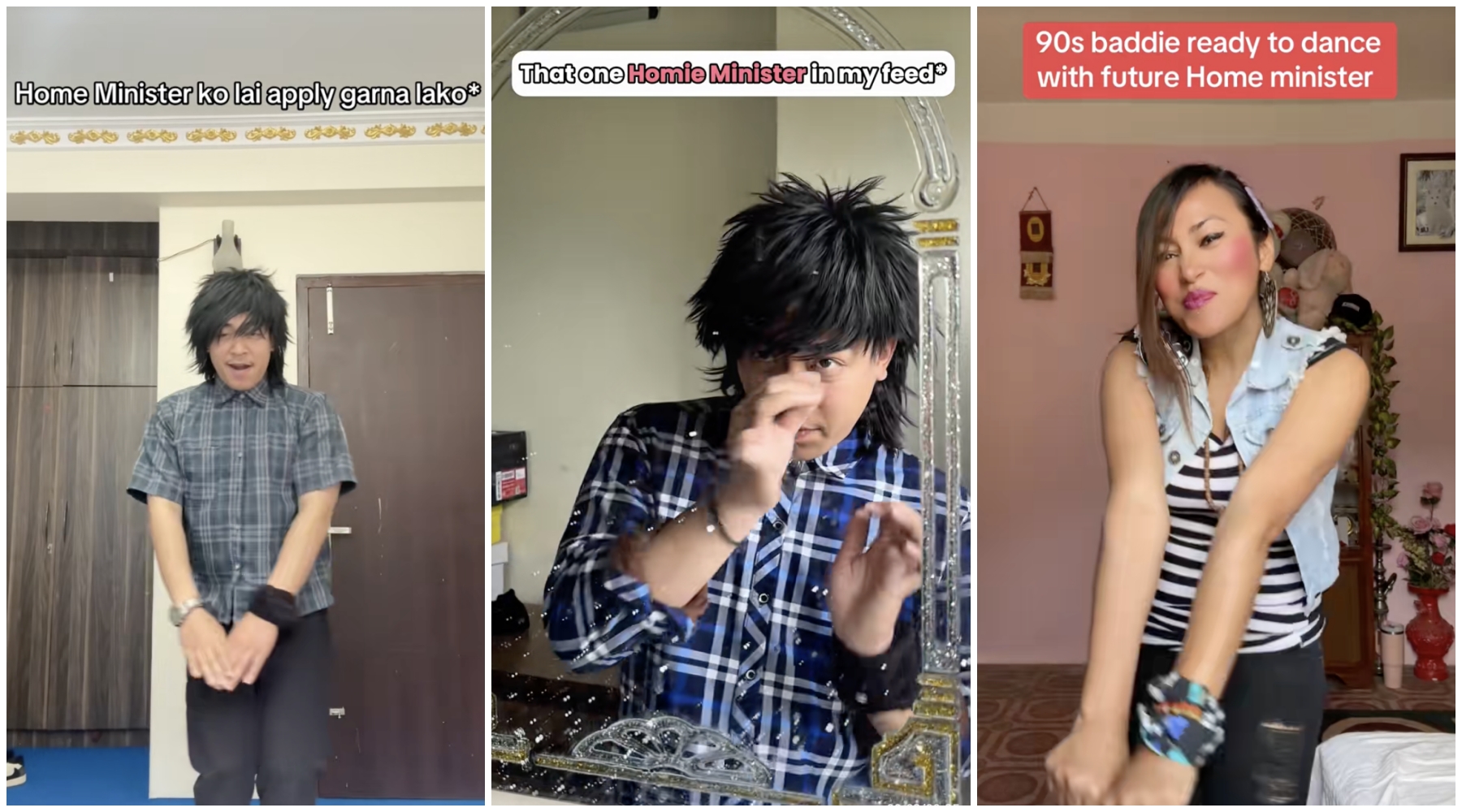
The effect transcended GenZ. A TikTok trend captioned NOT ONLY OUR HOME MINISTER, WE ARE ALSO FROM THAT ERA has millennials posting their own archive photos from the same period, aligning themselves with Gurung's pre-political aesthetic.
The aura did cross-generational work. It was a shared legibility, spanning at least 15 years of Nepali youth culture, with the Home Minister standing at its centre.
The traditional politician's entire adult life is a performance of identity. Every photograph is lit for the media, every statement is vetted. The persona is the product, and the product has been in development for 30 years. This makes the old guard legible but suspect in the attention economy.
A generation raised on authenticity-as-currency reads the decades of careful performance as evidence of something to hide. The polish is the problem. The nostalgic Sudan Gurung party clips inverted this. The polish was absent.
The footage could not be performance aimed at the viewer, because the viewer did not exist in 2009 and neither did the political stakes. The clip was therefore read as real, in a way a press conference can never be. It was just a kid dancing, and he happened to grow up to be the Home Minister.
But Sudan Gurung's job was never to go viral. The Ministry of Home Affairs requires the person running it to file a complete asset declaration and to avoid holding financial interests in crony entities.
None of that work is content. A correctly filed asset declaration does not get remixed into a trap beat. A functioning immigration database is not a TikTok. The paperwork that constitutes actual governance is structurally boring in exactly the way the old parties are structurally boring, and for the same reason.
It is the slow, procedural, checkable apparatus that the old system was built to produce and that the new system has not yet learned to replace. And it is painstaking follow-the-money paper trail investigative journalists in the legacy media who uncovered the evidence.
You cannot auramaxx your way out of a share registry. You cannot post your way past a conflict-of-interest statute. No amount of fire outfits and wild DJ transitions does anything for you when a journalist pulls the initial shareholder list of Star Micro Insurance and finds your name at number 49, with Rs2.5 million in shares alongside investors linked to Deepak Bhatta and Sulav Agrawal — two men currently at the centre of a Rs 3.7 billion money laundering investigation.
Auramaxxing was engineered for the mechanics of reaching office. It is the reason Sudan Gurung became Home Minister and Gagan Thapa did not. The question that had not yet been tested, until this week, was whether the same weapon works when the terrain changes. The terrain does change when you assume power. This week, the answer arrived.
TWO CLOCKS
Two clocks had been running, and they did not sync. The first clock was built for auramaxxing. A clip posted at eight in the morning peaked by noon. A sofa photo was remixed before the minister had left the building. The feedback loop is fast and legible, and a politician playing this clock gets real-time data on what to post next. The old guard never learned to read it, which is a large part of why they lost the election.
The second clock was the one the ministry actually runs on. It measures in quarters, court calendars, and the slow grind of investigation files moving between offices. A share registry takes weeks to pull. A money-laundering case moves at the speed of the prosecutor's office, which is to say, it often does not appear to move at all, until one morning it does. The legacy mass media is fed leaks, and the second clock does not care whether the minister is currently trending.
The two clocks collided this week, and the second clock got there first. Faster than anyone expected. The first clock put Gurung in the Home Ministry in weeks. The second clock put him out of it in less than a month.
On Sunday evening, Diyopost and Janaastha published documents showing Gurung as a founding shareholder in Star Micro Insurance and Liberty Micro Life — companies licensed by the Nepal Insurance Authority in 2022 following what reporting identified as political lobbying by Bhatta and Agrawal. A photograph also surfaced of Hami Nepal, the NGO Gurung chairs, honouring Bhatta as a donor on 21 December 2021.
Gurung's first response was auramaxxed. A Monday Facebook post distinguishing ‘rumours’ from ‘facts’, insisting the shares were disclosed within his broader Rs20 million securities portfolio, promising to cooperate with any investigation. "Allegations and truth are not the same thing," he wrote. "Decisions should be based on evidence, not sentiment."
It was a coherent clip, but it did not stop the clock. By Wednesday, Prime Minister Balendra Shah had sought written clarification. Leaders within the RSP itself were calling for his resignation. The opposition Nepali Congress had framed the question as one of democratic transparency.
Gurung resigned, posting his decision to Facebook as he did everything else. Ethics, he wrote, hold more weight than any position. There is no power greater than public trust. He ended in English, invoking ‘my country … the respect of our security forces … the youths of Nepal’.
Even the exit was content. And this is the asymmetry the office exposed. A politician whose legitimacy is built on fast 30 second videos is structurally exposed to a process that runs slower than the news cycle, because the archive of aesthetic proof was not engineered to answer documentary evidence.
It was engineered to displace the demand for documentary evidence in the first place. When that demand returns, as it always does once a politician takes office, the digital archive keeps performing, but the documents keep getting uncovered. And the two tracks do not communicate.
The old guard knew this clock because they had no other clock to know. What they lost in charisma they gained in durability: a politician built over 20 years of parliamentary record is harder to dislodge with a single document because they have already survived thousands of documents.
The new guard has not been stress-tested against its own paper trail. Sudan Gurung has now been tested, and the test is over, and the template has been written in his exit rather than his survival.
A politician can enter office on the strength of a dance clip, and the same class of evidence — share registries, company filings, founding-shareholder lists at number 49 — that would have ended the career of a politician in a previous era of Nepali politics has ended his. The second clock got there. The feed did not save him.
Or not entirely. Because the resignation itself is now in the feed. The Facebook post. The 46 brothers and sisters. The epic sign-off. Within hours of stepping down, Gurung had already re-enrolled his exit into the same register that put him in office. The clip of the Home Minister dancing in 2009 is still in circulation. The sofa photo still reads as sincerity. The investigation into the micro-insurance shares will move at the speed of Nepal's prosecutor's office, which is to say, at a speed the feed has long since outrun.
The movement that installed Gurung in the name of ending elite capture has had its answer about whether its own hero is subject to the same audit it demanded of everyone else. He walked — or was walked — before the audit ran its course. The resignation was framed as moral choice rather than forced exit, and the framing is already winning. Whether that framing holds is the next test.
Auramaxxing, it turns out, is a weapon that works in one direction only: it got him the job, and when the documents arrived, it did not save him. But it may yet save the person. These are not the same thing.
If the technique is wounded, it is not yet dead. The next Nepali politician with a pre-political archive and a phone is watching how Gurung exits, not just how he entered. And the answer is: you exit the same way you entered: on Facebook. In your own voice. Before anyone else writes the caption.
Whether he comes back is the thing to watch. Whether the technique does is already decided.