
|
|
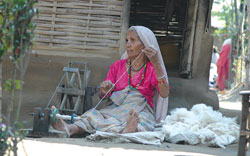
| SCRAPING BY: "Life is hard in the camps," says Jhuma Devi Adhikari, spinning the cotton that is her livelihood. "I'd definitely go elsewhere." |
Tika Maya Rai thought hard and looked around her tiny candy shop in the Bhutani refugee camp in Beldangi one recent chilly evening. "No, I don't want to go to the United States or any foreign country," she finally said.
"I don't know if life in America will be any different," Rai explained, and asked, "Is there any guarantee that we won't be repressed there too?" She just wants to go home.
Until a few months ago, sentiments such as Rai's-home, repatriation, being a good Bhutani-were the only thing you'd hear when visiting the camps or speaking with the refugee leadership in Kathmandu.
But that has changed dramatically in recent months. For every Tika Maya Rai we spoke with, there was a chorus of Chandra Bhattarais. "I'd happily go to America or even India". Bhattarai just wants to forget the "dark days" he describes to us in detail, Nepali Bhutanis were forced to give up every symbol of their identity, often on pain of death, rape, or torture. Bhattarai wants the religious and cultural freedoms of other countries, and life outside a refugee camp.
The offers by governments, including those of the US and Canada, to absorb as many as 60,000 of the 100,000 refugees over the next three or four years, has split the refugee community.
Bhattarai's sentiments are especially common among the young students in the local schools run and funded by Caritas-Nepal and UNHCR. Between classes there is talk of the US, Australia, the United Kingdom, but especially the US. "I want to go to America at least to study," says Subodh Adhikari, who passed SLC two years ago and is now studying hard for the TOEFL. Subodh's only hope of studying abroad is finding a sponsor. It's a common story in the camps, and young people say they ask every visitor for email and other contact information. "Maybe one of them will finally get me out of this camp," says young Jeewan Khanal.