
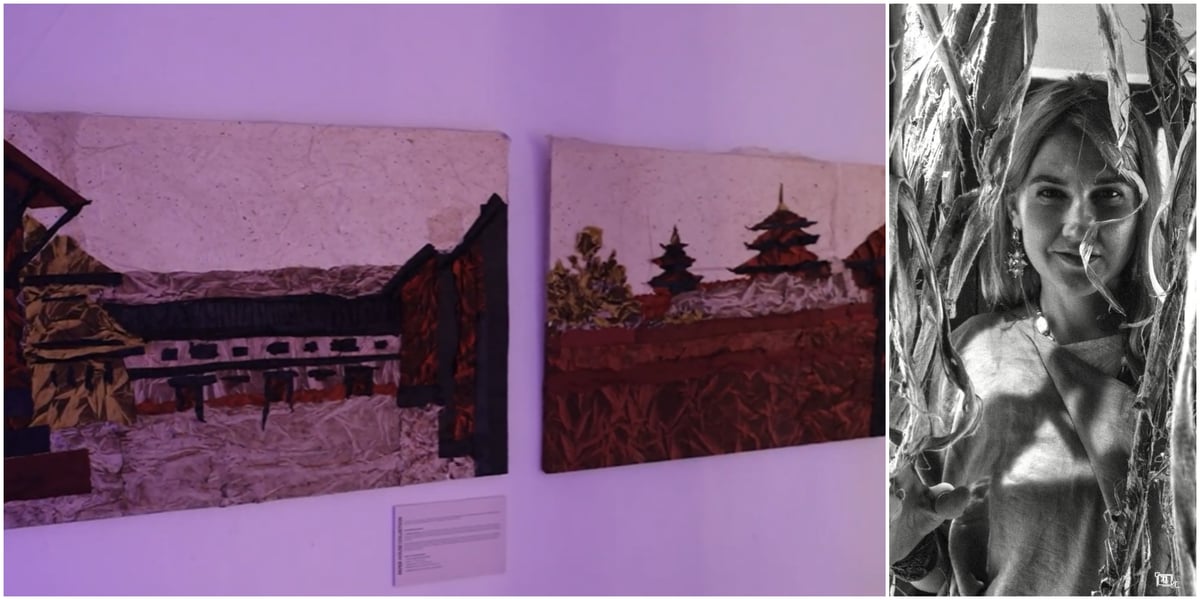
Home is a structure most people stop noticing once they are inside it. It becomes background, the shell that holds a life rather than the life itself.
Russian artist and designer Liudmila Rozvodovskaya hoped to change that with her ‘Paper House: Creation’ exhibition at the Siddhartha Art Gallery in Kathmandu during July. This was the second chapter of ‘Expedition Routes’, her three-part project.
The trilogy's opening exhibition at the Patan Museum was ‘Lokta: the Core Material’ inspired by the Heart Sutra, which follows the practice that form is emptiness and emptiness is form. This second stage turned that research into finished form, using paper, clay, light, and ritual pigment to ask what a house becomes once the person who lived in it has gone.
Rozvodovskaya's work insists on reversing that inattention. She treats home not as a fixed object, but as a mechanism for something that keeps moving after the building itself has stopped changing. Her artist statement frames the walls of a house as no more permanent than the body is for the soul. Both are temporary vessels, filled and forever changing.
Rozvodovskaya was interior designer for 20 years, studying in Altai and earning a Master's in art history at the Repin Academy of Arts in Saint Petersburg. She then completed a hospitality design programme in Milan before founding Enter-ra Design Studio in 2009, working on private apartments, offices, and public interiors.
But over the past several years, her focus has shifted from interior decoration and moved towards exhibition spaces and immersive installation, including curatorial work in Saint Petersburg and a solo show, ‘Support’, at the PRO.SEC.CO Creativo art gallery.
She lived at the AuroValley Ashram in Pondicherry which led her to light sculpture, and it was after that trip to India that she came to Kathmandu and decided to stay. She experimented with lokta, Nepal’s handmade paper from the bark of the daphne bush that grows high in the Himalaya. She experimented on the paper by washing it, drying it, and working pigment into its pulp.
Rozvodovskaya was convinced that the material held memory: whatever is added to it during production stays part of its body rather than sitting on its surface. Her exhibition at Patan Museum paired the papermaking process with the five traditional elements, earth, water, air, fire, and akasha, inside an eighteenth-century palace museum.
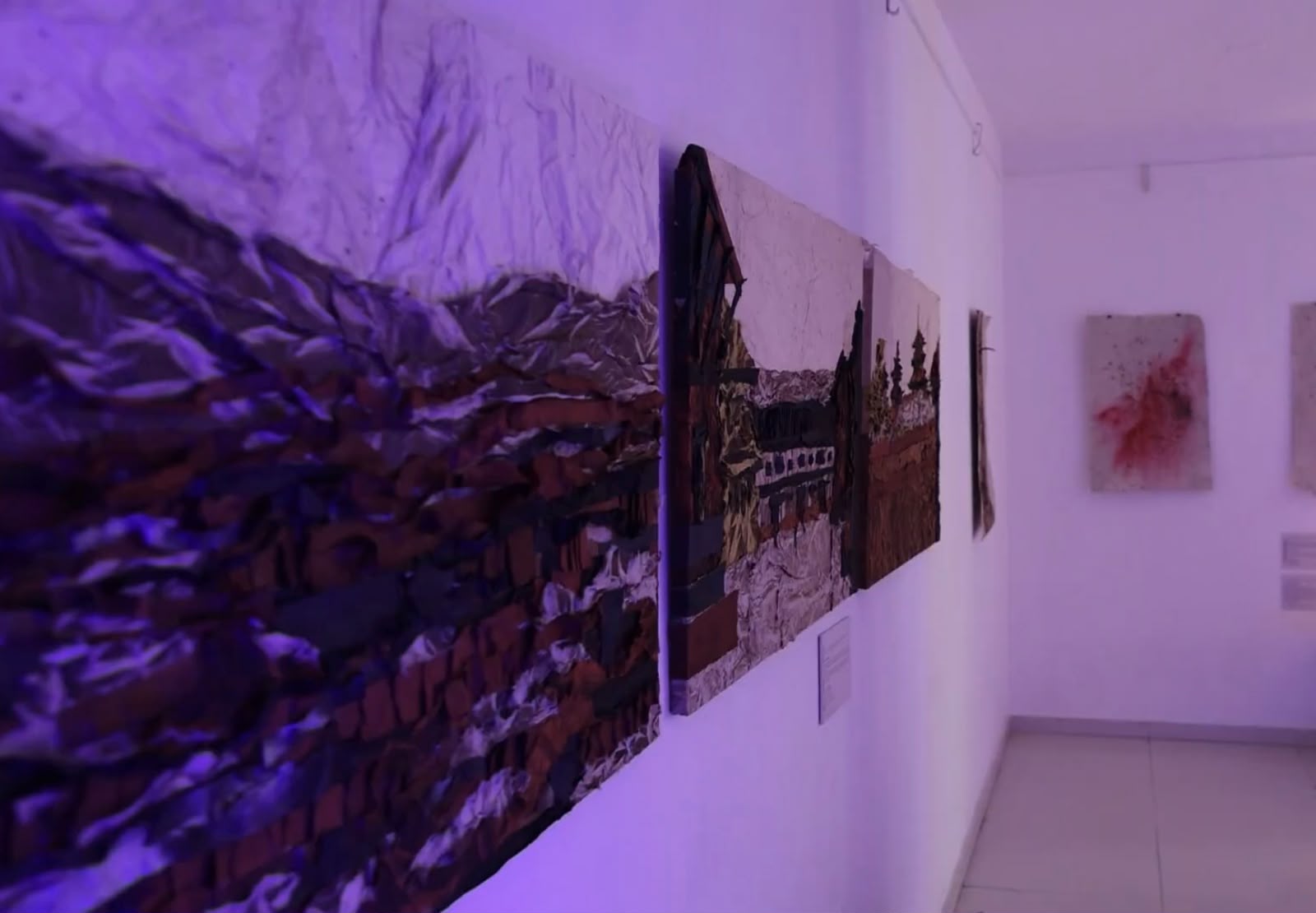
The Siddhartha Art Gallery show extended that research into a series of distinct collections, each tied to a specific place, workshop, or encounter from her time in Nepal. Starting in the early hours of dusk, the lighting of the space became integral to the experience as a whole.
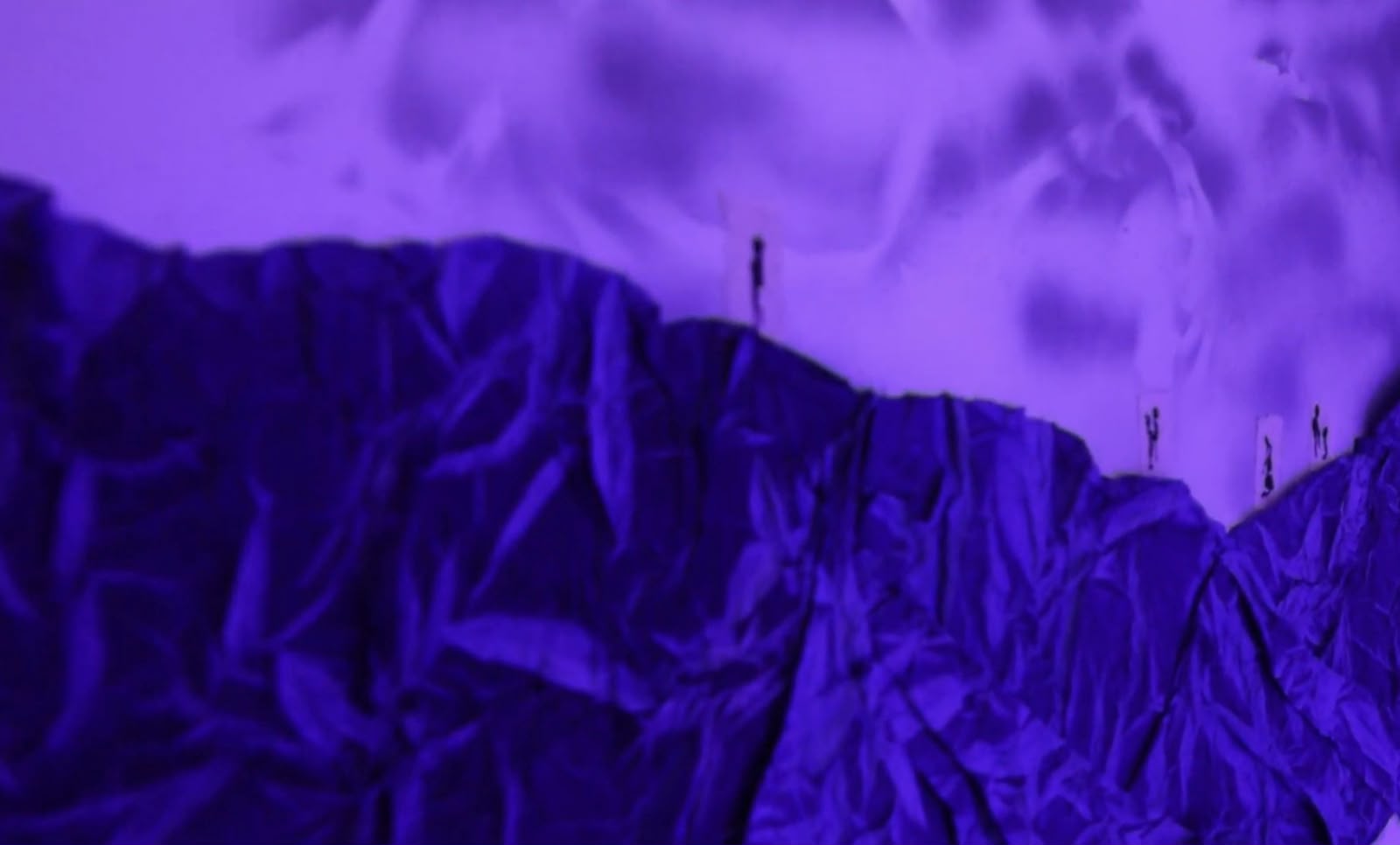
Mixing blue and purple created a safe space of calm energy, illuminating the art and sculptures to their true power. With the masterful use of light, positioning, and art, the gallery became a second home for its viewers.
At the centre of the exhibition stood ‘Ghost House’, five light canvases built from antique wooden frames once used for casting lokta paper by hand. The series traces back to a single night in Panauti, where Rozvodovskaya stayed in a restored Newari homestay only to learn, once she already held the keys, that locals had avoided the house for generations, believing it was haunted. She
stayed anyway.
Architectural sketches of the town's empty houses were later transferred onto the paper-casting frames, tools used in paper craft to shape, hold, and dry wet paper pulp into customised 3D impressions or sheets, and lit from behind so that the drawn structure appears to glow from within rather than sit flat on the page.
The fibrous, translucent quality of Lokta is treated as the argument of the piece rather than a decorative choice: light passing through the paper turns a static drawing into something closer to breath.
That idea sits close to the Heart Sutra's teaching that form and emptiness are not opposites. A teaching of Nagarjuna's philosophy, which the exhibition explicitly draws on, developed at length.
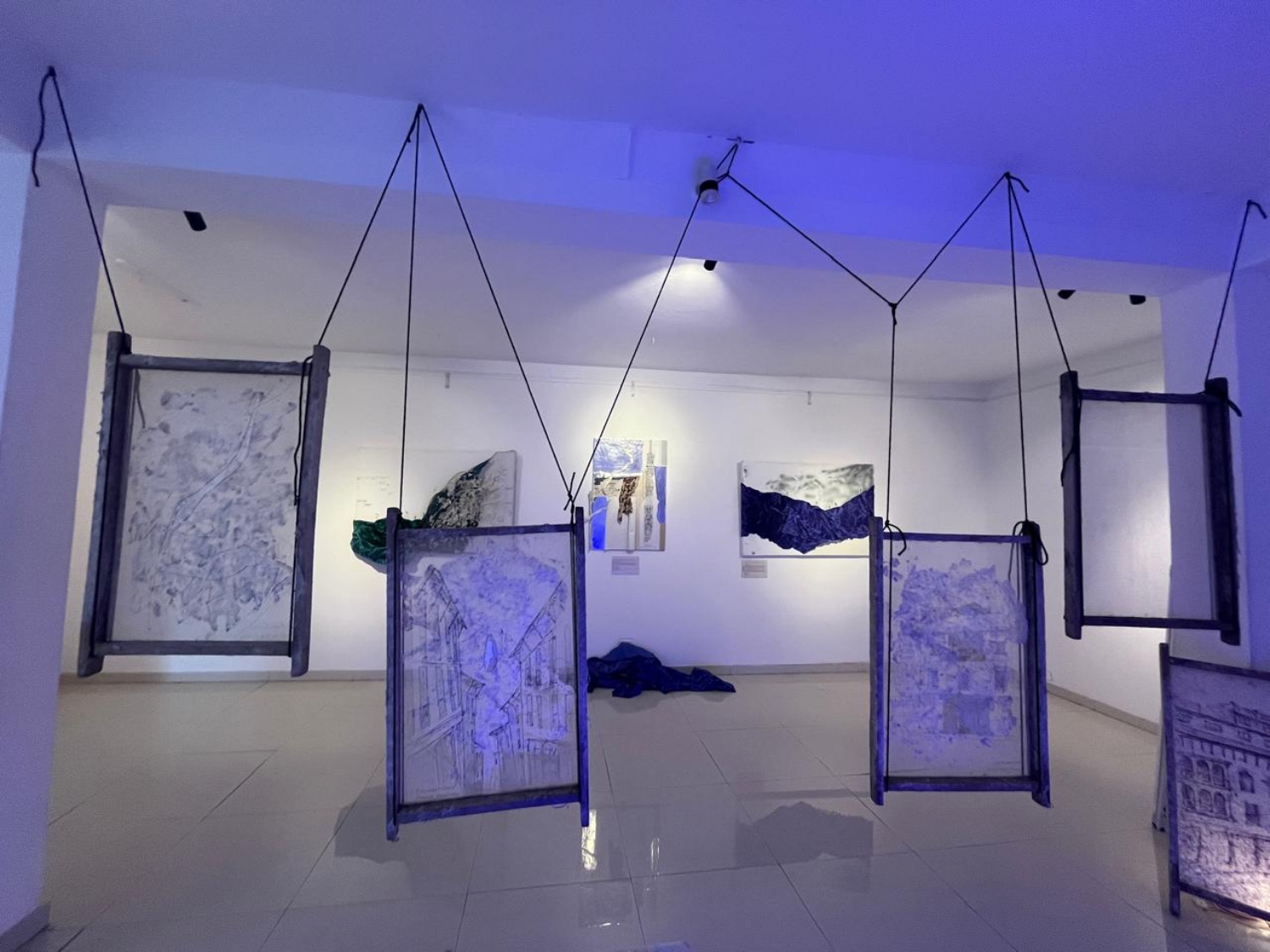
In Rozvodovskaya's frames, the wood keeps its shape while the paper stretched across it stays almost weightless, so the object holds both halves of that teaching at once: a structure that is fully there and, held up to the light, barely there at all.
‘You Are Here’ is a collection built around Rozvodovskaya's experience of getting lost repeatedly in Bhaktapur's unmapped alleys. The series takes the form of mirrors set into map-like frames, each marked not with a destination but with a single point meant to represent the present moment rather than an endpoint -- turning disorientation back onto the viewer, replacing the promise of location with a plain reflection.
‘Peacock’ was made experimentally at a Bhaktapur paper factory, and mixes raw lokta pulp with sindur pigment, marigold petals, ritual threads, and Nepali tea. The finished sheets carry a physical record of the pujas and communal tea-drinking they reference.
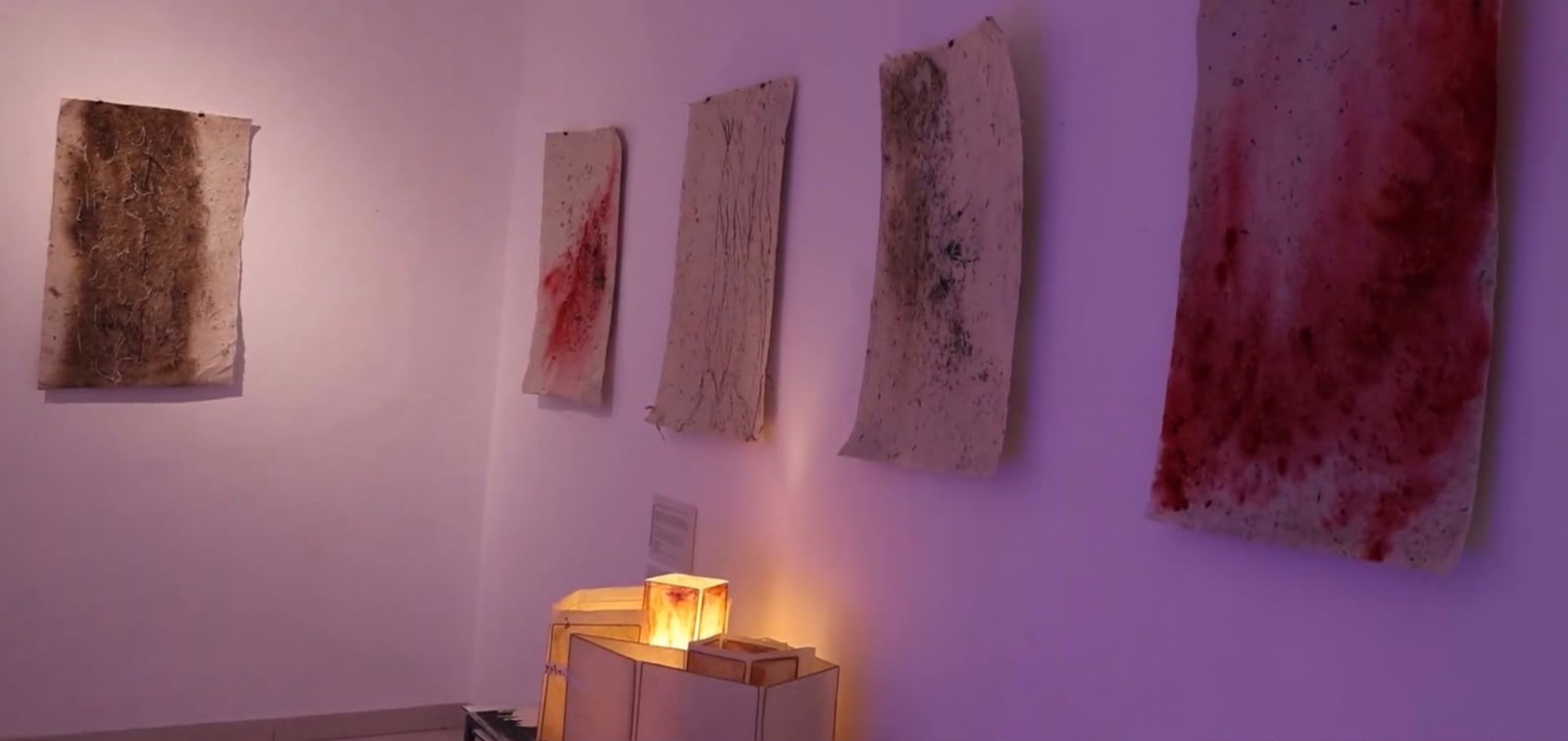
A related series, ‘Void’ consists of plain white canvases stripped of any added material, presented as a counterpoint: elements applied to the other works are treated as decoration in the same way Rozvodovskaya suggests everything built in a life, including a sense of self, ultimately is.
Two smaller series, ‘topview’ and ‘Pottery Square’ came out of time spent at a family ceramics workshop in Bhaktapur run by the potter Durga Prasad Prajapati. Top view translates Rozvodovskaya's own sketches of tiered temple roofs, and Pottery Square scales similar architectural forms down into smaller, more playful volumes.
On the gallery's second floor, a media hall screened a short essay film on the feeling of home, made the previous year by the director Evgenia Odoeva as a related art project.
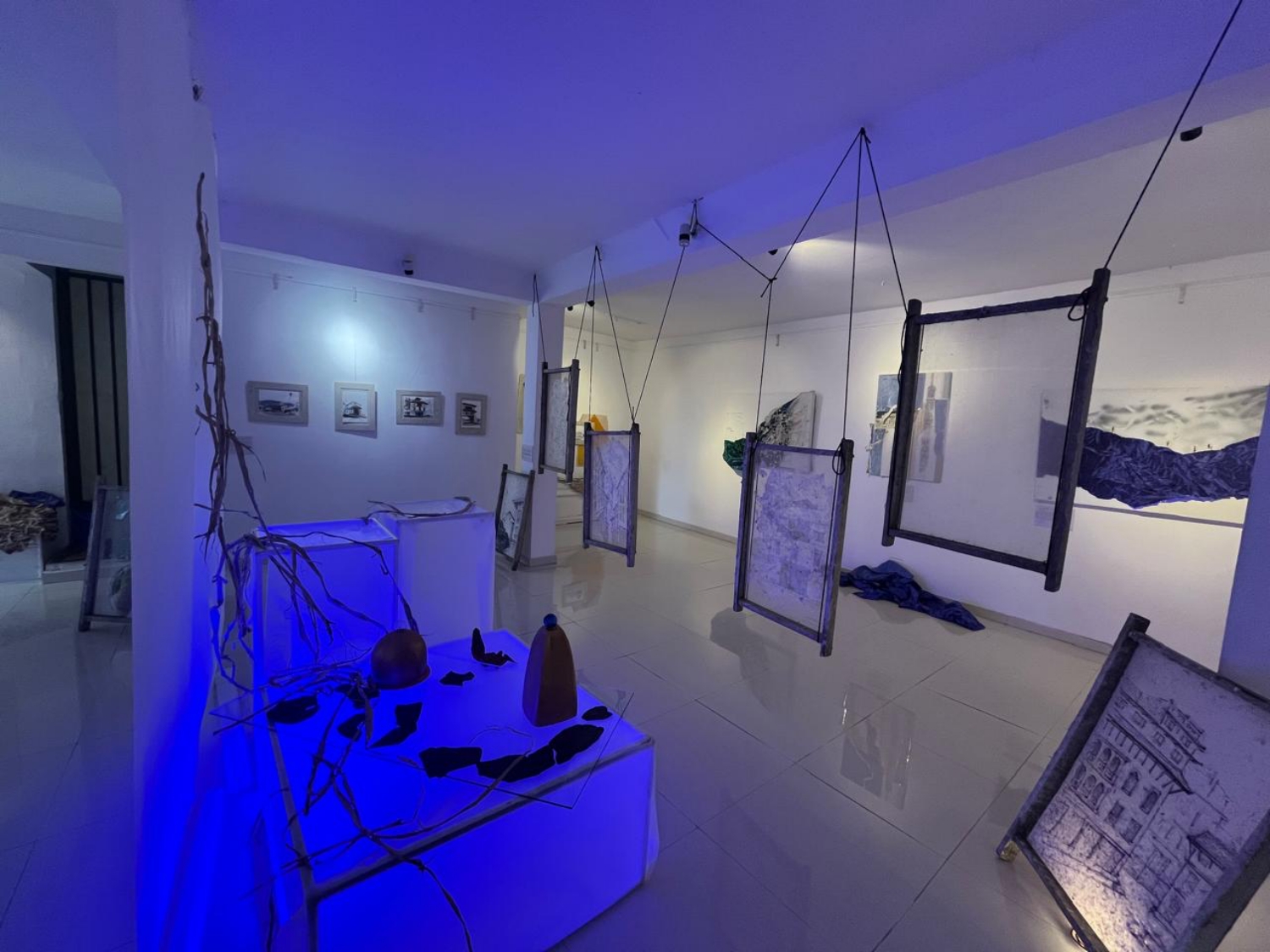
The exhibition's architecture was itself built around the idea of a paper house: a structure understood as fragile and temporary by design, drawing on the Buddhist philosopher Nagarjuna's description of form and emptiness as inseparable from one another. In Rozvodovskaya's reading, the paper walls of the installation can be physically destroyed without losing what mattered inside them, since the volume of a home persists as something closer to feeling than material.
Taken together, the collections on view at Siddhartha functioned as chapters of the same travel account. Each stop produced its own series, gathered here under one roof, and each series carries the same underlying claim: that a structure’s meaning outlives its walls, and that paper, dried and reshaped from something once alive, is an honest material to carry that claim.
‘Paper House: Creation’ left its viewers exactly where Rozvodovskaya says she wants them: standing inside this fragile structure, aware that the walls around them were never meant to last and that what they feel while standing there, in this gallery, is the only part of the experience built to stay.
Kian Lee Mitty, is currently majoring in art history and minoring in finance at Princeton University. He is also interning at Siddhartha Art Gallery.