
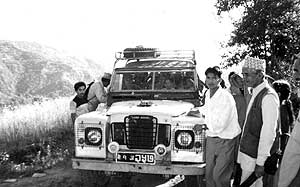
 If you ask Nepalis what they want most desperately in their village, more often than not, the answer will be: a road. In the more remote parts of Nepal, many have waited their entire lives for the road to get to their village. But in some places, they don't wait for the government: they build the road themselves. This is what happened in the north-east of Ilam.
 It isn't long, just 5 km. But that is all it took to join Jamuna with the road to the district headquarters, and what a world of difference it is going to make. It took the local people over six months to complete the task, and on 24 October two Land Rovers arrived here amidst much fanfare and jubilation.
"A gadi before Dasain" was the slogan in Jamuna and it happened with two days to spare. It proved to many here that where there is commitment, there is a way. The going was not smooth, especially on a road designed and built entirely by the villagers. The Land Rovers needed a bit of human power to get over the rough bits. The fast-flowing Mai Khola was still swollen with water because of recent rains, and the road builders had waited two days for the water to recede.
On the 24th they decided to take on the river, within half a day, there was a temporary log bridge in place. By early afternoon the vehicles were on their way, negotiating sharp bends up the spur on which the village rests. Villagers clung to every inch of space in the cars, dismounting to get around the quick twists that local engineering had not been able to get right. A loudspeaker mounted on the hood of the first vehicle croaked continuously-tinny music that was supposed to be festive. But no one was really that bothered, it was the sound of revving engines that was music to most ears.
As a visitor, I was co-opted to be the official photographer of the ceremony. My grandfather, 90-year-old Devi Prasad Bhattarai, was cutting ribbons. The bazaar folk had readied two ceremonial copper ghadas to mark the arrival of the cars and had strung marigold garlands on everyone that deserved one-including the Land Rovers.
It took some time for the moment to come because one road gang had marched ahead to level the road beyond the bazaar to take the vehicles to the high school from where it would be visible to large parts of the village. Local donors, drivers of the vehicles, village elders all had marigold garlands on their necks and vermilion all over their faces. It was a celebration of victory over the difficult mountain terrain and the triumph of self-help. I was born and raised in Jamuna and was visiting after a gap of about six years. The time that had elapsed since my last visit had effectively made me an outsider, and I was initially unable to soak up the joys of the road getting there. My admiration of my compatriots grew only when I heard the full story.
This was the second road the villagers had built in the past three years. The first one, of almost the same distance, connected it with the Indian border to the east. But soon after it was completed, a change in customs rules made it difficult for vehicles with Indian license plates to service the village. That was the end of the road, and all the money and labour that Jamuna had put into it.
"We realised we had to connect with the district headquarters," Jit Bahadur Sawa, VDC chairman told me. He began the work with a Rs 75,000 grant from the Village Development Committee, a promise by MP Keshab Thapa to contribute Rs 25,000 and Rs 120,000 from two local contributors. The villagers put in labour-some families up to 32 worker days. A villager with road building experience in the Indian hills was hired to be the surveyor, engineer and contractor.
The road has injected new energy into Jamuna. "We'll get back to road building again after Tihar," Sawa said. Surprisingly for a politician, Sawa worked on the road-gangs alongside the other labourers throughout the construction period. "It will be a shame if we don't fix the road and make it usable throughout the year," he adds. "Now we've an additional responsibility, thinking about how to build a permanent bridge across the Mai." That may take some time because with less than Rs 500,000 to spend every year, it is clearly beyond the VDC's budget. So what does Jamuna get from the road? Will the quiet little village be converted, like most other newly-connected settlements, into a squalid and noisy town? Perhaps not. The people of Ilam are very industrious, and this village of 6,000 people produces over 20 tons of cardamom, 40 tons of ginger, over 15 tons of potatoes and several hundred kilograms of tea leaves every year. They are sold mainly in India, carried on horseback or by porters. Now there is the road. "We are about to take a great leap forward," Sawa tells me, as the Land Rovers give off a mighty cloud of soot and heave up to the school grounds with blaring horns. "This road will help make it happen."