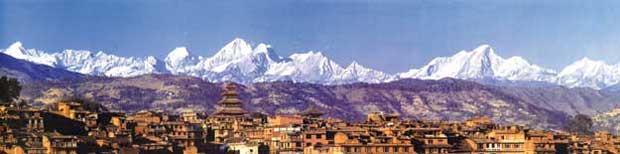
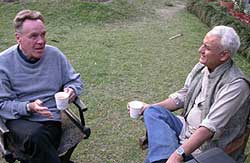
But the mountains have also come to be associated with pseudo-nationalism, personal ego, glory and money. The Nepali people would benefit from more and smaller flexible, club-type climbing of the lesser peaks. The 50th anniversary of the first ascent of Sagarmatha may be a good time to go back to the basics of the aesthetics of climbing where you can do more with less. Kanak Mani Dixit (pic, right), the editor of Himal South Asian magazine talked to noted British alpinist-turned-anthropologist, Michael Thompson (pic, left), about climbing ethics, nationalism, mountaineering and the market. Excerpts from the conversation:
 Kanak Mani Dixit: It's been 50 years since Tenzing and Hillary got to the top of Everest. Tenzing was a Himalayan and a climber at heart. If you read his writings, even those translated autobiographies, he was somebody with that fire in the belly of a climber, the sensibility, the broad-based understanding of the whole idea of climbing. It's been 50 years, but we are still looking for climbers like him in the Himalaya. There are few climbers in Nepal that come out of the urban milieu. I can't say whether this is a plus or a minus, but we haven't evolved mountaineering as a sport in Nepal.
Michael Thompson: If you look at how it happened in other mountaineering countries, there is a strong base of climbing. People start with hiking and then rock climbing and can even join numerous climbing clubs. That's how I started. You do some basic climbing at home and go for your first trip to the Alps. One thing leads to another and then you say, "Hey! We can go to the Himalaya." So you need to have this base and Kathmandu, with so many peaks of great variety nearby, could emerge as one.
KMD:But we haven't even reached the stage, people haven't even started hiking to the ridges along the Valley rim.
MT:Well, it will happen when people start saying, "Wow! What a fantastic country we've got." And it's a kind of middle class thing as well.
KMD:Clearly, we have a middle class but our middle class doesn't even climb Phulchoki, Nagarjun or Chandragiri.
MT:That will come. I think it's got to come. People will get bored. Young people with a bit of money will get bored if they are just going around on motorbikes. And you've got a fantastic country full of beautiful mountains. It will happen.
KMD:Then would people have to get more bored before they become more interested in hiking and climbing?
MT:Perhaps, and there might be something impeding it which is the official Nepali attitude to Himalayan climbing. What I know of the 50th anniversary is that the celebration is being presented in an absence of the aesthetics of mountaineering. They are proposing to give all the people who have been to the summit free visas as if getting to the summit was a uniformly worthy achievement. Or drawing up lists of summiteers and how many times they got there and so on. 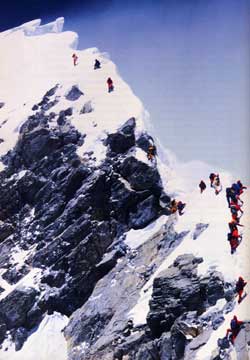 The essence of climbing is always doing more with less. So for the first time 50 years ago, the thing was to climb the mountain. It was a big expedition. They had oxygen and everything. The technology, knowledge, techniques and equipment were a lot different from today and they really pushed themselves to what was unknown and they got up there. That was a terrific achievement. Then, later people tried to do more difficult routes with the same-sized expeditions on the west-ridge climb.
KMD:Then there is the fact that we've let our nationalism run away with our mountaineering. It started right off the bat when Hillary and Tenzing came off the mountain and it was all murky-who was Tenzing? Was he Tibetan? Was he Nepali? And in the process, of course, the Nepali state took him over. We lionised him, but the moment he decided to go back to Darjeeling we just dropped him like a stone. We still haven't appreciated Tenzing as a climber, our nationalism took over. When Tenzing chose to live in India he suddenly became persona-non-grata to us. He is a true Everest man. He's seen the east of Everest, since he was born there, he's worked in the west of Everest, he tried Everest from the north and then actually achieved the summit with Hillary from the south in 1953. There isn't anyone more Himalayan than Tenzing, yet he did not fit our definition of Nepali nationalism. Likewise, we regard our mountains as if they were proof of our achievement. Tectonic factors made them high, not our hard work. Nepali children and adults and even our political leadership exhibit pride that Sagarmatha is ours forgetting that only half of the mountain is in Nepal. Nationalism has overwritten nature and mountaineering. And proof of that is the lack of genuine empathy and understanding among our public of the Everest 50th anniversary. But all is not lost. Hopefully, we can use the celebrations to inform the Nepali public about what these mountains mean to us.
MT:If somebody asked me what I think should be done with the 50th anniversary, I'd say just look at all these big expeditions to Everest. They are pulling the mountain down to their ability, they are dragging it down instead of climbing it. Everest has become a terrific honeypot. Well, one idea that crossed my mind, though it is a rather extreme measure, is to really try enforcing the aesthetics. I'd say don't allow any expedition on Everest where they've got more than one member. And don't allow any oxygen. That would stop that oxygen shop. You can have oxygen down below at the Himalayan Rescue Association for medical purposes.
KMD:Or maybe a moratorium until the mountain is clean, or to have a limitation on the number of teams. But can you enforce adventure on people? Isn't it like saying "Okay, I hereby decree only the adventurous shall climb Everest".
MT:It's not so much enforcing adventure on people, but taking away the non-adventurous. It is an extreme measure but it's well worth thinking over. The other thing is mobile and satellite phones. You call up and say I'm stuck. That sort of destroys things. In the best and the most congenial restaurants and clubs in say, London, you'd have to leave your mobile phone in a basket. In the wild west you had to put your gun away before you went into a saloon. Well, maybe we could do something like that or make expeditions walk all the way either going or returning, right from Kathmandu