
 KIRAN PANDAY |
A loss, a promise, and a waste define Nepali politics in 2010. These three incidents have touched almost every Nepali.
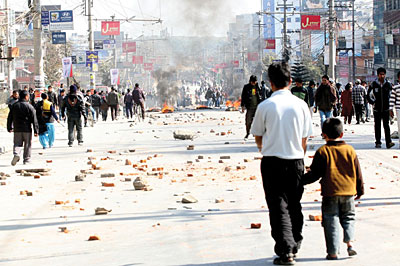
The death of Nepali Congress President Girija Prasad Koirala after prolonged illness, the shanti sabha (peace assembly) that blew away the indefinite nationwide shutdown by the Maoists, and the resignation of a prime minister who commanded a parliamentary majority to pave the way for an elusive 'consensus' were events have not only had a huge impact over the year but are also likely to shape 2011.
Koirala's demise was beyond our control, and the nation had to bid adieu to a man who courted controversies and people but whose crusade for democracy was unmatched by any contemporary leader in Nepali politics. An autocrat in his own party and at times a vindictive politician who hardly countenanced any opposition, he nevertheless made the greatest contribution to present-day Nepal. He courted and cajoled the then outlawed Maoists and once he agreed to do away with the monarchy, a 19-day people's movement did what the decade-long violent Maoist insurgency could not accomplish.
The shanti sabha in Basantapur in the capital on 7 May, the sixth day of a nationwide banda aimed at dislodging an unshakeable Madhav Kumar Nepal, will be remembered as the day when people rose to protest excesses by a powerful party that was acting as if it could do anything it wanted. That the assembly took place, despite dire threats from Maoist Chairman Dahal and the party's trade union wing, was so telling that you could hear its reverberations throughout the country. The party called off the strike later that evening. Dahal was shaken enough to rant in public against the 'sukila mukila' (the well-dressed).
As for the wasted resignation of Prime Minister Madhav Kumar Nepal, it happened due to a combination of factors: the desperation of the Maoist leaders, who were bereft of any agenda to fire the passion of their frustrated cadre and an increasingly apathetic public, the greed of the prime minister's party colleague and UML Chairman Jhalanath Khanal, and the cowardice of the hounded man himself.