jange Oct 8, 2010
We abandoned everything from the past, even the good stuff, and threw the baby out with the bathwater.
We??? Maybe you and your pseudo liberals revolutionary friends did. But most Nepalis were always aware that violence would not lead to revolution but only to chaos.
You and the NT had/have a bigger role in creating the current mess than the average Nepali. You chose to use your privileged position of influence to mislead Nepalis and perhaps, more importantly, foreign readers of NT who unfortunately have more power and influence than their moral and ethical attributes warrant.
I suppose this is what happens when you chase after the crow instead of checking to see if your ears are still in place.
Kale Oct 8, 2010
# 1 Jange
NT at that time was giving benefit of doubt to the Maoists.
nepalese are a breed; if you ask them not to touch fireor flame they won,t listen to you,. They have to feel the flame.
who cares Oct 8, 2010
we need to make a list of likes and dislikes.
Gole Oct 8, 2010
StatusQuoists and Agragamis are the opposites.in the lexicon of the Maoists.
it is the bane of our educated persons ,civil society in particular that they are afraid that they may be labeled as status Quoist or Pratigami.
What is a status - quoist from the Maoist point of view has been clearly defined by the publisherof NT.That is one who is for ahimsha non-violence, grassroots democracy,or pluralism,participatory development.It has implication on, becoming a modern society, about industrilization ,rising ,level of literacy,education and wealth., and urbanization ,good governance,human rights too.Maoists call them Pratigami; any one not toeing their line is a backward-looking pratigami.
Any one toeing their line are forward-looking and patriotic even royalist elites corps.
Agragamis can do no wrongs; they can exhort. ,kidnap,murderand can go Scot free even now; what will happen in their e reign if one happens to be a card-holding member of the party ?
What we need is a clear cut definition of Agragami and Pratigami now.
Will my blogger friends help by imparting their valuable opinion ?
jange Oct 8, 2010
# 2. Kale
Benefit of the doubt??
Murder, loot and extortion is murder loot and extortion. What's there to doubt about that?
The NT's position regarding the Maoists can best be described as opportunism masquerading as naivite.
Arthur Oct 8, 2010
At least this time the publisher is a bit more honest, tacitly acknowledging that his outlook reflects a "status quoist" yearning to preserve or restore the "good side" of the past instead of claiming to speak for a "golden muddle" caught between extremists on both sides.
Certainly many local initiatives may be far more promising than the paralysed national politics. But why give credit to the past instead of to the changes that have unleashed more vibrant local energies that were stultified in the past.
Was community radio produced from the old semi-feudal "elected" local councils that in fact represented local landlowners and other "notables". Or did it take off after they were overthrown?
Perhaps the large majority of Nepalese were not as pleased with the performance of these local notables as fellow notables like Kunda Dixit? Things can look different from the perspective of people forced to live on less than $2 per day and look for work abroad in a stagnant economy with no roads etc while the funds available for development are looted for the benfit of "notables".
Also honest is the reference to the current coalition undoing the local community forest groups to facilitate looting. But doesn't that show who is the real obstacle to local elections and the importance of defeating them nationally?
khanal, a Oct 9, 2010
"We abandoned everything from the past, even the good stuff, and threw the baby out with the bathwater." what good stuff?? journalism is not literature. gimme facts.
And by the way, wr hv lal and prashant gone??
a, khanal Oct 9, 2010
@ jangey -- hera saathi janayudhha ko kram maa timiley kunai byaktigat chhyati behornu pareko vaye, teslai samaya ko malam le samhalnu nai uchit hunchha.
yudhha timiley vaney jattikai nirarthak ra kurooop hudo ho ta , sansaar maa yeti dherai yudhha huney thiyenan. Aakhir marney maatra mann ( binaakaaran ko mrityu athawa naraamro kaam ko laagi mrityu ko samvaawana) kaslai po lagchha hola.
i suggest u to read paulo coelho's "the alchemist". in fact let me do u a favor - read this extract from the book -
"Because I don't live in either my past or my future. I'm interested only in the present. If you can
concentrate always on the present, you'll be a happy man. You'll see that there is life in the desert, that
there are stars in the heavens, and that tribesmen fight because they are part of the human race. Life will
be a party for you, a grand festival, because life is the moment we're living right now."
K. K. Sharma Oct 9, 2010
KD is again dreaming. "What is done cannot be undone". Past is past, and NT had contributed in making the past, past..No use, " crying over the spilt milk". The "great revolutionary leaders" you had promoted are in position now. So just rejoice, do not gripe.
jange Oct 9, 2010
# 4. Gole
What we need is a clear cut definition of Agragami and Pratigami now.
That depends on where you are going!!!
Agragaman is not always a good idea, especially if you are standing (facing) on a cliff edge.
# a, khanal
There are plenty of people within the Maoist group who enjoy killing and would love to do more of it.
That is the present reality.
Johann Oct 9, 2010
Very thoughtful and convincing piece from the publisher. The Maoist revolution is out of control of even the Maoists themselves...that much is clear. The trouble is, where are the democratic parties? To revive the self-governance achievements of the past you need to have a reformed Kongress Party and UML, but they are hopelessly corrupt and shortsighted. Still, I would rather believe in a party that is for an open society than a Stalinist one whose avowed goal is a Gang of Four Dictatorship. And what perplexes me is Nepal's European donors using my taxes to back these totalitarians. Stalinism was disastrous for Europe, but we seem to think it is ok for the Nepalese.
Lokendra Oct 9, 2010
Good news. Nepalis doing great stuff because there is no government. Couple of dozen more rounds of senseless elections and we really should be on the way! In a very perverse way these elections should really do us good. Perhaps enough Nepalis will realise that politics and politicians will not bring us that easy salvation that we all seem to seek. No more of that "Dwi barsa ma Singapur bainai dinchu" nonsense. Time to put the nose to the grindstone and start working instead of following politicians like that proverbial syal.
who cares Oct 9, 2010
what maoist did or doing is glorifying past evils, mistakes?
- maoist are far more corrupt than NC, the situation has become so dangerous that people could die for disclosing maoist corruption.
- maoist have politicized govt dept far more than NC and UML used to do. even worst is, they have politicized private org. too.
- one ethnic rule has crossed limit in maoist. can you believe, today, other ethnics are killing people for the single ethnic in the name of eliminating one ethnic rule.
- maoist have replaced mandalas with ycl (there are many times more ycl than there were mandalas), royal army with pla, local landlord with maoist local bosses.
- just like ex royals, maosit have monopoly over business.
- just like in NC (at least in the past), the boss, girija, in maosit too, the prachanda do not even like to pronounce the term retirement, and also, just liked in NC, in maosit too, other maoist do not see prachanda's replacement.
- maosit are pushing panchyas' anti india propaganda to out of control.
frankly speaking, all maosit represent is the worst form of mistakes, evils of the past.
Hermann Oct 10, 2010
#11 Johann
Absolutely right Johann. You got the right feeling towards this land.
We are fed up with the misguided notion of socialism for the development of the poor masses. It wil be nothing but state capitalism. Welfare state , free market with regulation and social and economic freedom has changed the face of Europe and America. There is a better living condition of labour and poverty is no longer there as in the past. Compassionate capitalism , globalization, right to property , rule of law, are more important. People will pay taxes willingly if our politicians are honest and if there is no corruption at the higher level; . This country can be a better example of the Scandinavian countries in South Asia that way.No place for Communism or any form of totalitarian system in this land.
BB Oct 10, 2010
Hey who cares #13,
What's your point railing against the Maoists? It was people like you who brought them to power from the jungles. You seem to be an NC-UML supporter. Well, wasn't it those NC-UML combine who brought the Maoists to the "mainstream" to build a brand new 'New Nepal'? So if Maoists are causing all this havoc now, then who is responsible for giving them the opportunity to do so?!
And what's the point bad-mouthing the monarchy? It was the monarchy that was trying to curtail the activities of the Maoists. And it was doing a decent job too until your mentors, the NC-UML gang, joined hands with the Maoists and brought them to power!
Ever heard the saying 'aafai boksi, aafai jhankri'? Well, look in the mirror and you will see the personification of that saying!!
Kamal Kishor Oct 10, 2010
body, td, input { font-family:arial; font-size:16px; } #container { padding:5px 20px; } #header h2 { font-size:27px; color:#d0d0d0; margin: 22px 0 10px; } #searchform { width:470px; margin:0; } #searchform input { font-size:18px; border: 1px solid #aaa; color:#aaa; } #searchform input:hover, #searchform input:focus, #searchform input:active { border: 1px solid #888; color:#000; } #searchform input.searchbox { padding:4px; width:300px; } #searchform input.searchbutton { padding: 3px 10px; color:#000; } #searchform div.poweredby { float:right; width:80px; text-align:center; } #searchform div.poweredby span { font-size:10px; } #searchform div.poweredby img { width:60px; }Never in my life I ever accepted that guns will bring peaceful and democratic changes. Any example where gun was able to change a system will prove me. Armed struggle makes deep scars and takes time (decades) to heal.
After Gyanendra forced 12 point agreement on NC and UML, despite their desperation to forge an alliance with the Palace, there could never have been any talk of keeping the best of the previous constitution. The whole political situation was turned into either supporting King or democratic parties and so any thing that the king gave us was rejected. Was it logical, yes it was.
But most of the progressives and democratic in the old constitution was retained though not accepted as such as those had already become part of NC and UML. So it was defined as the policy of NC or UML or others. But if you compare the two, you will see that name changed but content is the same in many aspect of the present constitution also. In that sense, Kundan is not right when he says that we abandoned every thing from the past. No. The progressive and democratic aspects of the previous constitution was the policy framework of NC and UML and it is there because of NC and UML. Remember, the Maoists wanted to destroy the very same democratic and progressive aspects of the constitution when they initially launched the "War".
But there are many aspects of the previous constitution which we either redefined or just eliminated because that did not fit into political negotiation. There are many aspects of the constitution, that are progressive and democratic but might not find space in the coming constitution in the same color. But that is a part of any transition of a system.
However, constitution can never be absolute. It changes with time. Thanks Kundan, you started a very good but serious issue.
rishav Oct 10, 2010
Good article! Truth is slowly comming out of the wood work.
A needless war, yes indeed. What did we get as a result??! A precarious and even worse off state of affairs presently.
Local government elections would be a good thing, but would they really be free and fair without voter intimidation?
It all comes down to sorting out the Maoist combatants and YCL. The Maoists have shown vulnerabilty and political niavity with the current events, which now even to their own admission would leave them worse off in any kind of negotiation on maoist entrants to be recruited ino the Nepal Army.
Nepal unfortunately ,had it not been for this waste of time Maoist self declared war on the state, we would have been in such a better poisition right now. An example of our determination is given by the reduction of the maternal deaths, neonatal deaths and lenghthening of our life expectancy shows what achievements were made even despite such diificult times. Our people are hardy, tough, resilient and able to endure while others fall down and pass out. We will endure the current situation, however turbulent it may be and once the opening occurs our people will flourish taking the oppoortunity when it comes.
who cares Oct 10, 2010
15.BB
how many times do we have to repeat the same story again and again? and why do you dead royalist, maoist and their supporters have to be so dumb, slow...?
first of all i support freedom, rule of law, development etc but not individual party or individuals. ..... NC/UML they just come and go. todya, most of the NC and one section of UML (there are three sections- democratic, maoist and confused ones) are democratic institutions, tomorrow some others will replace them.
and regarding, maoist, i always took them as a terrorist, but since they were begging to be part of democracy, rule of law,,, i was ready to give them a chance (at the time of 12pt agreement- 12pts were find but implementation was awful) but a few weeks after their entry to open politics, i no longer had faith on them.
regarding dead royalist, they were nothing more than a sardar of criminal gangs. as for me the title king its self is not acceptable. but since i am just one citizen of nepal, i can not dictate majority. and for majority the activities of shahs were the reason, behind republic.
let, me give you some examples about the evil, incompetent side of dead royals.
*there was relatively peace during shahs time not because they had skills to run govt. but because they used torture, disappearance, threat against criminals and at that time only criminals in their gang could commit crime. .... and not to forget that they used to bring in criminals into their group as mandalas, ministers. even in police, royal army criminal minded, rapist used to get easy promotion, they were trusted, reliable ones for shahs.
*do you remember how shahs, ranas used to monopoly over business just like maoist are doing today.
*at the time of gyn badahur's coup, some generals were complaining that democratic govt. did not let royal army work freely to eliminate maoist, so only under gyn bahadur, royal army could eliminate maoist.
look today, cause of the same incompetent generals, who do not even know the basics of international law, due to their free style of working, today army is facing tremendous pressure from international community.... this also proves what kind of incompetent, criminal minded individuals get powerful jobs during panchyat, shahs time.
i say, gyn bahadur and those incompetent generals should be feed to international court and protect our national army from the shadow of phoney HR agents.
regarding 7 party and maoist alliance:
since, maoist agreed to accept democracy and rule of law and gyn bahadur's coup, the 12pt agreement was not a mistake.
for me, both shahs and maoist are equally evil. but since, maoist were 100s of times more in number so there are more violence, crime than during the time before maosit.
and since, shahs had deep root in nepali society, connection with international power, so it was wise to make a deal with evil maoist and get read of evil shahs.
now, since maoist betrayed, so time to get read of maosit too.
and not to forget that its gyn bahadur who created maosit at the first place to destroy democracy, maoist joined hands with shahs to destroy democracy.
today, dead royal supporters are complaining cause they became the first one to be eliminated. dont worry, maoist, corrupts, crooks will join you soon.
what ever may be the actual reason, but on the outside, maoist killed 16k nepalese to get read of shahs, and shahs killed people in the name of eliminating maoist too?
can you analyse the out come after shahs and maoist join hand (which is likely if the do not get scared)? my guess is it will be bloody. and i am looking forward to it.
actually,on the outside, both shahs and maosit represent opposite ideology even though, in actual, both want nothing but power to loot, rule over nepalese.
the true dead royal supporters do not tolerate maoist and maoist genuine supporters are agianst shahs... so if they join hands, they will loose remaining genuine supporters. but opportunists will always be with them.
and you BB, stop criticizing maoist since your boss is about to make a deal with maosit. you could face physical assault from both ycl and mandalas.
we should get read of maoist for freedom, rule of law, development, nationalism, social harmony cause they stand against all of them.
BILL FRIDAY Oct 10, 2010
Madhesi Forum � Do not hang in there, take a side. I see your better future in helping Congress. Support them if you do not propose, if you get a chance propose them. I am talking for this Constitution making time.
UML � JNK made agreement with PKD. Oli and others should be able to make agreement with Congress. Party can approve JNK�s or Oli (others) agreement by majority. MKN � I think Congress helped you to become a Prime Minister and now is your turn to help Congress so that you can get such helps in future as well. It is better to plan for future than hang in there for few more weeks and integrity matters.
BRB, PKD, NKS, RBM � Read books about Gandhi you will learn more there than other books you read. If you want history to judge you positively dissolve both YCL and Maoist party and let them assimilate with peace, society and other parties. If needed form a totally new civilian party that does not have sickle and hammer. That is the only right path for you to go and time has come. You will not find friends in China as China itself abandoned the path of Maoist, there are no other friends in the World who help you to sustain. It will be near to impossible to survive in politics without some friends in the World. Moreover you should realize that people who are with you now will not be there forever because many of them are there either by circumstance or there for money and they have better future somewhere else. Propose Congress or support Congress for the leadership of next Govt. to bring relatively good Constitution.
Congress � Stay firm. You may outreach with alternative players and not just with key players of other parties. If meeting with JNK or PKD does not work, outreach with NKS, BRB, MKN, Oli and others�.and negotiate with them. Even if you withdraw from PM�s race it is your turn to take leadership in consensus Govt because past two consensus Govts were led by UML and Maoist. Moreover country needs your leadership to bring Constitution.
JNK, PKD and RCP � Do not take this a personal issue or winning or losing issue. Be flexible, it is good for all of you. After all what is left for winning now.
12 round of elections � You all want your children to succeed. 12 round of elections discourages young generations and talents to choose your career field. Nation will need many talent leaders in future. Do not be a bad example for the World, let RCP succeed. Abraham Lincoln failed several times in his leadership attempts during his career but American made him a president and gave hope to aspirants in this field.
Army integration issue � First identify or distinguish the issues. Army is a specialized area. A nation should not disturb that system. For the good of all including Maoist, ranks (leadership from top to bottom levels) should not be integrated because they will have a political career. Those who are not in ranks should not be a big issue. I think there are three types of Maoist, those who read Maoist books, those who joined by circumstance and those who joined for money. Those, who joined by circumstance or for money will easily assimilate. Among those who read Maoist books, I think most of them will not join because with the span of time they will start reading other good books in place of Maoist books and have better future somewhere else. The army admission process that you started should address this. Do not make too big army as Nation and budget cannot bear it. Nepal already has a big army for its size.
All CA Members � Constitution is the area where all CA members must rise above party interest. It should not be the field for doing routine petty politics or bargain politics. You must be able to cross party lines to bring constitution and for that matter formation of next Government. To bring a relatively good Constitution Congress leadership is necessary.
Sarath G Oct 11, 2010
well, that was bound to happen when you let a neigbouring country that can't even properly feed 400 million of its own people call the shots in our land in the name of democracy and what not.
Nirmal Oct 11, 2010
The publisher's note has quite a lot of nostalgia for the 90s, good things that started afterwards. Some nostalgia during Dashain is obviously good when "it comes to digest(read it face)," as usual we say during Dashain; in order to catch the true sense of the message. Morever, the interesting comments followed by contributors like Jange, Kale, Gole, Arthur, Johan, KK Sharma, Lokendra, Hermann, BB and others' contributions highlight the forum as a blueprint to understand THE MESSAGE. We have all elements involved to complete the definition right here. Context, emitter, receptor, channel, codes and noises so that a message is finally defined and arrives to its due destination. Let me contribute a little bit to the cause.
The comment from 1.Jange tries to make the emitter of the message become evident: our experience indicates that an intellectual is someone who is in the distinguished position to say anything without knowing anything. And consequently seen from this perspective the note Jange's comments is more alike a confession of the nostalgic right(let me clarify again-I've no problems with the terminology RIGHT-; it just depends on the location). At the mean time the comment by KK Sharma reminds that "there can be no second thought, the fruit of notalgia just to go back" and insists on taking care of the real context, but in no way there should be any "Khaye kha nakhaye ghich" situation( an offer with intimidation in figurative sense) KK Sharma, perhaps it is where the pluralism plays its role and there is where Kale and Gole have doubts over the Maoists, over their understanding about the definitions of the Maoists own messages ie their commitment to pluralism. In addition, Johann and Hermann's comments help us to not to see the code "pluralism" as the kinds of political offers thrown up in the air by the politicians for business du jour, publisher.
Beyond your perspective dear Jange, the question is whether there is still any intellectual figure, except the total instability of a country being trivialized and being converted into the show which has incinerated all instantly. Probably we are in dire need of more thinkers than intellectuals and currently found politicos in the market, among other things because the thinkers with quality attend the complexity but the intellectual serves and is grown in simplification. It is a prototypical feature of intellectual which persists in the ideological inertia of our nation's politics and deny the significance of technoscience. However, our nepali model tends to the elite technocrats with many holes already found.
Whereas comments from a, khanal and Arthur represent the confucionism omnipresent in our leftist spectrum.Our leftist intellectuals suffer from platonic complexity to believe how things should be, and it is supposed that they know it. The landscape of a, khanal�s second comment start from the era of Enlightenment and has reached to the era of intellectual digital forum of NT. But the problem is that this political history where he based his argument is a correlation of errors, with flashes of nobility to the good causes that require more brutal human sacrifices than respectful devotion. And at the same time, he and Arthur seems dazzling with the goal set by former red bandwagons: "Let us serve to the good cause and let�s be served by them." In reality it is the ambivalence of all former revolutionaries and communists. The real dilemma is how to be Lenin, Stalin, Che Guevara et cetera in this 21st century? Well Arthur produced some arguments but the problem is that his comment is well applied to the Maoists as well- to the new potential feudals who are replacing the old ones to be the new ones-. Arthur should not only based his point of defense on few of his books he read about Nepali politics, my humble suggestion for him. He has choosen a wrong chhanel to contribute to the cause of the message, I feel sorry for him. The rests of the comments are quite symbolic, significant noises when one emits the message to deliver.
Given the serious complications of many intellectuals from right as well as left terrirtory of nepali politics, when it comes to manage the environment during these turbulences, commentators like Lokendra would surely say it's better that the politicians do nothing. Applied to political management, this type of intellectualism rarely gives good results, because they are more prone to dogma than reality, to the ideology than the lessons of experience. Dismissive of pragmatism, love the maximalist demands. Therefore, further we are away from practical politics, the better we are, according to this perspective. But that does not negate a need that is more becoming of our time and its challenges: a certain intellectual quality is needed to the policy of everyday so that the message is well served.
May Lord Durga helps us to understand the real meaning of the message, Happy Viajaya Dashami ladies and gentlemen!
Anonymousw Oct 11, 2010
KundaJi's editorial this week talks about old Nepal being not any worse. But very few people want to talk about how we got here.
The community grass-roots movement has turned into a lucrative cash cow and they all know it and have poured in political resources and muscle power to capture it --mostly UML and Maoists. They are on the ground and the government officials and the enforcers (if any) are not in a position to say no. Hence they all collude for control and plunder. The Maoists knew they had to eliminate the obstacles and they went on a political liquidation killing more than 1300 NC walas (as opposed to 140 UML). Their work was made easy by Deuba (by eliminating the local gvt.), by Girija (by eliminating monarchy), and the civil society (by doing the rest including humiliating the army and labeling traditional values, language, and heritage feudal and pratigami). Above all, a fair share goes to Gyanendra himself for being an arrogant and short-sighted SOB. One unintended consequence was that the gate to Nepal was opened so wide that India walked right through without any obstruction...
Satya Nepali (1) Oct 12, 2010
Some of the comments above, such as the ones by who cares, make me want to posit a question I have placed before in this forum. So who exactly are these evil 'mandales' that are so 'anti-democratic'? Where are these guys and what exactly have they done to destroy 'democracy' in Nepal?
After stepping down in 2006, neither Gyanendra nor the Army did anything to obstruct the so-called 'peace process'. They quietly accepted whatever the SPA and Maoists decided. If extremist, right-wing 'mandales' really existed then the crying question is: where have they been these past 4 years during which the monarchy has been humiliated and (illegitimately) abolished? Why would they keep quiet and not do anything about it?
Fact is such right-wing 'mandales' do not exist (at least not anymore). But sections of our society still love to use these 'ghosts' to extend their own agendas. Trouble is, this kind of PARANOIA against imaginary 'mandales' has cost the country very, very dearly.
I don't blame people like who cares. Truth is politicians and media of our country have brainwashed our people with overly exaggerated tales against the monarchy for their own political interests. Nepalis should realize that succumbing to such SCAREMONGERING tactics has been highly counter-productive to our country as the present state amply displays.
We are in this sorry state because we (majority of us) agreed to view Nepal's political dynamics in 2005-06 through the Scaremongers' lenses. That is, as a struggle between hardcore rightists ('panche' and 'mandale') vs. so-called 'democrats' (SPA-M). The real struggle was between the 1990 Constitution vs those who wanted to destroy it.
As I said, it's hard to blame the ordinary people. Our leaders, both political and intellectual, either FAILED to correctly assess what the real struggle was about or deliberately DECEIVED the rest of us because it served their selfish interests. And an important element in the mis-assessment (to be kind) of the true nature of the struggle was this PARANOIA against imaginary 'mandales' - the type that who cares so sadly suffers from.
Get over it, who cares. Panchayat is long gone, and Ranas? C'mon. Get real. Get a grip on reality. I agree the Ranas and Shahs committed grave injustices in the past, but that's not where we are now! Your paranoia and scaremongering is counter-productive to all Nepalis because it has and will prevent us from correctly assessing our situation.
Satya Nepali (2) Oct 12, 2010
Another fallacy that Nepalis have been brainwashed with is the following by Kamal Kishor (#16):
"After Gyanendra forced 12 point agreement on NC and UML, despite their desperation to forge an alliance with the Palace..."
No one 'forced' the 12-point on the mainstream parties. It was their own choice. If anything, one may say they succumbed to the 'enticements' of the Maoists and India. And of course, our 'intellectual' and 'civil' society played a great role in pushing them in this direction.
The Palace was open to forging an alliance with the democratic parties. In fact, Gyanendra's whole calculation in taking over was that, given a choice between Maoists and Monarchy, the democratic parties would side with him. It does not make sense to believe that Gyanendra would take over wanting the parties to side with the Maoists. This is another fallacy that our media has sadly misled our public with.
The real barrier to a Palace-parties alliance was Girija's senseless demand for the restoration of the dissolved parliament. That was the single-most undemocratic demand in our history. Let me explain why:
(1) As PM, Sher Bdr Deuba had the right to dissolve the parliament. This is a constitutional right accorded to all PMs in all parliamentary democracies (to the best of my knowledge). This question was even taken to the Supreme Court, and the highest Court in the country endorsed Deuba's decision.
(2) As such, the only option left was to go for fresh elections to elect a new parliament. This is what the constitution says, and if one truly believes in the Rule of Law, one needs to follow the Law whether it works in your itnerest or against it.
(3) Even if one continues to disagree with this line of thinking, the fact of the matter was that by 2003, fresh elections were due anyway. That parliament was elected in 1999. Even if Deuba had not dissolved parliament in 2002, fresh elections had to be held in 2003 as a matter of course anyway. Can parliamentarians, once elected, continue to rule forever (citing one excuse or another)? Aren't they supposed to face the electorate every 4 years in a true democracy?
Hence, going for parliamentary elections was the democratic duty of our political leaders. But instead they chose to take short-cuts with this easy method of re-instating parliament. This is the great big problem of Nepalese democracy that our 'intellectuals' and media have kept tightly wrapped in blankets. That was the great mistake that we Nepalis have to really learn from if we are interested in building a strong democracy. (sorry, gotta run now, hopefully more later...)
who cares Oct 13, 2010
23. Satya Nepali (1
shahs and their aides used to take service of goons and criminals to attack oppositions. and those gangs were tagged "mandalays" by the society.
most of those mandalays must have crossed 40-50 yr. i have heard many can be found working in some sports related org. even gyn bahadur included some of the mandalays in his cabinet. even thapa guy from RPPN used to be mandalays. some even became CDO.
a few months ago, that fight director something khadgi, just after entering maoist/ycl, he proudly admitted of being mandalays (or just royalist, i dont exactly remember).
they create terror to prevent democracy. a few years ago, paras used a few hundred criminals gangsters to try to attack UML office to take revenge when he was still in power. if we were still in power, these would have been neo mandalas.
there were not official gang, and due to the lack of private media and govt. totally controlled govt media so, crime during panchyat were never came to light especially from shahs side.
and those mandalays did not obstruct ending of shahs cause they are not powerful without the backing from police or army. and you may have seen some past mandalays organizing rally supporting shahs. without back force, bullies are chickens.
"............. this kind of PARANOIA against imaginary 'mandales' has cost the country very, very dearly.
..... has been highly counter-productive to our country as the present state amply displays."
you mean to say, cause of the end of shahs, life expectancy of nepalese grew which lend to food scarcity, unemployment.... due to booming of media, nepalese found out the progress made by other countries and thus nepalese have started to demand more....
and stop comparing between shahs time and today. cause no nepalese support today. today is just a gate to tomorrow. we should work to eliminate all the bad and evil of today- corruption, anti nationalism, blocking of development, blackmailing etc and etc.
... failed to access. - so you were expecting cat walk.
on the one hand you agree shahs and ranas committed grave crimes and on the other hand you want them back.
in democratic republic, we sideline failures and choose the best available, but depends upon the ability of the voters.... but things keep improving.
even though the available are not good enough, but, it will be easy for the good ones to enter... and there are some who are far better than any of those shahs.
Arthur Oct 13, 2010
Satya Nepali 23#, your defense against attacks on royalists by "who cares" (similar to jange's complaints against Nepali Times) is not unreasonable. They have, as you say been remarkably uninfluential for quite some time.
But it misses the point. There is a reason their critique of mandales is so unconvincing. It is the same as the reason NTs earlier attempts to pose as a "middle" between two extremes (as though the mandales rather than the status quoists were still the main problem) was so unconvincing.
But this reason is not, as royalists naturally assume, because the royalists were right after all and everything that has happened since could have been avoided if only these people had not rejected the royalists.
The reason is that neither "who cares" nor Nepali Times can admit that they are now the obstacle to the changes needed in Nepal.
Royalists can remember clearly enough that the people's war was indeed launched against the parties that governed under the 1990 constitution and not against the King.
But it is very difficult for "who cares" or Nepali Times to admit this even to themselves, let alone say it as clearly as royalists can.
If they were to admit it to themselves, they would be accepting that they were the ones defeated by the People's war, who were offered a "safe landing" of accepting free elections to a Constituent Assembly and being allowed to present themselves as joint winners against the King, instead of as complete failures who were imprisoned by the King because they were complete failures and forced to join with the Maoists against the King because everything they had built their hopes on was comprehensively demonstrated to be impossible as a result.
It is vital to their self image for people like "who cares" to see themselves as having led the people in overthrowing the King, having offered the Maoists a "safe landing" to join in the style of politics they prefer, and now being in a position to discard the Maoists for not living up to their expectations.
This complete nonsense bears no relation to the actual balance of forces. But it is easy to understand that they NEED to believe it, just as royalists need to believe that monarchy could have been successful in the 21st century.
Kunda Dixit will continue to believe he represents the "golden middle" even while his efforts focus more and more openly on preserving the status quo.
raju Oct 13, 2010
#23 SA(1)
1.Royal comeback is not in the near future; or ever. The ultra-rightare not organized yet;and yhe chances are remote.There will be minor show of their existence . Gyanendra is a miser and he has not yet found a donoragency to finance his cause. He does not have the capacity to lead the rights of Nepal, if they at all exist in numbers.This is still a phantomand we have quite a few Don Quixotes.
2.The real fight now is between the communist system and the democratic system .between open society and closed society,between dictatorial regime or democracy.
3.In a country where people are not awareof varios system of governance and their historic consequences that happened elsewhere, it is very easy to mislead and deceuive the masses with romantic ideas, populist slogans, and raising their expectations with impossible toachieve type promises,
communal politics together with secularism,etc
3.So the only solution lies in open discussion and debate involving , educating the masses and not in closed house conspiratorial type meetings.
4.The top leaders of all existing parties have failed the people.They are not only demagogues but really dead woods. it is high time they should be culled or pruned ,a democratic , forward looking and with much higher qualification and trained leader ship should replace them. Induct highly qualified youths in the system . Unless they join the main stream there is no hope for the country. Citizens participate at this hour ,not stay nuetral.
We are paying the price of staying aloof and keeping quite.
Satya Nepali (3) Oct 13, 2010
Who cares, all I can do is repeat these lines to you:
We are in this sorry state because we (majority of us) agreed to view Nepal's political dynamics in 2005-06 through the Scaremongers' lenses. That is, as a struggle between hardcore rightists ('panche' and 'mandale') vs so-called 'democrats' (SPA-M). The real struggle was between the 1990 Constitution vs those who wanted to destroy it.
The struggle you still seem to be stuck with occurred in 1990 with the downfall of the Panchayat. The leader of the Panchayat, King Birendra, himself came half-way and called time on the Panchayat system.
If you place it in global historical perspective, a one-month long agitation with 50 or so deaths is hardly a 'Revolution'. (As a small example, almost 100 were killed this summer fighting for freedom in Kashmir with no result). The fact that Birendra gave in so easily tells you just how 'power-hungry' and 'hardcore rightist' the head of the Shahs was. Fact is, even people within the Panchayat (including Birendra) were willing to end it.
Given its quick demise, the 'criminals' and 'goons' and 'mandales' you're so paranoid about were just a small and less influential section of the Panchayat. Many so-called 'royalists' were happy to move on to the 1990 Constitution.
And the 1990 Constitution was what the Maoists attacked (as Arthur #26 has also pointed out). Given that they helped to usher it in, it should have been the democratic parties' greatest duty to defend this Constitution. But as I pointed out in my 2nd comment (#24), they did not. Under Girija's short-sighted, selfish and wrong leadership, the SPA went against the 1990 Constitution and helped destroy it.
That last line in bold is a lesson that Nepali people have to understand and learn from if we are serious about building a strong democracy. Don't look at it just as an accusation. It's an important lesson that we all should learn from.
My big gripe is that our so-called 'intellectuals' and media have never brought this important point to the attention of the public. In fact, they've tried to brush it underneath the carpet. That was and is a Great Big Mistake. That is my point.
That's all I have to say to you who cares. I can take the horse to the water but I cannot make it drink.
No time to respond to Arthur and Raju, but I acknowledge your comments.
who cares Oct 13, 2010
28. Satya Nepali (3)
"The struggle you still seem to be stuck with occurred in 1990 with the downfall of the Panchayat. The leader of the Panchayat, King Birendra, himself came half-way and called time on the Panchayat system."
i really do not understand what that means. do you mean to say what i want today is i already got during 1990. or you mean, i am opposing 1990 compromise.
you can call me born republic.
but i am oppose king, dictatorship (but for a last few months, i am talking about army backed dictatorship, but its complex and let's not talk about it and it may not be real dictatorship) or commies or system based on religion because they are evil and do not work in reality.
i do not exactly know the details about 1990 constitution. but all i know is constitution monarchy was not good for nepal, nepalese, development, dignity, freedom etc.
why?
after 1990, the only thing that changed was "the people got to choose the pm or let's say the manager". it may looked like people had become the board of directors/share holders of nepal but that was not the case.ÂÂ
the quick power was in the hand of shahs which was then royal army. and gyn bahadur proved it. .... and because of that quick power, many in the bureaucracy, royal army, police, society were loyal to the shahs or at least feared them that was how it was so easy for gyn bahadur to coup.
and even during birendra bahadur's time, cause of his control over army and i already mentioned above, he was above law and he could easily protect criminals from the law and thus there was not the end of criminalization in the society even after the 1990 and that was one of the reasons which motivated or taught democratic ministers, bureaucrats, society to involve in crime, corruption.
because of the (in reality) power in the hand of shahs, no one could or at least had no guts to punish criminals, corrupts related to shahs at that time.
and you as well as many nepalese must have noticed that all or at least most of those criminals, corrupts were and still are supporter of then royals (some of maoist today).
other wise, why would any opportunist criminals support then royals if those royals were powerless.
and it was well known that royal army was not just loyal to then royals but it was then royals who used to control, manage the royal army.
"about 50 dying during the revolution". why did they even have to die if nepal belonged to nepalese. why could not referendum decide what people wanted.ÂÂ
some say, birendra bahadur was a great king, but for me he was just a boss of criminals even criminal himself, and the narayanhiti massacre, for me, law could not punish him so god had to intervene.ÂÂ
and you are right, mandalays were not many in number but with the backing of police, royal army, being above the law one do not need to be in large numbers to influence.
its like mandalays could thrash anyone, but if victim had responded/defended, then the victim would have faced the police so obvious number not important.
and maosit, girija, let's say they are less important.ÂÂ
cause maoist, they are a dumb bunch of gutsy murderers(the real carders in the past) leaded by a bunch of idiot opportunists. they even dont know what exactly they want, they do not even know what is the meaning of lined they memorized from commie books. what is possible what is not, how to get it done. they have no idea about ground reality. etc etc.
here is a major proof that their leaders have no confident in capturing state or so called revolution. if they have had confident, they would not have been involved in accumulating personal wealth.ÂÂ
but that does not mean, they will not try to capture if given a change.
regarding girija, he is the biggest curse in the democratic nepal. he was the man behind corruption, protecting corrupt, criminals, gangsters.... he was the reason democracy was weak. some say, they did not support decocracy cause they used to  see democracy meant making girija pm.
regarding 12pt agreement:ÂÂ
*spa joined hands with maosit to punish gyn bahadur. if they did not have joined hands, all they had to do was wait for a few months or one or two yr and they could have got constitutional monarchy. if they had wanted status quo why did they risk joining hand with maoist.ÂÂ
*republics must have pushed seven party bosses against dead monarchy.
*maoist joined hands with spa, cause they were being pushed by their mentor/protector delhi and gyn bahadur was about to eliminate them which prachanda confirmed it.... he said, only 5/6k pla was left in the video tape scandal. and if there would not had been the revolution, after a few months, i am sure, foreign powers would had started to supply arms to gyn bahadur and democratic govt. could had been in place.
so we can say, seven party had options  but maosit did not.
ÂÂ
*may be you remember, many foreigners pressed spa not to join hands with maosit. so we can say, majority of foreigners wanted constitutional monarchy. by which confirms that its people's will which has realised republic of nepal.
*as for me, i am fine with 12agreement, cause, if there had not been 12pt agreement, there may or may not had been the second revolution. thirst for peace (12pt agreement which maosit later betrayed) and exposure of gyn bahadur lead the revolution.
if there had not been the revolution, gyn bahadur would had eliminated maosit- only 5/6k pla were left, and 3/4 k weapon, and they had no presence in cities, teral - and if gyn bahadur were able to eliminate maoist, no one would have been able to touch him.ÂÂ
so, for easy, early republic 12pt agreement was the must.
*and never forget, its not maoist who brought republic, all maoist did was, made people to decide weather they want republic or not and people's decision went against feudal shahs.
maosit can get credit only if society agree that da vinci's father is greater than da vinci himself. without father there can not be son, right.
now we should look forward and sideline remaining problems, like maosit, corrupts, crooks, incompetent etc.
wtf Oct 16, 2010
well, that was a long good read, I mean the comments not the article. I don't have much to say about the article, but some comments:
@Jange:
"The NT's position regarding the Maoists can best be described as opportunism masquerading as naivite."
What do you think of NT's position as such now? I think it has always been opportunistic kind of view point. The writings of the article smiply prove what I just said. I read NT regularly, and have been doing so for quite a few years now.
It used to strike me very hard when once, NT would be praising King G's takeover and being sympathetic to him, while a few months and issues later, it would start leaning towards the Maoists. Now that we're all seeing the mess created, NT's position is again moving.
I think thats called 'go with the flow'. It's one thing to report current happenings, but another to write Editor's note, which are always moving in thought and never providing a solid foundation of beliefs.
I think instead of editor's notes, the article should be called 'the editor echoes where the political air is now moving notes'. The editor actually writes better food reviews, I quite enjoy his writings in that.
@satya nepali:
"The real barrier to a Palace-parties alliance was Girija's senseless demand for the restoration of the dissolved parliament. That was the single-most undemocratic demand in our history."
I remember the times when King G was repeatedly calling for parties to come for talks, and get an election going, but yes, at the time what you mentioned above was happening, probably because the leader's individual wishes were not being satisfied, or probably a bigger carrot was dangling at the end of the 'other' stick...or probably both.
Granted EVERYONE has some things to gain in every play, but I get surprised how people quickly neglect what King G tried to do, and how the parties rejected and caused much worst situations for the country, like stubborn , foolish kids..stuck on the NO word all the time. Yet they are quick to praise these parties and the press which is hasty on stereotyping the King repeatedly with newly learnt words like 'feudal' and parties with 'democratic'. What has all this 'democracy' gained the common man? it has been a loss for him. It's been like a toy in the hand of few who have the sole power of manipulating it, thus, by definition making it undemocratic.
The only difference I see in democratic and undemocratic Nepal is that the press gets restricted or gets to write more juicy gossip which is more often than not baseless. What else has anyone seen change? Oh yes, it has actually gotten much, much under developed than before.
I wish anyone here could tell me one good and happy thing to have happened to the country in the last 10-15 years of all this brouhaha...except that the shortest man alive is a Nepalease.
while once in my life I could walk around anywhere, do remote treks and talk with folks who were poor yet always so hospitable, I dare not venture 5 kms away from my home now...who knows, I might get abducted, I might need to give 'chanda', I might simply not get to talk a decent word with anyone I meet on the paths or I might simply not get to return home...and mind you, I am just a simple moderate person of Nepal...where is the democracy in that?
Gyan Oct 16, 2010
The postings to this article prove that Girija may have been right all along: that Mandleys and Maoists are one and the same. The extreme left and the extreme right always see the middle democratic path as their greatest threat and will use violence to crush it. The middle, since it believes in non-violent struggle, can only fight back with ideas and its value system based on democracy, human rights and freedom. These, I believe, are values that Nepali Times has always defended, when it was targetted after Gyanendra's coup in 2005 and when it was [physically assaulted and vandalized by the Maoists after they came to power. Unlike some of the previous commentators, I think Nepali times, far from being opportunistic, has always stood up for democratic values. It gave Gyanendra the benefit of doubt when he tried to rein in the wayward parties, and it did the same for the Maoists when they won the elections. But both ends of the political spectrum ended up showing their dictatorial and totalitarian tendencies.
who cares Oct 16, 2010
30. wtf,
so you want to talk about security situations?
let's see.
in terms of number, the crimes, violence look relatively higher today than during the time of shahs. and i do agree, and no body is saying present situation is acceptable, we all want things to improve.
but supporters of dead royals talking about security situation of the past is mere propaganda.
# you are saying, you could travel freely at the time of shahs. but i think it was not so as you are claiming.
in the past, we could not travel freely, there was a threat of being reaped by security forces, dead royals, their aides etc.
in the past, security org., royal army used to be considered as rapist, thrashist. people used to advice "not to buy property around barracks". royal army, shahs used to protect those rapists, incidents did not use to come to the light.
even though there are similar crimes from different sections of the society, but today, if you can prove, you can easily punish such evils, at least in most of the cases.
what do you thing the worst terror a family could had to face than having to fear from those who were suppose to protect them?
eg- rape case involving the daughters of govt. official. rape case involving two foreigners in the jungle near kathmandu.
# today, someone could get looted, may have to pay ransom, forced donations.
yesterday, we did not have such crime or were less in number. why?
just recall those days. how much money you used to have? how much money you used to carry? how many jewellery you used to wear? what was the cost of your watch, or you may not even had watch? you did not even have mobile phone.
which means you had nothing looter could loot then how do you expect criminals to loot you during the times of shahs.
# even though, in the past, we did not use to have the kind of crimes we have today, but, they did use to have those kind of crimes that they could commit:
*landlords capturing the property of poor in the name of providing loan, tamashuk.
*forced slaves, kammyas even without providing little food.
*70 yr old landlords/local aide of shahs forcefully marrying 12 yr old poor girl.
*crime against wives, daughters, in laws, female. sexual harassment on the street.
* and many more.
# one of the worst part during the time of shahs was, they used to promote criminals, rapists in the police, royal army.
can you imagine what kind of outcome that kind of system had brought?
i used to think, our security situation has worsen than during the time of shahs but if we make a least of then and now, actually, our country is more peaceful than in the past.
in the past, terrors did not use to come out, terror used to be considered as tradition, culture, part of our life. today, due to the improvement in our thinking, those cultures, we now see as terrors, crimes.
so, from now on, if someone gives me option between security situation of the past and present, i would choose the present situation.
and these activities are what we call feudal.
and the terror from shahs and their aides were so sever that later maosit were able to use those victims and today maost are able to replace past feudals with their own feudalism.
even though, present situation is far better than during the time of shahs, present situation is not acceptable to any nepalese. we want far better nepal.
regarding gyn bahadur's talk call; who gave him the right to coup, after messing up, he wanted to go for election,,, and what election when no one could visit their constituency to ask for vote. so nothing makes sense, even during those days.
wtf Oct 18, 2010
@who cares:
I think what you wrote upstream is very one sided. "and what election when no one could visit their constituency to ask for vote" --who wouldnt let the one not ask for votes? I don't think the King had any such threatening hold on politicians at the time, if you're talking about the Maoists threatening, then please don't mix things up.
When you talk of bad things happening, nothing like that has ever happened since then? I think much worse has happened in many magnitudes more.
Think of a ENTIRE generation of nepalease kids who were forced to grow up in camps with indoctorined and false philosophies, think of what they missed in life, think how they were abducted and made to forcefuly join this so called army.
Think that they did not get a chance at CHOOSING how they wanted to grow up, think that they never went to school, and think that now that the 'conflict' is over, and they are grown up, they know nothing about how to cope with life.
I don't think a bigger and worst rape of our country could have been committed.
I am not taking sides, but I believe there were other alternates to get to a democratic and fully functional society. Including shedding individual egos and working with the King. I don't think we gave him a chance to prove himself as much as we repeatedly keep giving these incumbent politicians.
I don't see any of the current crop of politicians who are fair, stratight forward and actually lookig towards doing something for the country. And that's why the above issue of the children I mentioned becomes a even graver sin.
Thats all.
who cares Oct 18, 2010
first of all i am not saying present situation is acceptable.
so, yes i meant maoist would not had let free and fair election. and even worst was gyn bahadur himself was the problem in conduction fair election.
just remember that election day in kathmandu where gyn bahadur's sheep were involved in multiple voting, gangs were moving around who were dumping bundles of votes in the box. .......... so talking about then election is just wasting time.
and, i again repeate, present situation is worse, but the situation during the shah's time was the worst.
dont you thing present forced donation and past's looting of property belonging to poor by landlords/shah's aide are similar? actually, in the past magnitude was higher, ever one had to fear shahs and their men. today at least majority of people living in cities are safe.
even worst is, today's looters are opposition to security force, in the past security force and such evils used to be from the same section.
and regarding brain washing, how could anyone forget that the children in the past were taught like- "hamro raja hamro... " "the king is a reincarnation of lord..." "they were born to rule nepal/nepalese"...
and about giving chance to gyn bahadur, i am a born republic. even though i am a hindu, even the god bishnu himself turned out to be the king, i wont he accepting him as the king. so forget about the family goons running my country. . why doesnt he try through democratic election if he really thinks he is something and since he and his close aides are rich, finance wont be their problem?
BETTER NEPAL
Satya Nepali Oct 21, 2010
Gyan #31 claims: "both ends of the political spectrum ended up showing their dictatorial and totalitarian tendencies."
I ask again, what's 'dictatorial' abt attempting to hold parliamentary elections that so-called 'democrats' had shown little interest or effort to hold for 3 years (2002-05)?? As I explained in #24 and 28, parliamentary elections were the right thing to do as per the Constitution of the time. If you believe in democracy and rule of law, one has to follow the existing laws even when it is hard to do so. When people ignore the Law and try to make their own rules to suit their own interests (as Girija tried to do), that is when democracy fails and we get chaos!
It is absolute bullshit to claim that parliamentary elections would lead to some 'totalitarian' government under Gyanendra. (But this is precisely what politicians and media wanted the poor and naive Nepali people to believe). Just think abt it. Those elections would have restored the parties themselves to power. At that time, most parties, inclding so-called 'royalist' ones like RPP (Surya Bdr and Pashpati Shumsher) were anti-Gyanendra. It is just senseless that these parties would suddenly become subservient to G after the elections. The only party that was pro-G then was Kamal Thapa. There is no way, no way, that his small party could have commanded any kind of majority in a government through elections...no matter how much 'dhandhali' G tried to do. Just some elementary maths should enable anyone to see this.
The real truth is that the politicians of these parties were afraid they would not win in the elections. The Nepali people would have chosen new faces. On the other hand, running after Girija's idea of re-storing the dissolved parliament would enable these politicians to hang on to power. That is why the politicians spread this GREAT BIG LIE that going for elections would lead to Gyanendra's supremacy and that elections were 'dictatorial', 'totalitarian' and so forth. Nepali people were stupid to believe these LIES. The smart thing to do would have been to make a distinction between Gyanendra and elections. No matter how much we hated the one (G), we should not have shut the door on the other (elections).
Those elections would have re-stored parties to power sans (without) the same old faces. And that would have been the best and most democratic outcome for Nepal. Elections would have re-stored the parties to power even if held under G's regime. Simple elementary maths can show this.
Some people claim that Maoists were the barriers. This is another part of the GREAT BIG LIE. The security forces of Nepal had already prepared a five-phase election plan to counter the threat of Maoist hindrances. They were prepared to provide secrity for both campaigning and voting if done in phases. C'mon think abt it. Elections are held in the most dangeros places on earth - Kashmir, Iraq, Afghanistan. It is possible for security forces to provide enough secrity to hold elections. Besides, the Maoists of Nepal were really not that powerful to overwhelm a well-organized security Plan. Even Prachanda has admitted this in his Shaktikhor tape.
So that is my bottom-line. It is a fallacy to believe that going for elections would have fulfilled Gyane's 'totalitarian' objectives. On the contrary, they were the democratic and lawful (constitutional) thing to do. It was possible to hold them. And they would have led to a democratic and legitimate government, which could then have negotiated a peace with the Maoists from a position of power, instead of running off to Delhi to do so!
I rest my case. May good sense prevail.
Kaman Singh Oct 23, 2010
"If believing in grassroots democracy, participatory development, non-violence and pluralism is to be a status quoist, then we are proud to be for the status quo." And no doubt, you are one of the most prominent status quoists in present-day Nepal.
Jyapu Oct 27, 2010
In defence of this status quo?
Transparency International (TI), the global coalition against corruption, has placed ranked Nepal 146th out of 178 countries surveyed in the Corruption Perception Index (CPI) 2010, making it one of the most corrupt countries in the world.
The index shows that with a 2.2 score, Nepal is second most corrupt country in the SAARC region, below neighbouring India and Bangladesh. Afghanistan, with a score of 1.4, was ranked as 176th.
Nepal slipped three positions down this year. Last year, Nepal was ranked 143rd.
The CPI 2010 was released worldwide including Nepal on Tuesday.
Arthur Oct 28, 2010
Yes, Kaman Singh #36and Jyapu #37 have it exactly right. Kunda Dixit is one of the most prominent defenders of the status quo in Nepal and the status quo he defends is one of the most corrupt countries in the world.
Of course that still lets him think of himself as "the golden middle". After all he does not want Nepal to become like the most corrupt country in SAARC (Afghanistan). He would rather remain the second most corrupt, so he is "progressive" compared with what some others prefer.
Vija Srestha Nov 7, 2010
As a human being who takes responsibility and walks the talk one talks I totally and unconditionally agree with the point of view Mr.Dixit has expressed in his article and I totally and utterly disagree with all the folloowing comments.As a journalist it is his duty and responsibility to write and invite people to discussion table,and he has also expressed his opinion ,but the responses are not about what was good,what worked or what didn't or what one is doing as an individual ,comments are based on critisizing the ones who did something,right or wrong,but one has forgotten to mention what he as a citizen is doing today for himself and for others with what he can.However after reading all of the comments,I have come to conclussion that the narrow mindedness,looking at others and just thinking what others have done or not,totally not doing anything about to change oneself is a sorry state to observe.I don't need any one who has commented on the article to tell me who is God and what means good or bad in the real sense of the word ,what is morally right or wrong,because no one of you has lifted a finger to help even your child or neighbour or anyone has gone out of their zone of comfort to go and plant a tree or at least keep yourselves responsible for the mess you create around yourself in everything you touch.Begin with the children.Yes,I agree one can not change everything and one can not do all the jobs and errands needed therefore we are there,all the spectrum of people,with different capabilities,talents,use it for the good of people,do not all the time count how much profit I will get or is there anything for me,this is the attitude of almost all the people and it is getting worse ,because it is taking root in every place possible,but there are millions of people who have not been able to even afford the cheapest school or cheapest food right there in front of your eyes.But one can start sharing if not material goods at least the simple knowledge and experience one possesses,so other person can learn something useful.Sharing,not boasting and trying to find ways how to overpower or over play the other ,like for example opening schools ,inviting people from outside as the pictures that someone has a connections in the developed world and after a year abonded it all together , any beginning based on dishonesty or the hope that money will come from outside has short life.The only value that never gets lost is ones own efforts and work.How can anyone talk about new Nepal if at home the only talk in most families is how to earn profit,the ways to get it without actually doing nothing about it.It is so easily observed through Nepali newspapers ,how minds of politicians work or what they promise after their return from some trip or when the announcement in the news papers says that some foreign government has given this and this ammount of money ,what is going to happen.Like recent donation for the construction of roads.Now tell me,how much is still left to actually use for the purpose?Not just to cover some holes in Kathmandu ,but for the purpose.Money has come,has the job started?No excuse is good enough here.Do it for purpose,juggling money to cover holes in other areas is not a way out of situation,be consistent in what you do.There was one funny example given by one of the politicians,saying that he recognizes his mistake of lettting his fellow politicians buy cars and use for the jobs they do,this is just one example how anything starts in Nepal,one has to get something for himself first in the name of the whole people.
My other question.Which is a shame to even to think about.The Kingdom of Nepal doesn't exist anymore,which means the whole tribe has to disappear!?They are humans like everyone of you,if you think you were excluded when they reign,then we are not better,we are doing the same.If he and his family are citizens they have the same duties and rights like all of us.Should we be afraid?No.Invite them to participate,share,and again,sharing doesn't mean getting money from somewhere and announcing it as sharing.Share something you own,use it for good cause,organize it ,get involved ,put forward your ideas,go to people,own the responsibility and do your talk.There is a teacher and the owner of the schoold now,she herself opened a school ,but had no idea how to actually run the school or work with the children .She found people who were passionate about the work with children ,and it has grown since then into an established ,child orientated institution ,the whole process of growing is in front of our eyes and few generations have benefitted from it already.Or the other example of a farmer planting and harvesting the best apples in Nepal.Giving money to government and letting them decide how to spend is a waste ,until the government has not done it to prove ,no money should go through the government.There are thousands of people without jobs in Nepal,I think country that donates money should not just give it ,it should follow through with the projects and that way at least for a few years jobs can be created inside Nepal ,one needs to learn .
I would like to explain myself why I have come to this conclussion.
First of all I understand that the article written by Mr.Dixit is not about crying for ''The Old Nepal'We live in the world not in the isolated state,and no one Nepali wants or denies the necessity of growth ,but it is foolish to abonden things that were well done and had results and were on the right track.I repeat it is foolish.
Just a very simple example.Quality of road management and everything that goes with it,first beginnings were seen after 1990 and I like to mention this year as it was the most succesful and seen in Kathmandu and started to spread to valley.How can you ever reach outskirts and every Nepali village, if you do not communicate,and first and the most succesful and acceptable way is a radio,how can you get people involved if you do not trust them to manage the things they may know better than any city person.What do you know about forests or the agriculture if you don't work on land .Do not give me the bullshit about poor people not being able to.Danish and Norvegian projects are the examples of how the forest management would get on track.It is caring,it is planting,not cutting down everything for an easy cash and quick results.It takes more than half of our life for a forest to take strength therefore giving back responsibility to communities is an exccelent idea and again,if we do not let people implement now,if we wait for a politician to take action it is a waste of everything.
What is a government?It is a group of people we elect.We as a whole Nepal not just a bunch of people who think they represent everyone.If one wants to be elected he needs My Permission to be elected and here I mean everyone of us otherwise it is not a government it is a self proclaimed government For me as a citizen or a visitor of Nepal doesn't matter,who made things happen,because that is not important,what is important that it was implemented and made for every person's benefit.Books,computers ,TV, telephones,delicious foods and the colourful markets during the celebrations or abondence of goods sold in shops,the originality of goods typical hadmade and handcrafted by people,the welcoming of guests, I could walk the streets not being afraid of being hit by the car or I could walk the streets late in the evening of not being robbed or raped etc.Every generation or time has its plusses and minuses and it is from our ignorance,mistakes or indiference ,but we are getting there ,it is just taking too long to acknowledge.Why wait ,when we already have everything to start job,yes we do,even the money is inside the country,even to build the roads,we have knowledge and many people from outside Nepal would share,do not disrespect the lifes and efforts done by the people who are outside of the country.They are by the way the people who did not want to wait for government like it is now to give them something ready to start with.They took the responsibility of their own families at least ,as government can not even provide simple needs,food ,schools,health service to everyone.Time has come to start working together,share the knowledge,do not be afraid to be judged,include every person,get over your ego trips,treat people with respect from all walks of life.Do it now,do not wait ,keep what is working,acknowledge mistakes ,but keep going,laws are written for people who break them,yes,there must be basic human rights and that is what needs to be recognized and implemented and followed.If all the leaders or politicians would just think about what is that what they are doing,if answer to all your questions is positive,go ahead,but own the responsibility and talk ,it has to go hand in hand,either from the government or from each individual.
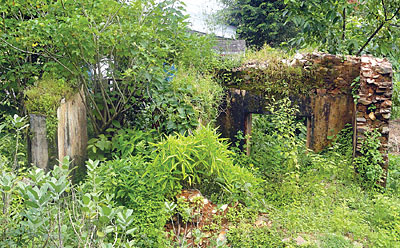
The photo presented with this article is very impressive.It;s a Jungle out there,onse sees the walls of what once could have been a house,it is empty,no people in it or around it,old and unhealthy tree stumps and uncultured forest is what is left,but the grass is still growing ,it is the new generation of Nepalese still present there,who are lost because of the trust and love any child puts in the parents and does not want to live the land that calls them Nepali sons and daughters.
Mr.Dixit's way of talking to all of us is,do it now,do not wait for someone to help you lead your life,take action now ,which doesn't mean all the means of using your strength and power are good enough,but do not wait for people like maoists or any other politician to tell you what is right,acceptable to you.Every human being knows what is good and what is bad,everyone,do your best with means acceptable and respectable to the individual,it is a society with myriad of cultures and all the above comments it is you and me ,even if you did not do anything ,you were still a by stander ,get involved ,do it now.