
 |
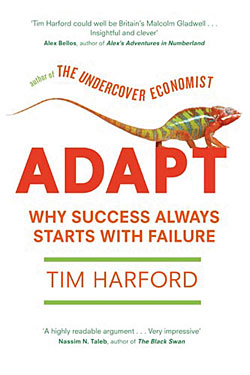
Success always starts with failure. This is both a subtitle and the premise of Tim Harford's enjoyably readable latest book Adapt. But what kind of failure is helpful for success?
Harford starts out by pointing out how complex and fluidly changing the world around us is. He uses the bread toaster as an example. If you were to start making a toaster from scratch today, at your own house, the task would be next to impossible.
The workmanship, the logistics and the materials needed for a toaster are all so maddeningly complex -- and the knowledge about what makes a toaster a toaster is dispersed among so many different people -- that is impossible for any one person to actually build it.
If the simple task of understanding how a toaster is made is so complex, what makes us think that, with a few degrees and few experiences, we can really understand the world at large? On the other hand, if the world is so complex, how are we to come up with successful products and services? Harford offers three interlocking views.
Expertise is overrated: The flip side of this view is 'Consult experts, but think for yourself'. Experts are best understood as people who have better maps of a particular territory. But having such maps is no substitute for actually walking up and down the changing territory.
Experts routinely underestimate how complex the world is for them to understand, and overestimate the explanatory powers of their own maps and mental models. Schooling, after all, is only one among many small ways to understand how the world works. When experts were tracked for the accuracy of their predictions, it was found that they were only marginally better than amateurs. Better, then, it is to think for oneself, and learn from mistakes.
Try new small things, and survive failures: When no one knows for sure what works and what doesn't, it pays to try new things, but in small doses. Trying out new things will invite failures, to be sure. But those failures, Harford notes, tend to be survivable failures, which help make the final product better. In other words, do not try new big things, only to fall flat on your face, but try new small things, which you can gradually improve to make it a success.