
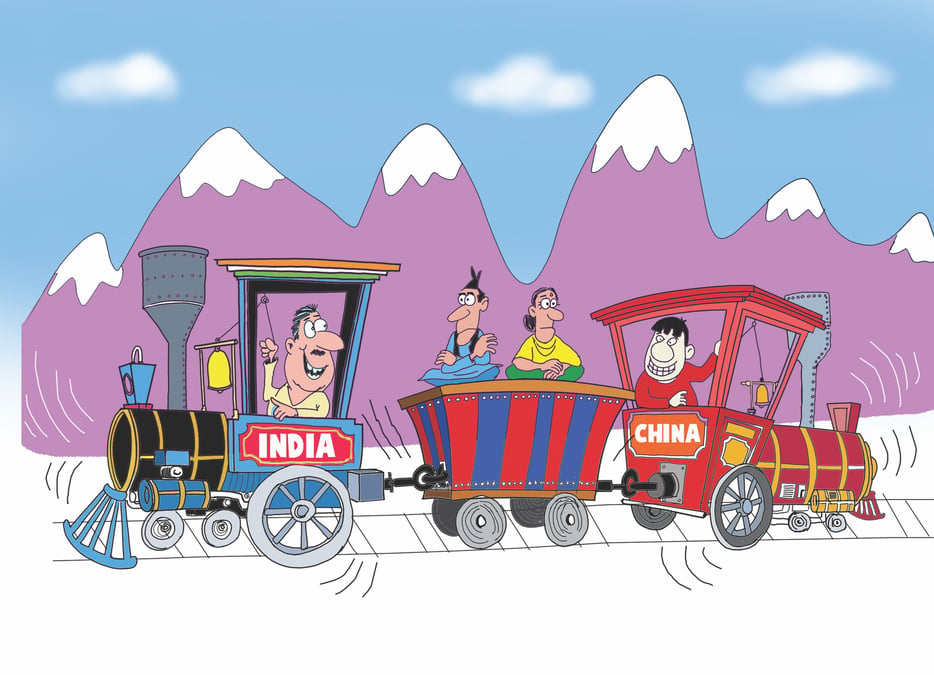
Prime Minister K P Oli returned from his China visit in December with the freshly re-inked Belt and Road Initiative Framework Cooperation Agreement.
Ten infrastructure projects proposed by Nepal were approved by China as part of the BRI deal which will fund projects through ‘aid-assistance’, a wordage used to get around political sensitivity about more loans from China.
One of them is the ambititious Kerung-Kathmandu Railway, with financing, geotechnical and geopolitical challenges. Nepal sought better connectivity with China after the 2015 earthquake-blockade crisis as a way to counterbalance India’s dominance.
China was looking to expand its sphere of influence in South Asia, and got Nepal to already sign the BRI framework in 2017 which included extending its Trans-Himalayan Multi-Dimensional Connectivity Network to Kathmandu.
Not to be outdone, India signed a MoU in 2018 with Nepal to survey the proposed Raxaul-Kathmandu railway, followed by another agreement in 2021 to prepare a Detailed Project Report. Konkan Railway Corporation handed over its Final Location Survey (FLS) to the Nepal government in 2023.
“We have added our comments and feedback to the draft after review and sent it to India, but haven’t got back the final report,” says Kamal Kumar Shah of Nepal’s Department of Railways. The 141km long broad gauge railway will reportedly include 42km of tunnels, 124 bridges, and 13 stations, and will cost more than $3 billion.
More expensive and difficult will be the trans-Himalayan railway that is an extension of China’s Lhasa-Xigatse line. A Chinese pre-feasibility proposed tunnels between Kerung to Kathmandu below Langtang National Park. The tunnel will have to spiral to offset the gradient drop from 4,000m on the Tibetan Plateau to 1,400m in Kathmandu. More than 98% of the 73km standard gauge railway will burrow under the Himalaya, costing $5.5 billion.
A feasibility study of the Kerung-Kathmandu railway by Chinese consultants is underway, and is expected to be completed by June 2026. The team is drilling into the mountains for the geotechnical investigation.
The northern rail alignment is expected to face delays because of land compensation and environmental concerns.
For China, the trans-Himalayan railway has strategic connectivity value that goes beyond Nepal to facilitate a future non-maritime trade route with India. China is India’s biggest trade partner and its ocean route could be affected by tension in South China Sea.