
The challenge in examining inequality among countries is relativity. The United States ranks higher than India for income equality, but each country determines its own standard on poverty.
‘In India, the term middle class is elastic,’ writes journalist and historian Dilip Hiro in Indians in a Globalizing World: Their Skewed Rise. ‘Whereas a middle-class household in the West has a mortgage on the house, owns a car, and enjoys an annual vacation of a few weeks, the one in India manages a balanced diet daily, sends children to school, and can afford to buy a colour television.’
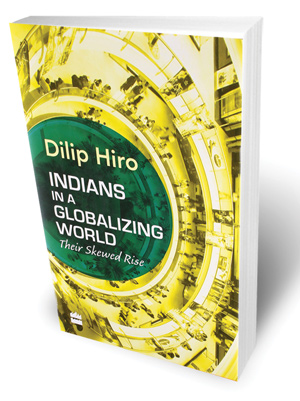
Indians in a Globalizing World - Their Skewed Rise HarperCollins India, 2015
by Dilip Hiro
344 pages,
Hardcover
Rs 1,000
India’s richest 10 per cent own about three quarters of the nation’s wealth, and Hiro relays personal tales of fortune and woe that offer insights into reams of complex data on inequality and India’s rapid development as an emerging economy. Hiro’s book, a good reminder of the complex realities for Indian policymakers, is a must-read for employees of multinational corporations striving to do business in the country.
With the normal challenges in the developing world, let alone the lingering notions of caste, India is not an equal society. The rags-to-riches stories, the surge of ideas in the workplace or coffee shops, exhilarate and inspire, each peppered with details on deliberate plotting, hard work and clever persistence in the competition to develop one’s self and business. The tragic tales are frustrating because stagnation and failure are not so mysterious with entrenched poverty, corruption, nepotism, inability to control natural resources and exploitation. The greedy and ambitious find ways to subvert government’s egalitarian intentions.
For Indians, the correlation between income and education is highly visible. Even in the slums, upward mobility, though slight, is possible. Hiro’s descriptions are blunt assessments. Education offers the most reliable path to comfort and affluence, and the theme is woven throughout the chapters. Agriculture is the leading source of jobs in India, employing two out of three Indians, but uneven education opportunities in the rural areas contribute to exploitive loans and support for subsidies, reducing India’s competitiveness in global markets.