
|
|
In recent months many leaders of education in Nepal and elsewhere have been attracted by the rhetoric about One Laptop Per Child (OLPC).
While computers in schools are a good idea, an over $100 million project to give each Nepali child a laptop is not.
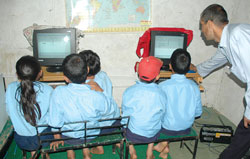
There are advantages to having computers in schools. FIT Nepal has recently installed telecentres in government schools; ENRD has done so in Kaski; Madan Puraskar Pustakalaya's Bhasha Sanchar project has installed four-computer networks that work in Nepali in two schools. These enable teachers to prepare teaching materials, and children to use educational programs and become familiar with computers.
With internet connections, these computers could be used for management, interacting with computers in local District Education Offices and ultimately with the Ministry of Education and Sports (MoES). Two locally developed proprietary schools management systems were demonstrated at CAN Softech in May. An open source system is being localised to the Nepali language and education context.
An installation of four computers with a high-powered 'server' and cheap recycled 'thin clients' costs Rs 120,000 ($1,700). With transport, installation, and training, the final cost is around Rs 200,000 ($2,800). Equipping Nepal's 26,277 schools (MoES. 2004) with this very simple network would cost $74 million, not including installation and training. Schools also need internet access and a reasonably reliable electricity supply. This infrastructure has not been costed in, since it is necessary for any computer use in education.
A great potential use of computers, the internet, and a schools network is to disseminate the best teaching practices in inclusive education in Nepal. This is where one laptop per teacher comes in. The OLPC is too small for adults. It aspires to be the $100 laptop, but in reality costs $150-$200. Fortunately other companies have announced competing full-sized offerings-Taiwan's AsusTek has announced a $200 full-sized laptop and Intel has a similarly priced community PC.
With a laptop each, teachers can take distance education courses, share practices, and develop educational materials. To equip each teacher with a laptop and a computer lab in each school would cost around $100 million.
OLPC groups sell their proposal partly on price (though it costs twice the claimed $100), its robust technology, and its claimed educational advantage. Now OLPC was conceived by Nicholas Negroponte while he was director of MIT's Media Lab. In 1995 Negroponte wrote Being Digital, which describes a world that has become real for many rich northerners, in line with MIT Media Lab's mission. His enthusiasm for computer-based education, based upon the advocacy of Seymour Papert, is embodied in OLPC.
But Negroponte's expertise is questionable, particularly on big and expensive projects. In the 1990s he sold the Media Lab to the governments of India and Ireland. In exchange for substantial payments for using the 'Media Lab' brand, and for advice and help in setting them up, Media Lab Asia was established in Mumbai and Media Lab Europe was established in Dublin. But just a few years later, the collaborations had failed and both governments lost a lot of money-the Irish figure is reported as $40 million. This negative experience should make us cautious about acting purely on Negroponte's assurances.