
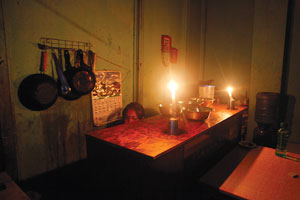
 BIKRAM RAI DARK YEAR: How can Nepal's economy grow in the dark? |
Politics cost the economy dearly in 2012, and 2013 looks like it will be no better unless we put our house in order.
Although some important policy changes were made in 2012 to promote investment, we will not see results unless the overall political climate improves. Bilateral investment promotion agreements were sealed, significant government institutions like the Board of Investment were established, government institutions were streamlined and revamped, and administrative capacity of the government departments improved in 2012.
But in 2013, Nepal plunges headlong into another crisis that threatens to turn us into an international financial pariah. We narrowly escaped being blacklisted by the FAFT (Financial Action Task Force, a global anti-money laundering body) by endorsing two bills on Anti-Money Laundering (Mutual Legal Assistance and Extradition Treaty) through ordinances in June. The third bill on Anti-Organised Crime Act was not passed because of political pressure. This landed us on FAFT's 'grey list', and it will all come to another review in January.
The endorsement of bills on anti-terrorism and organised crime, amendments to the act on anti-money laundering and automation of the Financial Information Unit (FIU) at the Nepal Rastra Bank to ensure transparency and exchange of information will pose the biggest challenge in 2013. Failure to pass these bills will put our international trade and reputation at risk and Nepalis living abroad will be under stricter surveillance and scrutiny.
Investments are going to be critical in 2013, and Nepal should continue its reform agenda in order to maintain its current levels of FDI and also to better position itself for the future. To sustain reforms, managerial level skills and experience and the administrative capacity of the government needs to be continuously built upon and improved.