
 |
Panchakanya's first significant industrial venture was in 1971, when it introduced modern rice mills to Jhapa. Chairman Prem Bahadur Shrestha and family made the move to take advantage of Nepal's status, at the time, as a net rice exporter. The family owned property in Jhapa, where land was particularly fertile.
 AHMAD ISKANDAR |
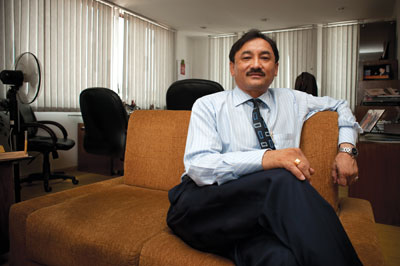
"Our family is from that part of the country, so it made sense to start there. It was very much a local-based operation," says Managing Director Pradeep Kumar Shrestha (pic). The company was named after Panchakanya Temple in Ilam, which is devoted to the five major goddesses of Hindu tradition.
The agro-business proved lucrative, and enabled the group to diversify its trade. It entered the timber industry in the mid-70s, building six saw mills in eastern Nepal. But when the government instituted an anti-deforestation policy, the company found itself in an awkward position. "We had to do something new, but our experience at the time was mainly in timber and local raw materials industry. We thought that we should enter a related sector, so chose construction," explains Shrestha.
That sparked a phase of vigorous industrialisation. In 1981 the company established Panchakanya Iron Industries, later rechristened Panchakanya Steel, which pioneered the manufacture of earthquake resistant TMT Reinforcement Steel Bars. It based its steel operations in the west in order to help develop that historically poor region. It began manufacturing PVC and PPR pipes to replace steel and cast iron pipes that left a potentially toxic residue in the water supply, and took over Nepal Bitumen and Barrel Udyog Limited, the only industry in the country to produce bitumen.
And there's more. Today, the Panchakanya Group manages ten companies and trading houses, which deal in products as diverse as plastic, wires and hydroelectricity, and has investments in the financial and utility sectors, to name a few.
The journey hasn't been free of challenges. In the early 1970s, there were very few Nepali industrialists, so many didn't think Panchakanya would get very far. Shrestha recalls: "People would say, 'Can Nepalis really run a factory?'". Additionally, the company was up against much more experienced competition, which began a price war in order to throttle the fledgling company. It was then that Panchakanya decided to prioritise quality, even if that meant charging more.
The market response was not satisfactory at first, but improved when Panchakanya Iron Industries became the first industry to win the NS Quality Award in 1998. "Today, we can proudly say that Panchakanya products demand a market premium," says Shrestha.
Panchakanya Group also sets aside a portion of its profits every year for social causes. It has invested in national level research, campaigns to clean up and improve traffic in major cities, skills development for blue-collar workers, and has sponsored, among others, schools, temples and hospitals nationwide.
In the future, the Group plans to remain committed to the core values of integrity and honesty that have brought it so far, and use that as a platform to help build society. "We're a mature company now. It's time we thought in a big way," says Shrestha.