Ram Jan 14, 2011
Isn't it ironoic that these so called Student Neta like Himal Sharma are 40 plus and has his kids studying in China, turn around and tell us that we need to close private schools. Do we not have a right to choose where we want our kids to study or do we need to be dictated by these idiotic people. If these people have the guts they should come out of the so called Student Leader Tag and enter the world or real politics. One should leave Politics out of the educational system.
jange Jan 14, 2011
You are being unfair to the Maoists. We all applauded the Maoists when they murdered, looted and extorted in order to get a new constitution, remove the monarchy etc. Yet when they continue to use violence to make further revolutionary gains for Nepalis you have the unmitigated gall to complain!!
Ingrate.
who cares Jan 14, 2011
why not make govt. pay the fee for private education?
free ma khana palke ko bahun haru... this is the nature of bahuns, they want everything for free.
where there is food bahuns are good, no food no good.
equality= burnt plant= burnt animals= ashes.
Arthur Jan 14, 2011
One would think that with the benefit of an expensive private education, a writer could come up with some plausible argument in favour of private education.
Instead we get an illogical rant, simply pretending that the opponents of private education are opposed to education.
Obviously the argument is about whether better off people should help pay for poor people to go to school through taxes to fund a public education system to the same level for all or whether the poor should only get less education and children of better off parents get the education their parents can afford.
By pretending the argument is about whether there should be education or not, the writer shows that he has nothing relevant to say.
Samjhana Poudyal Jan 14, 2011
I whole heartily agree with Jange. But do not know why 'who cares' is complaining ....I though the Maoists were for fighting for marginalised ethenic groups...not bahuns (althought a few senior the leaders are); or is it that I am in a difffernet Nepal to where 'who cares' refers to. I guess 'who cares' does not care anyway....just does not like bahuns!
Sorry the reality is you cannot get rid of them...as I recall a survey done a decade or so back by a group called HANDS, came up with the finding that most of the beggers were bahuns !
Bikash Jan 15, 2011
ok i'm not a bahun but isn't there supposed to be a moderator whose job is to omit comments like the one above.
Simple Man Jan 15, 2011
Just a logical reponse:
School takes money from kids, then pay teachers.
Maoists want to take less money from kids, and pay more money to teachers.
Question of the day :- Where else do you get the money to pay the teachers? Government? What government? Nepalese government? Really? Seriously? And from what I learned at school, money doesn't grow on trees.
So if maoist's dream came true, the school won't have any money to pay the teachers. So it shuts down. No more school for children (yipeee), No more jobs for teachers (uh oh)....
End of Discussion.
Merlin Jan 15, 2011
Arthur, you are for the Maoists. The writer makes his opposition to Maoist tactics clear. Obviously, the best way to neutralize the writer's point is to say that "he has nothing relevant to say". This dismiss-your-critic tactics comes from Section 3 Clause 5 Page 22 Para 5 of standard Maoist playbook on how make propaganda that washes brains. In the meantime, schools continue to shut down.
Arthur Jan 16, 2011
Simple Man #7, logically it is also necessary to have a functioning government that can pay for teachers and schools. Accepting that Nepal cannot achieve that means accepting that Nepalis will remain uneducated and Nepal will never develop. Those who do "accept" that are the small minority of better off people who loot the aid that should be used for development including education. Naturally they still want to send their own children to school in preparation for sending them to more developed countries. They just don't care about educating the majority.
Merlin #8, if the writer had something relevant to say he would not have pretended that opponents of private schools are opposed to education. Then I could have replied to whatever he did say (and you could have said that my reply was just Maoist brain washing because you, like the author have nothing relevant to say).
You should know that aid to Nepal's schools was suspended by the donors because the Minister was looting the funds by requiring teachers to pay him bribes for appointments. As long as the "elite" can send their children to private schools they will continue to just loot the government schools and prevent the large majority from getting a decent education.
Merlin Jan 17, 2011
Arthur, however you slice and dice it, shutting down private schools is tantamount to being opposed to education. Maoists shut down such schools regularly. Maoists are therefore against education. Elites everywhere have long been sending children to private schools. What's so surprising about that? What is remarkable is, as the writer says, so-called anti-elite Maoist bigwigs also prefer to send their children to such expensive schools. This is indeed surprising. Talking about education and talking about corruption in education can start without having to shut down schools. The writer does not talk about the corrupt education minister in the article. You do. This is your attempt to divert the comment thread, while beating the drum that the writer has nothing relevant to say. You can still talk about the corrupt minister without having to shut down schools. By your comments, you play the classic Maoist propaganda play-book.
Arthur Jan 17, 2011
Merlin #10, "Elites everywhere have long been sending children to private schools. What's so surprising about that?"
Not surprising at all. Nor is it surprising that poor people everywhere have fought against elites everywhere.
Nor is it surprising that the majority were able to establish the principle of free and compulsory primary and secondary education in all developed countries.
This was conceded by the elites in developed countries because they needed a more educated working class and to avoid being overthrown by a brutalized and uneducated majority.
They still have their own private schools for the elite, but they also have free and compulsory education for all.
Nepal's elite is too stupid to understand the need for free and compulsory education for all.
If they were also as stupid as you and the author seem to think, then they might also believe that no more private schools means no more education for their children, just as you say.
But in reality it means they will have to help provide education for all children, including their own. They end up having to accept the need to educate all children in order to educate their own.
"...so-called anti-elite Maoist bigwigs also prefer to send their children to such expensive schools. This is indeed surprising..."
It is not so surprising, but it is certainly something the Maoist party has to end. Both you and the author seem to be in agreement with me and with the Maoist teachers and students organizations on that point at least.
I said:
As long as the "elite" can send their children to private schools they will continue to just loot the government schools and prevent the large majority from getting a decent education.
That is a direct and simple explanation of why it is necessary to shut down some schools in order to force the elite to allow decent education for all.
A consequence is that there are no strong movements for shutting down private schools in developed countries where there is also free and compulsory primary and secondary education.
So if you want to keep your elite private schools there is a simple path open to you - ensure free and compulsory education for all. That will weaken the movement against private schools.
Instead all you can do is denounce "Maoist brainwashing".
If you were able to reply you would reply. Instead you just say that is my "attempt to divert the comment thread" and Maoist propaganda.
rishav Jan 17, 2011
Reply#11
Arthie, you are really one deluded, messed up western commie wannabe.
Your preconcieved ideas of what private schools are like in Nepal, are completely messed up. I guess your using an undertsanding of what private schools are like in your western country as a bench marker and trying stupidly apply that model to Nepal.
If you were to ever live in Nepal, you will see endless children from all walks of life dressed in the school uniforms emmacutaley going to school everyday. Education has been something at least the prior Governments have always empasized on, hence the widespread of teachers across the country and unfortunately have been major victims to the Maoist atrocities during the insurgency. It still not perfect but that has alot to do with the disruption due to the Maoist insurgency in the last 10 years or so.
Most so called elites as you would call them Arthie, including your dear Maoist leaders won't even send their children to the private schools in Nepal, they send them abroad, to darjeeling, other parts of India, even the Philipines. You know why, because of all the disruptions due to political bandhas, made popular by the idealistic, arrogant Maoists and their supporters.
If you were to have looked closer at these private schools you would have realised various schools have different fees regarding the financial background of the parents. Unfortunately, if the Maoist continue their pressurisation of the top private schools in Nepal, the parents will simply send their children abroad for education, and guess who misses out the Nepali economy and education system.
Arthur Jan 18, 2011
rishav #12, although you have the usual pointless insults, you also said:
"Unfortunately, if the Maoist continue their pressurisation of the top private schools in Nepal, the parents will simply send their children abroad for education, and guess who misses out the Nepali economy and education system."
That is a noticeable improvement on both the article and the comments by Merlin. It offers an actual argument in opposition to the Maoist policy instead of simply pretending that opposing private education is opposing education.
My answer to your argument is that it is true, but only for a small proportion of those who can afford the much more expensive costs of education abroad. Some wealthy parents will simply send their children abroad for education. This is will be a loss to both the Nepali economy and education system, although there will also be some benefits from the connections with other countries both from those who return after education and those send remittances and maintain connections with family in Nepal that assist with international trade etc.
However for most people who are forced to pay for priate schools to provide some reasonable level of education for their children they will not be able to afford to pay even more to send their children abroad, so they will have to join the rest of Nepalis in working to raise standards of the government schools so that they are acceptable for all.
Instead of just saying "ke garne" when they see looting of education funds (eg to provide the money the richer elite need to send their children abroad) they will end up understanding that they have to end the looting and stand together with the poor people whose children will attend the same schools.
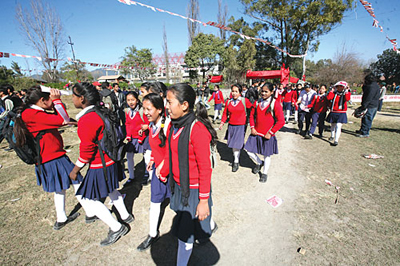
Perhaps they will not actually be smart enough to join in the bandas they hate so much (although it is obvious from the photo accompanying the article that some of their children understand where their interests lie).
But they would have to be really exceptionally stupid not to grasp the need to support decent education for all, once they find they cannot afford to just provide decent education for their own children, but can only obtain this by joining together with others.
Parag Jan 18, 2011
This is an ongoing tactic of the Maoist hoodlums. In the name of promoting "education for all" they shut down private schools where their murderous leaders send their kids--this is nothing but a ploy to extract money from these schools. How many times have they done this before only for the schools to reopen after some behind the scenes negotiations and cash transactions? The thieves are becoming greedier by the day and want more money from these schools--plain and simple. There is no other motive behind closing these schools but to collect more and more money.
By the way, the so-called well wishers and keepers of the proletariat not only send their priviledged, elite kids to private (read elite) schools, but they themselves gallivant around getting best medical treatment and "preventive" care from private hospitals in Thailand, Singapore and elsewhere, all funded by their armies of murderous monkeys running amok collecting protection taxes from the private schools, among others.
Does anyone really believe these goons are for real reforms?
who cares Jan 18, 2011
my request to non nepalese:
do you smell racism in "3"?
some info: bahun is one of the ethnics of nepal, they control around (conservative estimation)- 70% in politics, 80% bureaucracy and total population is around 12%.
ps: NT declined to publish my explanation.
why did NT publish comments like 6 which is anti freedom of speech, which is against constitution. or NT too oppose our constitution?
who cares Jan 18, 2011
ranas prevented nepalese from studying cause they believed that eduction makes people smart. that is why they were able to rule for 100yr.
shahs did similar. they built some inferior schools and college for nepalese while they sent their children to foreign schools and universities or build special schools for their children. and were able to dictate for 150yr.
all maoist is trying to do is copy them. whatever maoist has been doing are all copy of previous evils. but since they are unable to get result, people sidelined them in 9mth.
Bahunbaje Jan 18, 2011
#3 who cares
Are you an aborigine from Nepal,s outback?
Or are youmember of Hitlerite National Socialist Party , a Neo-Nazi spreading anti-semetic tiraDE AGAINST bAHUNS; OTERWISE STOP YOUR MONKEY- BUSSINESS.
KiranL Jan 18, 2011
Many private schools are extorting parents, who are desperate for quality education because cheaper government schools are so bad. The answer is not to close private schools ,but regulate their fees and improve the quality of government schools. Many government schools have shown that you can have a good school without exhorbitant fees. The Maoists are not for free universal education, that is just a slogan for them to extort the private schools. You just have to see how the campaign against private schools always gears up at admission time. Private schools should be less greedy, the government should improve its schools and the Maoists should be lined up in Tundikhel and spanked in their buttocks.
rishav Jan 18, 2011
Reply # 13. Pointless insults hey Arthie, you deserve every insult you get and even more if I were to ever to see your deluded western maoist wannabe back side.
From your response it has become more clearer to me you have no real understanding and using your own messed extreme," the Maoist can't do no wrong," ideology in explaining the education system.
1. As the Maoists are forcefully shuting the private schools down for what ever reason, well then that's an act of violence and intimidation, which is against human rights and also child abuse. Every child has a right to education and development. Do you agree to the threat of violence, whilst you sit comfortably at your laptop at home in your western law abiding democratic nation. In an democracy you do have a choice and their parents have a right to send them to private schools if they want to do so, as do many Maoist leaders who also send their children abroad for education.
2. You presume only rich families send their children to private schools, yet again you will be surprised again of the total mixture of children from all sorts of background attend these schools. Also these schools regularly give scholapships for children living in the remotest of districts to get free private school education in the schools of the capital. You will also be surprised it is just not the elites who send their children to schools in India, and abroad but many other families as well, quite a significant number due to the disruptions in education by the Maoists. Also you will be surprised Government schools also charge a fee for education as well which everyone does pay, amount depending on their financial background.
3. The Author also writes about how education is needed to bring about a more educated young society who will question the establishments and take over eventually. A young Balram Bhattari, was brought up in a remote village in Gorkha along side a young Upendra Devkota, both went to local Government schools, both aced their exams, got Government scholarship one went to study Architectural engineering, while the other studied Medicine respectively. This was a time of the old feudal regimes as you would put it Arthie, the argument being Arthie that the Government schools have produced great success stories in the past not just a few but many doctors, engineers, leaders etc etc. Would there be an environment for a future Balram Bhattari, Upendra Devkota, to come from such remote village especially during the Maoist Insurgency over the last 10 years, the answer is a flat NO. I'll tell you why Arthie, people like Upendra devkota and Balram Bhattari would've been forcefully recruited into the PLA as child insurgents, spending the next 10 years of their life wasted in those camps whilst their potential just diminishes.
Speaking to alot of teachers, who are teaching these adults who were recruited as PLA child soldiers now recently discharged, there is alot of frustration and realistaion by these cadres of what a waste of time it was to be a PLA insurgent and how much of their lives have been wasted whilst the Maoist leaders sit high and mighty getting rich through bribes and via corrupt means.
You mentioned a quote Arthie, "ke garne." I see you must reading a lonely planet guide book to Nepal, as your reference and understanding to Nepali society. I'm afraid such lack of depth of reading of our society and having the arrogrance to write such rubbish, really requires someone to knock some sense into you matey!
Reply #14, say's exactly why these Maoist thugs are trying to close these schools down.
Do not use you western model of private vs public school argument which is going on in your developed western nation and apply that to Nepal. A little more depth and understanding of the ground realities is needed hey Arthie old boy!
bedanand Jan 19, 2011
15. who cares
my request to non nepalese:
do you smell racism in "3"?
Why are you so concerned about what Non-Nepalis think?
Are you hoping that your spewing out venom against other Nepali citizens and groups will elevate your stature in their eyes?
It seems what the non-nepalis (Europeans,Indians,INGOs,missionaries etc)think is more important to you than what Nepalis themselves think.
who cares Jan 19, 2011
17. Bahunbaje, those who are in power, position should stop their monkey business, not me.
those who are destroying nepal, society are note evil to you but the person protesting is bad one?
20. bedanand,,,,,, i want to know the answer from foreigners cause, in nepal we do not even have word for "racism", even when we have around 100 different language. its imported.
in the past, ranas, shahs used to punish people for criticising/exposing them in the name of nationalism. today, different people in power- politics, media are doing same in the name of racism.
racism i heard about US, Germany look totally different, and i do not understand how i have become racist.
and what do you say about those bahun ethnic politicians and some columnists who write/say/criticize about their own race just to get support, donation?????????????????? and remember, they are no different from those whom they have been criticizing, insulting.
PEACE, but wont be tolerated.
Arthur Jan 19, 2011
rishav #19, the "ground realities" are that you can spew as much hatred as you like, the majority of Nepalese are determined to establish a system of free and compulsory primary education in Nepal and no amount of shouting against the Maoists will prevent it.
I have replied to your only attempt at rational argument. You have not replied to that but simply returned to the usual incoherent rage.
Battisputali Jan 19, 2011
Maoists are 'former' insurgents after all. Shutting down schools is a way of creating insecurity. If you are in government, your job is to decrease insecurity. If you are not in government, your job is to increase insecurity and use it for your own ends. Maoists had success with this tactics in the past, so why would they not use it now? If your grand strategy or �mahan tactics� as Prachanda calls it is to capture state power (through revolution), your short-term tactics will be to create pockets of insecurity (like shut down schools). So, your task will be to create audacious schemes of insecurity one after the other. One result of this will be, like here in the board, people will voice their opinions of how Maoists are ignorant you know whats. Sooner or later, they will start saying that the government are ignorant you know whats and rise up against them or even start supporting the Maoists. This might sound illogical by many but in the realm of strategy, it is pure logic. Our own country has shown how insecurity can promote revolution. What else were 1990 and 2006?
There is also a moral argument made by many here on the board. Keeping education from kids is immoral. Lenin�s view was a little different. Maoists keep to Lenin�s dictum that morality itself is a bourgeoisie device and everything that promotes revolution is moral. So, shutting down schools is moral because it promotes revolution.
rishav Jan 20, 2011
Reply #22
Hang on a minute. This artcile and debate has been about the forced closures by the Maoists of private schools, by the threat of violence and potential nasty repercusions if the schools were to remain open.
And as per usual as you can't face the defeat in your argument and you divulge into something else inorder to try and make people not aware of your defeciencies and failures. I have explained to you in detail of what is happening in Nepal and explaining to you why your hypotheitical , "the Maoist can't do no wrong ideology," in explaing what is happening and what will happen is wrong. You obviously can't deal with it, so then you should really just shut up and walk away.
You mention a free and compulsory primary school education for all, I think every Nepali person believes in that, but the way you have written implying we don't, silly Arthie, and besides the topic of discussion was about the forced closures of the private schools in Nepal, So making that clear to you, as my reply #19, which were the "ground realities," faced by us Nepali's you have yet again been unable to deal with such situations and the experiences we face.
The reason why I bother to reply to your rubbish Arthie is this. I will explain, if you were a Nepali and you had these views I wouldn't be too bothered in dealing with you, as I realised the lack of exposure or certain indoctrination and false hope could explain such extremist thoughts. But you Arthie, live I presume in an English speaking western nation. Which most likely has freedom of speech, governance of law, low corruption, democratic political set up and highly developed infrastructres. So you do have a taste of the good life and most likely something you take for granted. The fact that you support such a group like the Maoists, with their warped ideology, the use of violence, threats and child guerilla fighters during the insurgency say's alot about you as an individual.
Another reason, why I bother to quell any rubbish you write is to show us Nepali readers the mentality and views certain westerners have about Nepal. It seem that you are doing some sort of research in the south asia, and possibly media in Nepal as well. It gives me great concern that people of your extreme ideology are the ones who attend these courses and later probably get recruited by INGO's, the UN, etc because no one really has a great interest in Nepal in your countries and therefore people like you, as so called experts in Nepal, get jobs quite easily. Scary really with your warped ideology and own messed up agendas.
The Maoist insurgency, has been very bloody, affecting virtually every family in Nepal in a really bad way, either with a loss of a family member/s, or experiences of torture, forced recruitments, violence, extortion and intimidation. It has been a dark cloud over us for many years now, we are trying to deal with it the best way we can. The wound is still fresh in our hearts stirring up emotions and grief at the same time. Your comments, especially who you are and where you most likely come from, really has become extremely insensitive and annoying, it's like your trying to add more salt and rub into our already wide gaping wounds. Is this some game to you, which your getting some kick out of this inorder to wine us Nepali people up, who are hopefully trying to come out of an insurgency. If that is so, you really do need some help.
My advice to you Arthie if you do ever come to Nepal, keep your crazy looney left views to yourself, we Nepalese have a reputation you know, unless you do want your neck to experience a Khukuri.
Arthur Jan 20, 2011
Battisputali #23, people have been saying the government are "ignorant you know whats" for a long time. It seems to be one point of unanimous agreement among commentators here.
So your theory that Maoists create insecurity by closing schools to achieve this result is as illogical as it sounds.
Your reference to Lenin is wrong too.
The real situation is that for exploiting class morality everything is moral and "secure" when the majority have to live on less than $2 per day and cannot send their children to school. But ending the privileges of the minority means revolution and so is not just "insecurity" but "violence" and an affront to basic morality.
Naturally people who do not benefit from this situation have opposite views as to what is moral, logical and educational and so regard revolution as a moral necessity for basic security.
Battisputali Jan 20, 2011
'your theory...is as illogical as it sounds.Your reference to Lenin is wrong too.'
Such subtle trolling You my friend have perfected the art.
I infer that your alternative explanation to "closing schools" will be that the Maoists seek to create of a just and equal society in which the poor get the same level of dignity that the rich get. But, many of the children of the same majority go to the very schools that are being forced to shut down. So, dignity is being lost when
What the Maoist aim to do is commendable but they are going too far with their tactics.
Battisputali Jan 20, 2011
Give me a better explanation as to why schools are threatened or shut down when as many commentators have pointed out here, kids from the "majority" go to the very schools that are threated.
You my friend are admirable in your call for radical justness and equality. But please don't be blind to the injustices that can be created by taking good intentions too far.
Unlike you in .4, i think the writer makes perfect sense,
"Next time Maoist organisations call for a shutdown of private schools, let us tell them: sure, there are aspects of private schools that could be better. But to close them down or harass them is to be against democracy"
battisputali Jan 20, 2011
please disregard 26.
Arthur Jan 20, 2011
Battisputali #26 and 27,
My understanding is that the Maoist policy is for no additional private schools rather than for closing existing schools.
There may well be injustices in the course of any campaign. By all means oppose the injustices and any tendency to "go too far".
But the essential point of the article is to defend the existing system in which people who can afford to send their children to private schools do not need to worry about ensuring decent education for the majority.
The fact that some poor people get scholarships to expensive private schools is certainly positive for those students. Likewise the fact that tobacco companies sponsor sporting activities is positive for those sporting activities. But the reality is that this is done to preserve a system in which the large majority get no decent education at all.
Concern should be focussed on that central issue.
rishav Jan 21, 2011
Reply #29
"My understanding is that the Maoist policy is for no additional private schools rather than for closing existing schools."
Hahaha! Is that really their policy?! As the Author and many Nepali commentators have mentioned the Maoist leaders and cadres are attempting to forcefully close down private schools, ignorant crusaders, the whole point of this artcile and discussion.
"There may well be injustices in the course of any campaign. By all means oppose the injustices and any tendency to "go too far"."
So you do recognise injustices carried out by the Maoists, well that's a start, but then you kinda accept the violence as being part of the campaign plan. So really do the ends justify the means, hey Arthie?
"But the essential point of the article is to defend the existing system in which people who can afford to send their children to private schools do not need to worry about ensuring decent education for the majority."
Hello Arthie, I really don't know what artcile you read? Is English really your first language, or perhaps your English dictionary is a chairman Mao sponsored one. The main point of this article was the idiocracy in thinking that forcefully closing down private schools as a way of "democratising," education. As with many readers here, the issue is not about closing private schools, which do a service in reducing the burden on the over sized Government school classes and poor resources but perhaps on ways in improving the standards in public schools similar to prior to the insurgency and then better afterwards hopefully.
We do agree that alot needs to be done to improve the public school sector, as they have taken a hammering during the insurgency, but as quite rightly pointed out by me there was a time in our not too decent history when we produced many professionals(Balram Bhattari, Upendra Devkota) from these Government schools. So they really can't be that bad then, oh! But that was the feudal era hey Arthie. The current situation in the government schools is majorly due to the insurgency over the last 10 years, where the Government teachers particularly in remote areas felt the raft of the Maoist atrocities and also the lack of funds to the education sector which was diverted in dealing with the Maoist guerilla force.
A solution Arthie, there are things called TAXES(hooray) which the Government collects and is a major way in which all parents, who either send their children to private or public schools, can contirbute if wealthy enough to the public education sector. So there's your answer Arthie, more financial investment through taxes inorder to focus on public school education. Forcibly closing down private schools is not an exercise in "democracy."
"The fact that some poor people get scholarships to expensive private schools is certainly positive for those students. Likewise the fact that tobacco companies sponsor sporting activities is positive for those sporting activities. But the reality is that this is done to preserve a system in which the large majority get no decent education at all."
I see your trying to quote me Arthie, about the scholarships, you seem to be learning and picking up things from us Nepali Gurus. However, comparing how sports activites are sponsored by tobacco companies and the giving of scholarships by private schools is really a weird analysis. As mentioned and clearly debated the existence of Private schools are not detrimental but in fact helps take the burden off an already overcrowdered, poorly financed Government public school education system. As already mentioned alot of poor families have been even able to send their children to private schools but at least are able to get an education either public or private rather than no education at all, as seen in many parts of the world.
Concern should be focussed on that central issue.
Yes it should be, and that is in providing education for all, were teachers are not intimidated, able to teach freely, have the right support and not overburdened with classroom sizes inorder to give to the children, the most important people, the best possible education either pirvately or publically.
You really don't understand things in Nepal Arthie. I really don't like the way you come accross, thinking your some sort of foreign Nepali analyst/ Nepali times monitor, trying to tell us Nepalis' wants going on in our own country, with your Maoist supporting views. The cheek! The manner in which you reply to many of the other Nepali commentators, is dammn right insulting and you think your witty or smart. If you continue to comment as you are, I will not hold back in continuing to exposure your ignorance and arrogance.
After all the Nepali people, are my people Arthie and issues relating to Nepal are my problem not yours so a kind request just BUT OUT. And if some foreigner who is acting over smart in trying to ridicule my people's veiws and experiences, I will not hesistate to act and respond.
Arthur Jan 22, 2011
Rishav #29, please continue your sneering lectures about how well you understand Nepal.
Since you are Nepali and I am not, I am hopeful that you will eventually shed light on something I don't understand.
Meanwhile the blustering tone and the sheer inability to argue coherently is very helpful in understanding why people like you have lost so much influence over the ordinary people.
K. K. Sharma Jan 22, 2011
This anti-private school rhetoric is just boring.
Those who want quality education had, have and will keep, sending their children to foreign countries mostly to India. So it really does not matter whether private schools are closed or not.
Improving the quality of government schools, depends on the quality of those involved in this sector. If they have no capacity well, bad luck.
As for the comical tactic of using the word "democracy" to counter the communists, shows total ignorance of this writer in that Communists are communists precisely because they are not democrats. So communists will really never fall for the rhetoric or rationale of democracy. Communists do not need free thinking individuals, they need ignorant individuals to be kept in communes as one would keep sheep in a pen. That is why the communists are doing what they are doing.
K. K. Sharma Jan 22, 2011
And as addition.
Like the doctors and businessment, the private schools are also rich sources for getting extortion money. One cannot extort without threats. And extortion has been the way of life for the Maoists and now imitating the Maoists for other groups also. It is not closing the private schools as much as threatining them to extort money.
rishav Jan 22, 2011
Reply #31
I have obviously successfully countered any rubbish comments which you produce. Leaving you in a state of frustration and realisation of how inadequate your understanding of Nepali affairs are. I'm sure, I have also highlighted to you how stupid your actions are in trying to impart your theoretical Maoist predictions, with very little background knowledge on us Nepali's, and then left frustrated when we explain our understanding and experinences ,which are obviously valid being Nepali, contradicting all your false preconcieved ideas.
My blustering tone , thank you for the compliment , as I have demonstrated true Gorkhali spirit. in defeating dodgy foreigners like you and the same spirit which created my nation Nepal.
Oh! I definately have shed alot of light on issues you obviously have no clue about, e.g. your shock or lack realisation that alot of school children go abroad to study. Come on, that's basic alot Nepali people are aware of that but silly outsiders like you, who obvioulsy have no clue and feel fit to spew out rubbish against our understanding of the education system in our country.
If i am so incoherent, and not understood then why do you feel the need to respond, and try to sideline valid points which obviously either goes over your head, or you just realise you don't know enough or have the adequate experience inorder to argue against me.
As I said again, it's my country not your's so BUT OUT, pick another country which has a problem with a rise in communism because your time in trying to comment and understand on Nepali issues has failed.
Finally you don't know me and the rubbish you have said about me having "lost so much influence over the ordinary people," what bollocks is that. You are living in the cookooo clouds boy! That must be your Maoist textbook rubbish comming out. I'm not a politician , so I have never had any influence in the first place but to say my views are not shared with the majority of Nepali's would be very naive and stupid indeed.
krishna Jan 23, 2011
It is hard fact that quality of public managed shools drop to minimum, root reason is nepali politics and curruption in employing the teachers. private school should come in interation and coperate to improve the quality by teachers exchange program for short period.
FunkyBuddha Jan 23, 2011
The shameless defenders of the animalistic tactics used by 'Maoists' induce nausea. If these neanderthals were really that concerned about public schools, why didn't they propose any substantial policies when they were in power? Why don't they lead by example by making every single member of the party put their kids in public schools? Amidst all the political gloom in the country, the only refuge for the most children are schools and the 'maoists' threaten that solace too.
Vija Srestha Jan 29, 2011
I think it is important for everyone to understand therefore I am posting my thoughts under this discussion as well.
First of all,all government or private run schools must be separated from the politics of any kind and most importanly it is not the teachers job,there is administration,parents and teachers executive commitees who bring forward needs ,interests and problems of the schools,who interact with other schools in the community ,bring forward decisons made in classroom communities ,in school community.In the end of the day we need to consider needs of the children,schools are for the children eventhough the property may belong to somebody else.
I do agree that there is a huge discrepancy between private and government schools as there is a huge discrepancy between private and private schools.
I like to mention just few observed differences.
First of all physical structure of the buildings.Having beautiful ,huge buildings is not the reflection of quality education children should be receiving.Education must be child centred.Many big reputated schools have nursery groups and children as young as 3 are sitting a whole day in the environment that is nothing to do with what the child requires and can do ,must do at this age.I do understand that parents of such children need to go to work and maybe it is the only way for them to teach their child,most of the parents of such children are looking up to teachers and have kept faith of their child's education in their hands,however I would like to add that schools which are having such small children need to re-think their curriculums and build age appropriate education ,with wide range of themes and variation of mediums to work in .
Most so called well of schools have lots of books in the libraries,big classrooms with computers ,however methods of teaching specially at the primary level need to be improvized according to the age and interests of children.Such schools neeed to think about Multiple Intelligences of a child and give as much support and encouragement as possible,which is totally out of curriculums of most such private schools and it totally doesn't exist in government run schools.Government schools that are supported by a few very good private schools in Kathmandu and other parts of the country ,are the best examples of human individual responsibility towards the society as the citizens,but how much can we lay on such people's shoulders.
Ministry of Education must invite leaders of such schools to work in the Minuistry of Education,and my personal view is, fire all the staff who till now have been sitting in the Ministry and have not done even simple thing,have not worked out the simplest curriculums for kindergartens and primary level children.It is absurd!!!!!!!!!!!!!!!!!!!!!
Most importantly ,include in constitution the right to education for children of all walks and give free education to all the children who require such help.People need to learn to help themselves,just by asking free education without acknowledging importance of self is not going to help the child succeed because education is not just about letters and numbers.Nothing in life comes free is a reality ,you can not have food on the table without putting an effort or any empty promise is not what is life about .
I will argue with any one and everyone who wants to deny or lessen the importance of private schools or government schools.
We need to be proud of and praise all those schools ,their leaders and children for their existence in the society.All private schools are the perfect example of how the school leaders perceive ,have understood and implemented their methods to give the children education they need,eventhough there is a lot of improvement to be done,but shutting them down is like putting blindhold on every ones eyes and telling ,now you walk and find the way out.
I totally agree that each child has a right to good education and I totally support every private school which charges higher fees than usual and I will tell you why,however I as a parent or invester want to know where the high fees charged are used for.
Parents ,teachers and school leaders of such schools have taken charge of something what government has not done till now.They have understood that by giving little something into the big pot ,is helping many more children in the community.The work done by such schools is just praise worthy.
Together everyone achieves more, but not by looting together or killing together,by treatening together,it is by thinking and working together.
However the government again is not doing its job.Proper tax system would be able to support all government schools even without the help of foreign assistance.We need to choose the priorities and invest appropriately.Eventhough there exists some kind of tax,it is way off the reallity.One more important issue,every parent ,rich or poor must pay tax and be involved according to what one owns,land,property ,income tax,health insurence accordingly ,but not the way it is till now. Do you really think that school itself would be able to sustain,support other community schools in the community around if there was no help from all those parents whose children attend such schools.
I hope that wisdom will prevail and understood and most importantly government leaders in Ministry of Education will be replaced with practitioners who have proved how it is possible ,with teachers who have wide range of knowledge and most importantly experience in teaching .Most importanly,listen to children ,they will teach you what they need to learn and let's not forget,children learn what they live.