Danny Birch Mar 19, 2011
The decision to remove the monarch's picture from money is another proof that the politicians have no knowledge of the history of the Shah dynasty's role in the existence of Nepal nor any respect for Nepal as an independent, unified multi-ethnic nation. Any Nepali with a primary school education should know that without the unifying force of the Shah kings, Nepal would not exist today. It would most likely have become a part of British India. Within a few years of the deposing of the Shah dynasty Nepal has been fragmented into regional, tribal and linguistic factions. This has resulted in a steady slide towards total chaos. The politicians play on such sentiments and make the various clans, and castes pawns in their own power game. Instead of a garden of castes and tribes living in peace and harmony as promoted by the Shahs, Nepal is in danger of becoming a tangle of weeds where each group tries to dominate and take advantage of each other. That is what the present political parties promote. Jai Nepal!
Slarti Mar 19, 2011
Danny, one thing I have realised is that I and anybody else should no longer talk about the king or the monarchy.
While we may feel bitter about it, the fact is that the King left several years ago and has been pushed to irrelevance.
The King appears to be doing well for himself. If we talk about the Monarchy that leads all sorts of people to become extremely abusive. I simply don't think it is fair for the last of them to do any worse.
That period is now gone for good and forever. We are better off dealing with our current realities as calmly as possible.
I understand the desire to set the narrative right, but I assure you we are in such a knot that people like us have to live with the victors narrative.
Thats just life.
NYIMA LAMA Mar 19, 2011
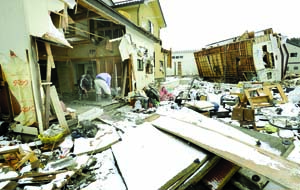
Oh god please give some sense to our political leaders to think about what would happen to Nepal if something like Japan happens.
who cares Mar 19, 2011
two out dated clowns on the above.
after british left their colonies, there began terrorism, famine etc etc.(in the past there was no such thing like famine in the news paper)
so bring british back.
Slarti Mar 19, 2011
Danny, if you care for such things, you know what kind of future is staring at us when you see a positively deranged, clueless, twits as above making vehement comments without a clue to its validity.
The comment is made simply because he knows some buzzwords and copies other people's ideas, like democracy and free market that better people have defended better and with a lot more calm reason, and because he has no sense of proportion.
Still the great value he adds is to insult other people and strengthen their commitment to fight on regardless.
To compare the Nepalese Monarchy with British colonialism takes a seriously dysfunctional brain.
This is the reason why I have admit that the Kings were the lowest life forms and the most meaningless creatures that the world ever saw, and now have now decided to move on to better things.
Slarti Mar 19, 2011
Anybody who has any love for Nepal and any pride in being one must make sure that no matter what happens, people that #4 represents do not have control of our fates. Everyone must express their opinion very strongly in the most public and safest forum available here. Just sitting at home and complaining bitterly won't help. If you do that, you can keep doing it eternally at home for all your lives.
Slarti Mar 19, 2011
"Instead, the government appears to be focused on implementing measures that attract a lot of attention but mostly inconvenience the public that does live here."
Its not just that, the entire basis of governance and politics is the irrelevant. Politicians, instead of focusing on finding real solutions to real problem are instead engaged in a war of silly rhetoric.
It is incredible how they go on making the most pointless comments about the most senseless things and journalists let them get away with it because it allows them, in turn, to just fill space with nice sounding rhetoric as well.
who cares Mar 19, 2011
every nepalese should be aware of the lies, those lie, in between the bitter truth being vomited by the individuals like 6.
world knows that every sector in nepal is politicized- students are not just students, bureaucrats are not just bureaucrats.... but this person blasted from the past clams as if everything is wrong today and only mandale time was good times.
as if we dont know the facts- the job of bureaucrats during mandalas was to serve shahs "we love our king more than our life", those bureaucrats used to be kings outside the palace. we still remember how they used to treat common nepalese who visited their cabinets.
fellow nepalese, hitler would not had been anything more than that tiny dog had not he got support of millions, puspa would have been nothing more than a guinea pig with out the support of tens of thousands of criminals.
similarly, without the support of likes of "6", gyn bahadur would not had been able to threat nepalese- remember that coup video.
so, our real bigger enemy is likes of "6" who has been the source of power behind tyrants, not the real tyrant.
manohar budhathoki Mar 20, 2011
I agree with Slarti. The present system is dysfunctional and our society is not on the mend. My spirit died the day murderers and extortionists were made ministers and prime minister. What kind of society awards people with blood on their hands, with no regard for their crimes and no concern for the people who were at the receiving end of their violence? Our country is "sati le srapeko" and i see no healing in our lifetime sadly.
The criminals run the streets and the country and the good people of Nepal (and i know there are many) stay silent or leave the country.....
jange Mar 20, 2011
The banknote fiasco is just a mild symptom of things that are rapidly going wrong with Nepal.
With the CA having lost all credibility as well as legitimacy it will now be a free for all and the bureaucracy will do as they please since there will be no legitimate political authority over them.
For a legislative assembly to prolong its life is a fundamentally anti democratic act. With all the billions spent on political advice and advice to write a constitution it is vary sad that no one noticed this little anomaly.
Wait until the CA extends its life for another year. It will get far worse. And when it extends its life for another year after that then it will get really really interesting.
Slarti Mar 20, 2011
"every nepalese should be aware of the lies, those lie, in between the bitter truth being vomited by the individuals like 6."
In No. 15, I ridiculed those who opposed elections, and I did the same thing in every other comment. Mine are smarter and well reasoned.
Read them and the the hunderd's of others that I have written and try and first understand what is important.
3. Slarti
Tell me now, why did you not utilise your energy in advocating for an election at the earliest possible time?
I assure you, that is the only course of action available which would ever get out of this rut. Have periodic elections and wait for the time when the right set of people would do the right thing.
I will explain why I say that.
If we were growing at 6% in 1996, which I think we were, the size of Nepal's economy would have been double in 2008 to what it was in 96. There is compounding for you.
The prevalence of peace and timely elections would also ensure the occurrence of another miracle. Despite repeated annoyance from the contemporary political leadership, timely elections would have ensured that people would sort their priorities and would have voted in the right set of characters, largely.
Another factor would have been to change the quality of the economy. If India and China can evolve into sophisticated economies over a 12 year period, then Nepal was small enough to see an acceleration in the pace of expansion as well as a transformation in the nature of economic activities.
What I do agree with you on is the advocacy of taking students out of politics, at least till the graduate level.
4. Slarti
#2, what an online identity!!
Anyway, Nepali society is one of the few in the world which actually knows how to govern itself. It is in this society's genome. We understand that the current fraudulent set-up is a sham and a sideshow. We know that it will collapse under its own weight of extraordinary folly and colossal stupidity. We will not react, we will simply move on to better times.
You have said nothing, but have given every reason to everybody that democracy would not work, if its hopeless, pointless people like your good selves are in control, or give directions too.
Go, burn some tires.
Soni Mar 20, 2011
Your view on women:
Singing of sorrow, Indu Nepal
so you want to blame everything on others...dont forget, this is not america where term feminists sells. so people are going to respond to your nonsense.
the biggest enemy of female are females. females pull legs, they destroy your life, they will connect you with the wrong male. do you know what is the biggest reason behind your misery?
the combination of your dumbness and indian movies. for eg- in indian movie, the rapist personality character for everyone is presented as hero for heroin and in real life, the followers go on to believe in the boy/man with similar personality, behavior but the ending will be different than in those movies....... and then come individuals like you, who go around blaming everyone but self.
one obvious, simple, clear example is the wife of shovraj.
if you look clearly, you will see mainly three types of pro females in nepal:
1: politicians in speech- for vote.
2: articles- to sell paper.
3: ngo- to milk donors.
many do act as if they agree with them, but it wont follow with action. why? the reason is simple, cause they all have suffered from female one war or other.
one can get lots of benefit from female, it is really easy to fool females, may be you have seen on street with addict boy with good looking, smart girl,,,,,,,,,,,, ,, but if you start to respect, care her, she will make you pay.
its like, you use her or you will be destroyed by her. if one gets only two options, definitely, male will choose the first one.
who cares Mar 20, 2011
12. soni.
(tell me if i misjudged your intention.)
what i meant to say in that comment was:
i wanted females to understand their surrounding,
i wanted females to have a life, relation... they deserve,
i wanted females to protect themselves from vultures,
i wanted females to overcome their weakness,
...
just like i said there, seems like you are angry with me for my honesty... may be, just like i said there, you must prefer some male who says: i would do any thing for you, you are the most beautiful woman in the entire world, i cant live without you...
..........
dont get me wrong, i just wanted to open your(females') eyes.
you have a lovely name, hope you too are lovely.
Soni Mar 21, 2011
One of the best ways to sabotage an idea and its credibility is to let fools defend it.
By having people like who cares defend democracy while at the same time bad mouthing everybody else and using derogatory terms for everyone, on as broadly read publication as Nepalitimes, erodes the very basis of intelligent thinking and prevents others from defending decency and everything that is important at this critical juncture of Nepal's history. People start to lose hope and the psyche of ke garne dominates.
People like him do not have an impact, they are mere irritants, but by being irritants they prevent people from having their say because people get convinced that if they express their views it will be held in the same view as that of an abusive individual.
This is also true for the media as a whole. In their effort to sound progressive and democratic and what not, they have thrown reason and evidence to the wind and instead have allowed mere assertion to act as a defence for the very existence of Nepal.
It is understandable though, with mere assertions such as "there will be a constitution", "won't be a constitution", "first peace process then constitution", "we are united and back stabbing each other for fun" and all of that politicians have depended on their assertions to maintain a hold on power.
Media, manned by politicians appointees appears to be just following their masters call.
I have sympathy for the editor when he says:
"Alas, the media itself, obsessed as it is with the twists and turns of Nepali politics, only rouses itself to indulge in sensationalism that sells. Reduced to covering Khagendra Thapa Magar's public appearances, the media hit the jackpot in its coverage of the events in Japan. And in this respect, it followed the lead of media outlets across the world."
Soni Mar 21, 2011
Some of the comments that I read on Nepalitimes and elsewhere are so full of hate that I sometimes wonder if I don't hate enough. I am really trying to come to terms with the enormity of the situation here.
I read Capt. Vijay Lama's article in conjunction with what Prashant has written about businesses being in cahoots with politicians (or the other way around). I am reading that NAC being directly and deliberately damaged, I read today that entire VDC staff in Sunsari resigned and recall having read about many who had resigned earlier (so far no news on their return) and I am also reading that the politicians are saying exactly the same thing that they have been saying for the last five years.
I am reading the same articles that I have been reading all along, I could give you samples but that would unnecessarily take up space. And you know perfectly well what I am talking about.
Given all of this and more, what exactly are Nepal's options?
It's clear that this state of affairs cannot continue, and while I refuse to believe that Nepal's politicians are so cynical that they don't want to do anything for the country, I simply do not even remotely see any light at the end of the tunnel.
What I would have hoped Nepalitimes and its columnists could do for us is explain to us in real terms, and plain and simple language (no more comprador's and cahone's please, I am nearly illiterate and while others understand these terms I have to keep a dictionary open to read your stuff) what exactly are the options that we have, given the facts of Nepal's national life.
I think I have a few questions that I would like to know more about.
Q. As of today, we have about 65 more days to go before the CA's extended term ends, if the parties think that a constitution is going to be on time then they should be able to, by now, share a preliminary copy with us. Why are they not able to do that, and if it is because the constitution will be written by that date then do they just plan to say, here it is lets move on?
Q. It has taken parties three years of painstaking negotiations to reach an agreement over each point, there are still some major outstanding issues, the Maoists have been making concessions while continuing to strongly suggest that they are not happy with all this. Given this, what is the guarantee that there will not another revolution or strong demand for a new constitution to finish "the unfinished business"?
Q. Why is it that news media with as strong a reach as Nepalitimes does not talk about the daily experience of tremendous insecurity building up throughout the country?
Q. If the same set of people, and their underlings and sidekicks, who we saw at the helm of affairs for over twenty years, are going to remain in control, what probability would Nepalitimes attach to chances of positive change in this country's governance?
Q. Why does no one at Nepalitimes stick their necks out and talk about actual options available to us, in terms of here are corrupt leaders and here is what can actually be done to ensure that they follow the right track for the countries development and establishment of real peace?
Here is the thing, I am positively tired and extremely embarrassed of writing comments on your paper and I get this feeling that I am a fool for doing that (which I probably am, in all sincerity).
I want to be able to stop doing that and I can stop only when you start talking real sense. I will stop when your editorials sound like conveying the strength of concern that millions of people in Nepal have, but cannot articulate as well as you.
I am sorry to say this but can you bring back Kunda Dixit to write his publishers notes because he really is a good writer and is capable of conveying a clear message. I won't agree with his conclusions but I hope to have something more substantial that this to disagree with.
It really would be fabulous to get a special report on what has happened in Nepal and why, all over again. How on earth did we end up being so hopeless that we have not moved an inch over the past five years, other than in rhetoric which is the same as it was three years ago.
Soni Mar 21, 2011
A very important point that I forgot to mention, as I do not believe that Nepali politicians actually want to sabotage this country or harm it and that somewhere deep inside they really want the good of the country, what prevents them and what has so far prevented them from doing what they are supposed to do?
Are they too dumb to do the right thing, too incompetent, do they not have the intellectual support to help them design right policies, what exactly is missing?
who cares Mar 21, 2011
14,15
so you are expecting respect with that kind of attitude. good luck.
did the person like me put venom into you or it came with your birth?
i wonder if you were talking to the mirror.
first of all, try to understand what others are trying to say before crying out loud.
Arthur Mar 22, 2011
soni #14, my impression is that Nepali Times is not saying anything clearly because it does not know what to say.
The old system simply doesn't work and only the Maoists are capable of actually governing Nepal. Nepali Times cannot say that, so it doesn't know what to say.
Since the articles do not say anything, the comments are filled with empty talk from people like "who cares".
Slarti Mar 24, 2011
To give you a sense of what I am talking about in #15 and 16, look at some of the simple things that this government has done with regards to the power crisis.
They have announced immediate action, not nonsense talk, but real steps to mitigate the crisis over the medium to long-term. You can, of course, debate the specifics but you can't fault the fact that this is a specific program and so any alternatives suggested would also have to be effective and specific, and therefore lead to an improvement.
I like the fact that they have said that they would reduce the amount of wastage, have specific penalty for people who do not pay the bill and have set a realistic target etc.
This really does make one wonder why other politicians also could not do these things. Not specifically in the power sector, I am using that as just an instance, but in everything.
Take another example, the fact that the PM snubbed the Indian ambassador is also encouraging. Not that I liked the specific action, but that because there was a decision, somebody followed up on it. This is what you need to follow up on, this is what needs to be encouraged.
jojo Mar 24, 2011
No king, no politicians, no (new) colonialists will ever save Nepal! Now there is peace, every Nepali has to take his or her own responsability and undertake some action and start to coöperate in small social groups to realise the changes the country needs today. Make life better and ACT ! Believe in the power of the people and of yourself! There is a lot of work to do! Go for it!