
A nationwide public opinion poll has shown that Nepalis are cautiously optimistic about the way things are going, but are divided on whether to keep the monarchy or not.
It was an almost 50-50 tie between those who wanted the monarchy abolished and those who wanted it to stay, but the trend shows clear divides based on gender, location, and education. Younger people and men tend to be republicans, and there are fewer supporters of the monarchy in western Nepal and among the educated.
The poll was conducted between 6 August-6 September among 3,000 respondents above age 18 all over the country by the Kathmandu offices of the US-based National Democratic Institute (NDI) and the market research company AC Nielsen.
The poll shows Nepalis are very sure about some things. For instance, more than 80 percent think the army should be under the command of a democratic, elected government. There is also overwhelming support for the job the seven-party alliance has done so far (91 percent said they approved) and for UN involvement in monitoring the ceasefire. An overwhelming 97 percent of those who'd heard of constituent assembly elections wanted them, perhaps because they think this is the only way to restore peace in the country.
The popularity of various political entities in 'thermometer ratings' showed the seven-party alliance scoring highest with +45, followed by the UML with +13, and the NC with +10 respectively. The Maoists scored -2 and the NC-D -39. This was corroborated with popularity ratings for personalities in which Sher Bahadur Deuba scored -39 with only King Gyanendra more unpopular than him at -59. Pushpa Kamal Dahal and Madhab Nepal tied at -1 and Girija Koirala came out with +4.
More than one-third of those polled hadn't heard of a constituent assembly or knew little about it, and slightly more than half thought the Maoists will not fully disarm. Even so, 56 percent said they would trust the Maoists to allow a multiparty system if they came to power. However, the formulation of the question leaves room to doubt whether this is what the people actually believe or what they hope will happen.
Whereas 89 percent of the people felt the country was going in the wrong direction in June 2004, only 7 percent think so now. And while in October 2004 74 percent thought elections couldn't happen in the next year , only 18 percent think so today.
A striking revelation from the poll is that when asked to name two of their main concerns most respondents said lack of jobs, followed by education and cost of living. Maoist violence came seventh, after health care and above corruption.
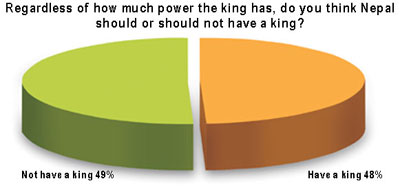
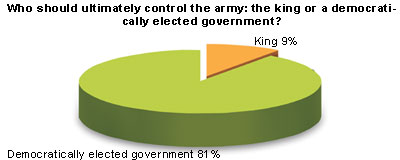
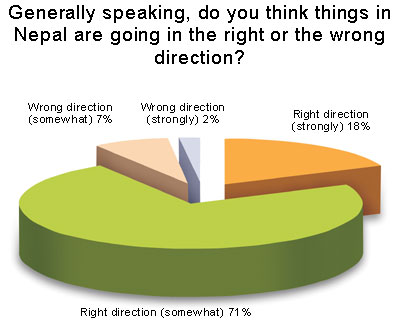
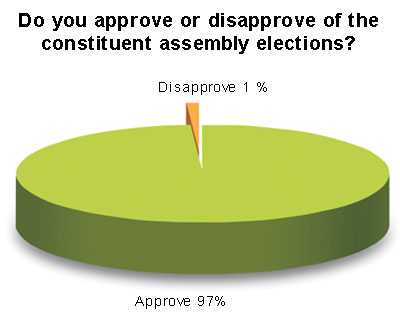
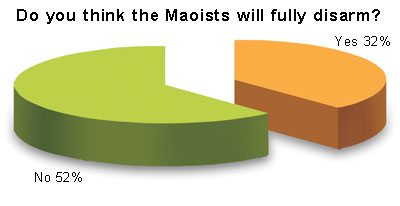
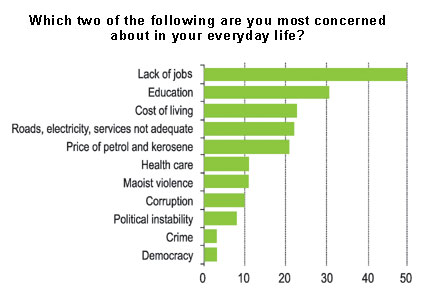
(The pie charts do not include 'Don't know/ Can't say' responses)
Optimism, certainty, and ambivalence
It may be a bit premature to discuss an election to a constituent assembly when 35 percent of the electorate either hasn't heard about it or knows very little about it.
Even so, there are telling political and psephological patterns suggested by the NDI-AC Nielsen poll results released this week. There is cautious optimism about some things, dead certainty about others and ambivalence on the remaining. But that just reflects the contradictions already present among the parties, the Maoists, and the royalists.