
|
|
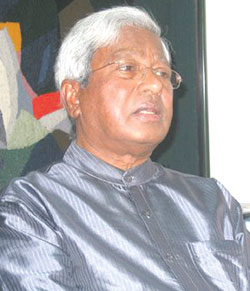
Fazle Hasan Abed is the founder and chairperson of the Bangladesh Rural Advancement Committee (BRAC). He gave up a thriving accounting career to help Bangladesh's independence movement. After the birth of the country in 1971, he started BRAC to help refugees and victims of war integrate into society.
He spoke with columnist Ashutosh Tiwari in Dhaka recently about his work, which has by now grown into a diverse array of social and commercial services to help the poor get out of poverty. With an annual budget of $436 million-three-quarters of which is self-generated, and with a 48,000-strong staff, BRAC is the world's largest NGO with branches in Afghanistan and Africa.
Ashutosh Tiwari: What development changes have you seen in Bangladesh since the first decade of its birth?
Fazle Hasan Abed: Bangladesh has changed dramatically in the last 30 years. Life expectancy at birth used to be 47. Today it is 63. Infant mortality rate was 142, and under-five mortality rate was 252. Today, they are 62 and 174 respectively.
Bangladesh used to produce 15 million tons of paddy for 74 million people on nine million hectares of land. On eight million hectares today, it produces 40 million tons for 143 million people.
Seventy-six percent of the population was under the poverty line in 1976. Today, that is down to 40 per cent, though the number of poor is similar. With poverty declining at 2.2 percent every year, Bangladesh can expect to be a middle-income country in about 20 years.
One of BRAC's early work involved immunising children. How did that come about?
I was struck that New York City in 1903 and Bangladesh in the late 1970s had the same infant mortality rate. From 1903 to 1925, New York's infant mortality declined fast. They started supplying chlorinated piped water to households. They rebuilt their sanitation systems. They introduced universal primary education. They spread knowledge about the nutritional value of food through mass media. They immunised everyone. On learning this, I decided to start a children's immunisation programs in Bangladesh. Immunisation was the most cost-effective public health intervention my small NGO could handle at the time. Besides, it was 1979, which the UN had declared the Year of the Child.
Persuading the government to help you must have been easy, since your work would reach out to millions.
Not quite. To reduce the rate of infant mortality, I needed to purchase vaccines from abroad. I needed fridges in villages to store the vaccines, but most rural regions were not electrified. I needed all the health workers in the country mobilised to administer the vaccine. But the government said, "We have waited thousands of years for vaccination. Why don't we wait for five more years when all the villages will have electricity? Meanwhile, you can do something else." So, we visited households door-to-door-13 million of them!- to teach village women how to make oral rehydration fluids by themselves with salt, sugar, and water in the right ratios. This bit of simple knowledge had the potential to save lives every year.
How did BRAC become the world's largest NGO?
The oral rehydration intervention was BRAC's first national program. Encouraged by its success, I convinced UNICEF to supply vaccines to start a national immunisation program. BRAC took charge of mobilising health workers and immunising half the country's children, while the government took responsibility for the other half. In four years, millions of children were vaccinated against childhood diseases. BRAC's nationwide success with immunisation programs gave us tremendous self-confidence. We then thought: why not also take agricultural, educational, healthcare- and livestock-related services to the poor? That is how BRAC grew. In the late 1980s, we had about 5,000 staff. By the late '90s, that number was 20,000. Now we have about 48,000 full-time staff in Bangladesh, and that number excludes the staff of the 60,000 one-teacher schools that we run.
What are one-teacher schools?
Of the 19 million Bangladeshi children, 16 million are enrolled in schools. Of the remaining 3 million, BRAC has taken in about 1.6 million as students at its one-teacher schools. The model is that we have one teacher for about thirty children of different ages and skills. This arrangement seems to work well for children who, for various reasons, are not enrolled at formal schools. A variation of this model also seems to work well in isolated communities where there are a handful of children, not enough to open an entire school. In desert communities in Rajasthan, India, I saw that they gathered children of various ages at once, and gave them three years' worth of literacy skills in one year. There are isolated communities in Nepal too. Using this model in those communities could be a way Nepal could work toward meetings its Millennium Development Goals.
BRAC is known for bundling microfinance services for the poor with market access. How does this approach work?
Microfinance is BRAC's largest program. This year, we have given out $900 million to 6 million borrowers, most of whom are women. Next year, we expect to give out more than a billion dollars as loans. Our borrowers meet our staff every week to pay their instalments. What we have done is connect our loans to income-generating activities. For instance, a borrower may buy a cow that gives her two litres of milk a day. She may sell that milk to her neighbour at 7 taka per litre. But I know I can sell that milk at higher prices in urban areas. BRAC collects milk from her at 18 taka, pasteurises and packages it, and sells it in Dhaka at 30 taka per litre. Both the borrower and BRAC make money providing a product to the market.