
|
|
It has been 30 years since Melamchi was identified as a potential source of additional water for Kathmandu Valley. The project has since been scaled back, delayed and is now stuck.
By the time it is completed, if ever, Kathmandu will probably need more water than it is designed for. Some experts are therefore proposing an even more ambitious Melamchi project that will add hydropower and irrigation component.
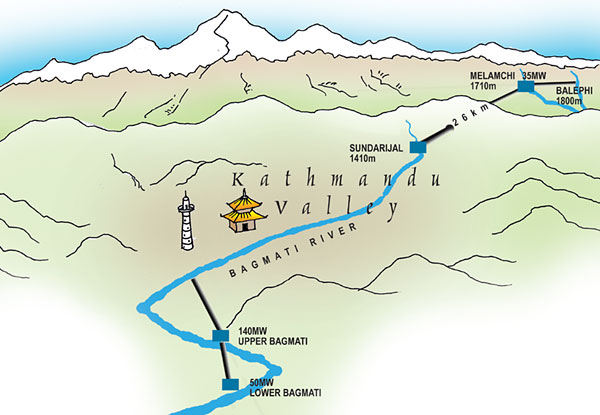
As it stands today, Melamchi will bring pure Himalayan glacial melt through a 26km tunnel to Sundarijal on the outskirts of Kathmandu. The lead agency pushing this $500 million project is the Manila-based Asian Development Bank (ADB) and its board meets to discuss Melamchi in late January.
Experts say the present Melamchi will not meet future water demands of the Valley. The project should add an irrigation component so that the tarai can also benefit, and hydropower generation to not just meet Nepal's energy needs but also offset the cost by bringing in private investment.
"There is so much investment in Melamchi, it is imperative that the project be made sustainable and viable so that areas other than Kathmandu can also benefit," says Padam Sunder Joshi of the NGO Forum for Urban Water and Sanitation.
The new proposal calls for collecting water also from the Balephi River in Sindhupalchok, a larger diameter tunnel to Sundarijal so that the water can also used to generate electricity in a cascade.
The tunnel is currently designed to bring water from Melamchi, Yangri and Larke rivers. Demand estimates show that water from these rivers will meet the needs of Kathmandu only till 2022.
"By the time the project is ready, there will be water scarcity once again," argues economist Ratna Sansar Shrestha, "if Balephi is added, the project can meet Kathmandu's demand beyond 2050."
One of the main arguments against Melamchi in its present form is that it only benefits the capital. The expanded Melamchi, however, can generate up to 225 megawatts of power and provide irrigation to more than 30,000 hectares downstream. "Melamchi would therefore no longer just be a water supply project, but a water resource management scheme with benefits beyond Kathmandu to the tarai," says Bhushan Tuladhar of the Environment and Public Health Organisation (ENPHO).