
|
|
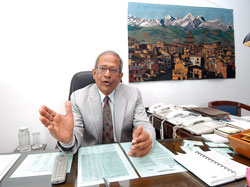
During this time he witnessed king Gyanendra's rule, the emergence of the alliance between the political parties and the Maoists, the April Uprising, the comprehensive peace agreement and the interim government. As he prepares to leave, Mukherjee spoke to Nepali Times.
Nepali Times: Nepal has gone through a lot during your tenure. What are your feelings as you take up your new assignment?
Shiv Shankar Mukherjee: Believe me, Nepal has been easily the most challenging assignment that I have had in my 36 years of service. For me it has been a unique experience to have served here through a period when Nepal has virtually gone through a rebirth. To have a ringside view of history is a very special feeling indeed.
I know there is a long way to go even now before the Nepali people achieve their goal of peace, stability and prosperity, but one thing I am absolutely sure about is that they will get there. As the representative of India, it was my very special privilege to have been involved in providing whatever support Nepal needed from India in this period of transition. And as I prepare to leave, I know that this will continue to be our policy: to provide all the moral, political, diplomatic and material assistance to Nepal that is within our capabilities to assist Nepal's own effects.
What aspect of the political changes are you most satisfied about?
I think the most satisfactory aspect of the political changes that have taken place in Nepal is the fact that they have arisen out of a mass movement, a genuine people's movement that expressed its desire for democracy and for having a say in the way they are ruled. To any observer it was clear that this was a total and genuine expression of people power and was non-violent yet unstoppable. Another thing that is admirable about the changes that have taken place is the adherence of the political parties to constitutional norms, even in this difficult transition period.
And what were the most frustrating?
Well, I really would not characterise developments as being frustrating or otherwise and I am not simply being diplomatic (laughs). What people find frustrating is usually because of impatience, the desire to seek quick results. For instance, people talk about various delays that have taken place in the peace process because of acts of omission and commission by the political parties.
However, as someone who has witnessed similar conflict situations on the ground in other parts of the world, let me tell you that Nepal has brought the peace where it is now in a space of less than two years, including mainstreaming an insurgency, and this is something that I have not seen or heard about in my almost four decades of service. By any yardstick, Nepal's achievement on this score is not just praiseworthy, it is amazing and I mean this most sincerely. I think those who look at this process in Nepal as full of frustration are those who will always find the glass half empty and not half full.
What advice would you give your successor about how to deal with Nepali sensitivities about "big brother" India?
What I would emphasise is that a vast majority of the population of Nepal at every level, does not wake up every morning and start thinking about his or her "sensitivities" about India. They want to get on with life, want improvement in the family's standard of living, better nutrition. There would be occasions, arising out of the mindset of the past, when those who have a vested interest in trying to muddy this relationship will try to do so, but I would also emphasise that their number and effectiveness is negligible and can safely be ignored most of the time.
I would equally emphasise that a stable and prosperous Nepal continues to be something that is a boon for India and that this goal is what both our countries will work for, in partnership. I would tell him about my experiences when I got out of the valley into the other Nepal, neglected in the past, and the genuine desire for cooperation and development that I have personally witnessed in the course of laying foundation stones or inaugurating our developmental projects 100 times over.