
|
|
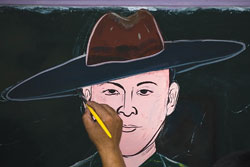
| FACE OF TRADITION: A freshly painted Gurkha portrait on the window of a British Gurkha training centre in Dharan. The Maoist called the employment of Nepalis in foreign armed forces "shameful". |
The Maoist sweep has been not altogether unwelcome here in eastern Nepal, but veterans of the British and Indian armies are worried that the new Maoist government may terminate Gurkha recruitment.
'Shameful activities like the employment of Nepalis in foreign armed services like the British Gurkhas need to be stopped. All Nepalis should take up respectful and useful jobs inside the country itself. Necessary steps will be taken to create the proper environment,' says the Maoist election manifesto which has a Prachanda-for-president photo on the back cover.
The Gurkha Army Ex-Servicemen's Organisation has taken strong issue with this. "If the Maoists stop recruitment, it would be a great loss for the country," says Gajendra Isbo of GAESO. "The Gurkhas do not earn peanuts. The money they send back keeps our economy going."
Remittances have increased in the past few years as the British government raised the salary and pensions of Gurkhas after protests by ex-servicemen. Ex-Gurkhas now also have the option of settling permanently in Britian (see 'Ae Gorkhaliharu', #391).
Much of Dharan's economy survives on remittances that soldiers serving abroad send home. Ex-servicemen form a vital part of the city's society and have strong political clout. After the manifesto came out, influential ex-Gurkhas made a lot of noise, putting pressure on the Maoist-affiliated Limbuwan National Liberation Front, many of whose own members are ex-servicemen.
The agenda is not new. The UML has also been against Gurkha recruitment, but that never stopped Dharan from being a UML stronghold.
The British started recruiting Nepalis into their army in 1815, and Gurkha soldiers fought for them in various insurrections in British India and during both world wars. After India's independence in 1947, under a Tripartite Agreement between India, Nepal and the British government, Nepalis were formally integrated into both the British and the Indian armies.