
 |
As the country lurches from one scandal-of-the-week to the next, there is a sense that this is a government that only reacts to the media. There is always a controversy brewing up in national politics, and reporters feel safe in the knowledge that they don't have to go after the news, the news will come to them.
The politicians have figured this out, and know just how to spin a story so their pronouncements at the Reporters' Club get prominent placement in tomorrow morning's paper or the evening news bulletin. Not happy with that, top politicians are now all regularly writing lengthy opinion pieces in the op-eds: mostly faulting others, but never themselves.
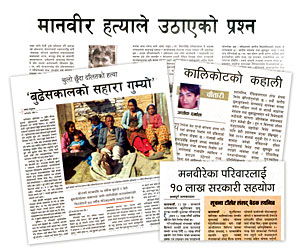
Last month, Dalit lawmakers across party lines obstructed the House over the murder of Manbire Sunar in a remote village of remote Kalikot district. They demanded the government to punish the killers, a Dalit group closed down Dang to demand the dead man be declared a martyr and his family awarded the mandatory Rs 1 million compensation.
The Prime Minister, perhaps the most hapless in history, has been giving in to everyone's demand to save his coalition. He was quick to agree to this one too. Editorials and articles were written shaming the government and 'elite' groups for discrimination. Sunar's case fit nicely with the discourse of continued marginalisation of those at the bottom of the caste ladder. It had all the makings of a good story: a member of a historically ostracized community was 'lynched' in one of the most neglected parts of the country at a time when a new constitution was being drafted to stop precisely this kind of thing from happening. Some went even further to blame the state for deliberately hushing up Sunar's murder because it took place in a Bahun-Chettri dominated area.