
 BIKRAM RAI |
When the peace agreement was signed in November 2006, the parties had agreed to set up a high-level Truth and Reconciliation Commission to probe cases of serious human rights violations during the war that had just ended. The Commission was envisioned as a mechanism to help heal the country and rebuild society.
During the Madhav Nepal-led government two bills were prepared to separately address the cases of disappearances and extra-judicial killings as well as torture. But the bill was never actually tabled in the interim legislature and remained in limbo for the next four years, bypassed by other priorities. Even so, human rights activists kept up the pressure on successive governments. So when the Maoist-Madhesi Cabinet forwarded a unified bill to the president's office last week, one would assume the matter would have been addressed satisfactorily.
But there are serious reasons to doubt the effectiveness of the bill to redress war atrocities. In the last four years, the two bills were never tabled in the interim legislature. It is worth questioning: what prompted the parties to agree on a unified bill and push it through at a time when there is no legislative body to deliberate upon it?
Reshma Thapa of the New York-based International Centre for Transitional Justice (ICTJ) says there were problems with the previous drafts as well, but the combined bill is worse. Gaping holes give the proposed commission power to grant amnesty for all cases, and give the Attorney General's office the final say on which case will be filed in court and which will not.
The Attorney General is a politically-appointed government lawyer and irrespective of the party that comes to power, the decision to take up the case will be a political one. Article 25 of a previously-drafted TRC bill had a specific provision that forbade amnesty in cases of custodial and unarmed killings, rape, torture, and forced disappearances. However, the new draft has conspicuously removed this provision, qualifying even the most gruesome crime for amnesty. The Maoists and the opposition are both guilty in turning this into a toothless document.
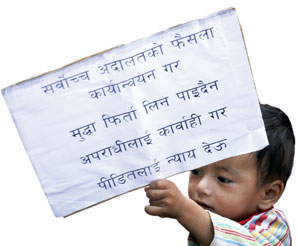
Perpetrators of extra-judicial killings among the Maoists like Bal Krishna Dhungel, Agni Sapkota and Prabhu Sah are not just walking freely, but have become CA members and ministers in government. Similarly, the army has been sheltering the accused like Niranjan Basnet and Boby Khatri despite the Supreme Court's order to present them before the court.