
Former army chief Rookmangud Katawal tells all in soon to be released memoir
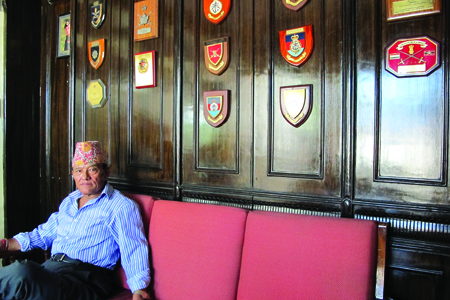 Rookmangud Katawal
A month after King Gyanendra's coup of 1 Februrary 2005, I was summoned to the Royal Nepal Army headquarters at Bhadrakali to meet Lt Gen Rookmangud Katawal. The coup had been meticulously planned, and was accompanied by mass detentions of political leaders and democracy activists. There was an information blackout, and military censors in the newsroom had to approve pages of Nepali Times before it went to press.
Katawal had a vice-like handshake which I thought was a part of his psy-war repertoire. In the hour-long conversation, he wanted to know the reaction to the king’s takeover among members of the international community and the media, and delivered a veiled warning to toe the line.
Nearly ten years later, Katawal still has an iron handshake and the same non-nonsense manner as he greets me in a living room festooned with framed photographs and military honours. His memoir, which will be published by nepa~laya this month, is brisk and brusque, just like the abrasive general himself.
An eight-year-old son of a Newari mother in Okhaldhunga, Rookmangud Katawal always wanted to see what a king looked like. So, when Mahendra was riding across eastern Nepal during one of his inspection visits in 1958, Katawal sneaked into the royal tent. The king, wearing shades even at night, was so impressed with the boy’s confidence that he instructed the Ministry of Education to enroll him in the boarding school in Pharping near Kathmandu. Later, on a visit to the school Mahendra was proud to see that the boy had topped his class even after a double promotion.
Katawal was a good student, and never lost his precociousness. Being a descendant of Dev Raj Katawal, one of Prithvi Narayan Shah’s generals who was killed during the siege of Kathmandu in 1767, he was destined for a military career. He rose up the ranks, and despite strong opposition from the established Rana-Shah brass, became Army Chief during Nepal's dramatic transition from war to peace, from monarchy to republic. Katawal, as it turned out, outlasted the royal rulers who were his benefactors.
Many thought the general’s rapid rise was due to his proximity to the royal family. Katawal says the palace just gave him a scholarship, but admits turning the rumours to his advantage. Katwal was appointed Liaison Officer to the Brigade of Gurkhas base in Hong Kong, where he hosted King Birendra in 1983 after his US state visit when Ronald Reagan endorsed Nepal’s Zone of Peace proposal. Katawal remembers frantically trying to find the king’s preferred brandy, and flying in a live goat from Kathmandu for the royal birthday party.
The 2001 royal massacre was the beginning of the end of the monarchy. Within five months, the army was sucked into the war, something Birendra had tried to prevent when he was alive. Katawal was then heading the Department of Military Intelligence, but says the army was fighting with its hands tied because the palace’s instructions were to not go on the offensive, only to disarm the Maoists and bring them to the negotiating table.
A few days before the 1 February 2005 coup by Gyanendra, Katawal noticed that the top brass was frequently sneaking out to the palace for meetings. “Something was cooking,” Katawal says, and his suspicions were confirmed when he overheard the Army Chief assuring the Indian ambassador on the phone that no coup was planned. The next day at 9AM, the prime minister was sacked, government dissolved and Gyanendra had taken over. Katawal remembers an envoy telling him: “RK, your king is a liar.”
Katawal admits that he initially supported the royal takeover to “teach the politicians a lesson” so the army could focus on defeating the Maoists. But a few days later, when Gyanendra appointed Tulsi Giri and Kirtinidhi Bista as co-chairmen, he felt it wasn’t going to work. Within 14 months, Gyanendra was forced to step down.
In 2009, with just four months left in his tenure as Army Chief, elected Maoist Prime Minister Pushpa Kamal Dahal tried to tempt Katawal to step down in return for being appointed ambassador to the UN or France. When the general refused to take the bait, Dahal sacked him.
The ensuing cascade of events is now called ‘Katawal Prakaran’, and resulted in President Ram Baran Yadav asking the Chief to continue in office, and Dahal’s resignation the next morning. Katawal’s account of 3 May 2009 is as riveting as thriller, detailing how he took two pickup trucks of commandos for his meeting with Dahal in Baluwatar with instructions to storm the building if he didn’t appear every ten minutes at the window.
Back at HQ, the situation was tense with the Maoist-appointed Gen Kul Bahadur Khadka preparing to take over as Chief, and Katawal was still in charge till midnight. Katawal summoned Khadka and didn’t mince words. “You bloody joker, what do you think you are doing?” Katawal says he told his colleague, but what he really said is probably unprintable.
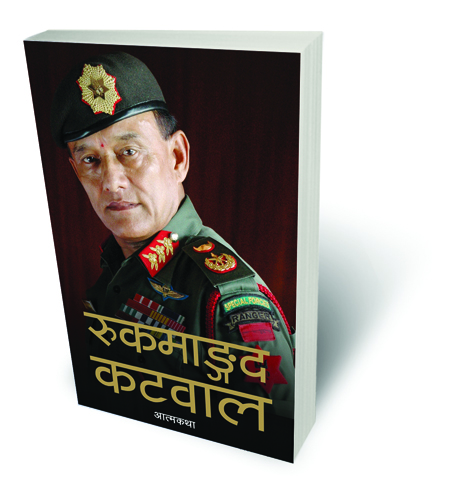 Rookmangud Katawal's memoir
“Prachanda thought he could turn Nepal into a one-party people’s republic, ” Katawal recalls, “he knew if he could take over the army no one could stop him.” Had he accepted Dahal’s bribe of ambassadorship and resigned, or surrendered to Khadka on 3 May, Nepal may have been a different place today – probably a one-party dictatorship.
Katawal doesn’t hide his disdain for Dahal and his manipulations, “Mr Cloud” (Ram Bahadur Thapa) and his hard line, Girija Koirala for being too soft on the Maoists, Ian “Mr Comrade” Martin and UNMIN for being against democracy.
After two recent books by Sudheer Sharma (Prayogshala) and Prashant Jha (Battle for a New Republic) both of which detail the depth of involvement of Indian intelligence in Kathmandu, Katawal’s memoir gives us an insider’s account of the events and personalities that shaped recent Nepali history.
Read also:
Past imperfect, Prashant Jha
Hand-to-hand, Prashant Jha
Start again, Editorial
____________________________________________________________________________________________________
Excerpts
Two translated sections from Rookmangud Katawal’s memoir.
April 2006
“Your king is a liar,” British ambassador Bloomfield told me one day.
I could not accept such things being said about our head of state and supreme commander. I shot back: “How could you ever say that about my king?”
“He is not fit to be king,” the ambassador said even more tersely.
The exchange went on for a while, but I could not convince the ambassador. None of the ambassadors were for an active monarchy, they were not welcome in the palace. But the people surrounding King Gyanendra, and those who were using his power did not warn the King that he was losing international support. At a time when he should be showing some flexibility, the King had become more rigid. I tried to convince the Chief several times to take the message to the King that he should meet the NC and UML, which still had popular support. He did not reply.
--
The 16-day war
Sunday, 3 May 2009
My daughter Nepolina called early in the morning from America. She is even more direct than me, just like her grandfather (my father).
"How are things, Chhori?" I asked.
"Dad, keep on fighting," she said, "you are taking a constitutional stand."
To boost my morale she used to write emails like this: 'You are on the right side of history.'
Her belief was that you can't be afraid to fight if you are a soldier. She continued on the phone: "Dad, if you are convinced you are right, don't surrender."
My daughter-in-law, Sulachana, is engaged on another front: to read emails, reply and document them, and monitor Nepali and international media reaction. My wife, Uma, was in Pokhara. My son Subhangad (Darwin) is a soldier like me, he was in the Panchkhal Base training troops going off for peacekeeping. Like other Majors in the army, he was curious about what was happening. My grandchildren knew what was going on watching tv.
"Prachanda Uncle and Sita Aunty used to come to visit Daddy, they would take me in their laps. Why are you fighting now?" my grand-daughter asked. I didn't bring my work-related matters home, but the children are exposed to tv and newspapers. Others in the household were also updated.
Distracted by them, I was a bit late getting to office. I as there by 8:30. "Sir, the Defence Secretary is on the line," a member of the staff said as soon as I got there.
"Chief, could you come to Baluwatar?" he asked, "the Prime Minister urgently wants to see you."
"And where are you Mr Secretary?" I asked.
"I am also at Baluwatar," he replied. As soon as I hung up, there was another call. A member of the Baluwatar security detail reported: "Kul Bahadur is with the Prime Minister and Defence Minister in Baluwatar."
I understood what was going on because a well-wisher Maoist minister had already told me to expect to be let go. I was on the cusp of my final battle. It was win or lose.
From the car, I first called the President. "I think I am being called to be sacked, there is no way I am going to surrender, Sir."
Then I informed Girija Babu, and while negotiating Kathmandu's traffic, I managed to call all the top leaders of the main parties to tell them what was going on. I also informed my foreign military and non-military friends. My message to all of them was: "The Nepal Army does not surrender, you can do as you wish."
I arrived at the Prime Minister's residence at 10 AM with my security at ready. I had taken Section Plus of the Special Forces with me, and at Baluwatar we had a Company under the command of a Colonel. In case the Maoist tried to detain me, I had a rescue plan in place.
I had told Chhatraman from the car: "I am off to Baluwatar, Kul Bahadur is apparently there, handle the Headquarter, you take the command, but don't make a move unless you hear from me."
Even my ADC is not allowed to enter the Prime Minister's residence, so I left them in the lawn outside, under instruction to enter if they got my order. "Every 10 minutes I will appear where you can see me, if you don't see me inform those outside and storm the building," I told them.
At 10:15, I was taken inside. My old acquaintance, Om Sharma, who was the Prime Minister's press adviser, was there. "Hi, Mr Adviser how goes it?" I asked, "I hear you have called the Cabinet to discuss Kul Bahadur. Why have you called me?"
He ordered some coffee, and said, "Just give me a second."
He tried to distract me: "Chief, I hear you have invested Rs 500 million in Kantipur, is it true?"
"Sure, I have invested some of the money I looted from 65 banks," I retorted, and he was too taken aback to reply. I remembered Prachanda's wife, Sita, once asking my wife, Uma in Sashi Bhavan: "They say you have a house in Noida, is that true?"
Before Uma could respond, I shot back: "Look for it, and if you find it, it's half yours and half mine."
My security informed me that at nearly 11 that Kul Bahadur left the Prime Minister's residence through a side door with an envelope in his hand. I immediately understood that Kul Bahadur had received his Army Chief appointment letter.
"I'm off," I said as I got up to go. Just then, the Defence Minister and Defence Secretary walked in. "One moment," the Defence Secretary said, stopping me.
"What?" I barked.
"You have to receive this letter," he said.
"What letter?" I asked.
"A thank you letter on behalf of the government," he said.
"Am I a peon?" I said stiffly, "did I come here to receive official letters wherever you want?"
"You have the right not to receive the letter," the Defence Minister said, opening his mouth for the first time.
I strode off to my car. Kul Bahadur had left 15-20 minutes earlier, so I told the driver to use the siren and rush back to Headquarters. I was busy on the phone, informing the President, Girija Babu and top political leaders about the Maoist decision. I told them it was an unlawful decision and I was not going to relinquish my position.
"This isn't just a blow to the Nepal Army, it is also a blow to democracy," I said. The President, Girija Babu and others told me to strongly maintain my stand. It was clear that the Maoists had taken a unilateral decision in the council of ministers, and the UML, Sadbhavana, Forum ministers had boycotted the meeting, saying the move was unacceptable.
Kul Bahadur had reached the Headquarter a few minutes before I got there are 11AM, he had showed them his appointment letter, telling the Adjutant General to start the process of installing him as Chief.
But Nepal Bhusan Chand argued: "Whatever the decision Chief Katawal's tenure is till 12 midnight."
All the PSOs were in the meeting room waiting under Chhatraman's command when I got to the office. I made a few important calls, but most of them had already heard that I had been told to step down and Kul Bahadur had been made acting Chief.
I went to the PSO meeting and said that under no circumstances was I going to surrender, I was ready to fight anyone and not going to bow down before a Maoist dictatorship.
"I am not going to accept this unlawful decision that goes against the Constitution and the Peace Agreement which are supposed to be taken only with a consensus," I told the PSOs, "what do you think?"
The PSOs only said "Right Sir, right, Sir." But the meeting's conclusion was that whatever the legality of the government's decision, my tenure extended till midnight."
I asked Kul Bahadur to be called to the meeting, and he came in looking flustered. I immediately pounced on him: "Hey, Comrade, under whose orders did you go to Baluwatar?"
A man who was boasting till a while ago that he was chief looked wilted and scared. He replied: "The Defence Minister summoned me, Sir,"
"Don't you know the army's chain of command, Mister? Who gave you the order to go there?" my voice had got even louder.
"I tried to calling you on your mobile many times," he said, "the Defence Minister called me repeatedly and I thought you had asked for me."
"Liar," I said.
"No sir, no, Sir," he said even more meekly.
"Go, leave immediately, you have nothing to do here," I sent him off, and then told Chhatraman and Gaurav not to let anyone out of the Headquarters without my orders. "Everyone stays here."
The DGMO immediately instructed all units across the country to be on standby. The Valley bases were asked to remain in barracks until further notice.
At 12 noon, the Defence Ministry sent a letter to Headquarters, and I asked a copy be faxed to the President and a letter written to him to say that the decision of the council of ministers was "unconstitutional". Soon after, I got word that the NC's Sher Bahadur Deuba and Sushil Koirala were on their way to see the President. The UML leaders were also on their way to Shital Niwas. There were meetings at various levels in the rooms of the President's office, with civil society, lawyers were all there for the biggest crisis since the President was installed nine months previously. I was getting information from there at regular intervals. The parties were worried that if the Chief kneels, the Maoists will gobble up the country. "Katawal should continue, we shouldn't let the Maoists get away with this," was the common refrain.
I instructed all army formations throughout the country to be on standby and apprised them of the situation. In response, the Maoists threatened to get their fighters out of the cantonments to make Kul Bahadur Army Chief.
Even though the short-term plan of the Maoists was to replace me with Kul Bahadur, their long-term intention was to install their own chief, induct all 19,000 fighters into the army and make one of them the Chief. Kul Bahadur was only a pawn.
There was no way I was going to let that happen. But as the clock ticked away, the country was sinking deeper into a crisis. It was 9:30pm, and still no sign of a letter from the President.
The top generals met in a secret room, and agreed to wait till midnight for the President, if not we were ready to go fight back. We sent this word to the senior leaders around the President.
Meanwhile, some UML leader apparently advised the President to ask both Kul Bahadur and me to step down. The UML was flip-flopping by the hour, it looked like they had no interest in defending democracy. We understood that this was a face-saving proposal for Prachanda. I send word to the President that it was either Kul Bahadur or me, he had to chose one.
Presidential advisers called to say it was difficult to get all the parties to agree, and it was looking like the matter would have to go to the courts. I told him it would best if the President took a decision by midnight. I was livid at the cowardice shown by the parties, and I sent them the final word: "My legitimacy finishes by 12 o'clock at night, we are not going to surrender. No way. I don’t want to do anything unpleasant myself."
Soon after at 11pm, the President himself called. “Do I have to put it in writing?” The President asked. “Can’t I not write it?”
I replied: “If it is not in writing, there will be a question of legitimacy. A letter would resolve the issue.”
By then, KP Oli had got to Shital Niwas despite his health problems, and called to say the President had decided to send the letter and to inform all the generals.
A few minutes later, the fax arrived, giving continuity to my position as Chief of Army Staff. It was a clear and direct letter, just as we wanted. Soon after, my mobile and all the landlines started ringing off the hook.
The needle on my watch was 15 minutes to midnight. I showed the generals the letter, and instructed that all barracks be informed and ordered that all new information should reach me first. The generals heaved sighs of relief and went to their rooms. But I wasn’t sleepy, and went to meet my soldiers outside in the Headquarter compound. Two or three security staff followed me, but I told them to go catch some sleep.
The soldier on sentry duty asked me for my password, which everyone in the compound needs after 10pm.
"Don't you recognise me?" I asked the soldier, but he wouldn't let me go without the password.
It was only after I gave the password that he stood at attention.
"How are you? Sleepy?" I asked "do you know what is happening in the country?"
"Yes, I do, Sir," he replied.
"Tell me," I said.
"We are fighting the Maoists, Sir," he said.
"How do you know?"
"I have FM radio on my mobile, and the commander also briefed us."
I asked him: "So, should I step down?"
"No, Sir, if you order us we are ready to fight." I was proud with his answer.
Just then, the security commander arrived with his unit. He also said: "Your stand is right, Sir, there is no way we should run away from a fight."
I went to another post, then another. I found them more alert and committed than us generals.
At midnight, suddenly I remembered that Uma was on her her way back from Pokhara. I hadn't had time to call her all day. I longed to speak to her.