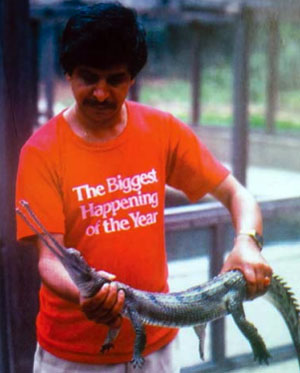
 FIRM GRIP: Hemanta Mishra with a gharial bred in captivity in Chitwan in 1977 before releasing it into the wild.
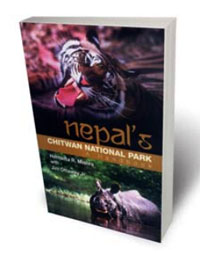
In Hemanta Mishra’s new guide book to Chitwan, there is a striking aerial view of the Inner Tarai valley probably taken from a flight to Meghauli in the 1970s. The tropical jungle and riverine grassland stretch far into the hazy northern horizon. And rising improbably into the sky like a distant cumulus are Himalchuli and Manaslu. This is an image that does justice to Nepal’s topographical and biological diversity – nowhere else on the planet is there such a treasure trove of plant and animal types in such a small area.
Mishra was a young wildlife biologist, straight out of the Indian Forestry Institute in Dehradun, when he was assigned to Chitwan in 1967. Five years later, Nepal’s first national park was set up by royal edict in a valley which had been decimated by trophy hunting and faced the threat of habitat destruction due to the government’s mass transmigration program.
Despite its rich habitat, Chitwan’s charismatic mammals didn’t stand a chance against royal hunting expeditions. In 1850, Jang Bahadur Rana killed 30 tigers in just one hunt. In 1911, Nepal’s royalty hosted King George V in Chitwan and the 600-elephant hunting party massacred 36 tigers, 18 rhinos, leopards, bears and even porcupines in one day. Juddha Shamsher was even worse: between 1933-40, he personally slaughtered 433 tigers.
Hemanta Mishra, in a career spanning three decades, was instrumental in protecting what was left of Chitwan. And in doing so, the park managed to bring back the tiger and rhino from the brink of extinction, and was listed as a World Heritage Site. There are now over 200 tigers, and 500 rhinos in Chitwan alone. As the park got overcrowded, Mishra spearheaded the translocation of tigers and rhinos to other national parks like Bardia. He started the collaboration with the Frankfurt Zoo to set up a breeding centre for the endangered gharial crocodile in 1977.