
Like most visitors to Kathmandu, Norwegian professor Vigo Brunn was fascinated by what the people of Kathmandu take for granted: the use of bricks for building construction in the Valley. Wherever Brunn turned, there were “bricks, bricks and more bricks’: in the houses, walls, palaces, temples, wells and waterways, darbar squares. The professor’s curiosity was piqued when he found out that he couldn’t find any literature on how bricks were made. Thus started a decade long research into brick-making in Kathmandu Valley, and the book, Fired Earth which was released in July by Himal Books.
Those outraged by the daily sight of brick baking: the gouging out of the fertile topsoil of Kathmandu Valley, the black smoke from the kiln chimneys, the horrendous exploitation of bricklayers and their families, child labour, the mistreatment of animals will be disappointed by Brunn’s dispassionate, dry academic style. The book is the result of meticulous research into the brick business. It goes into the technicalities of the various types of kilns from the bull trench to forced draught to the Hoffman chimney. It looks at the socio-economic background of the workers, the management styles of the owners. This is a qualitative study, not a quantitative one, so there are no charts with breakdowns and percentages. Brunn also personalises it with extensive interviews with workers and owners. The result is a book that has just about everything you wanted to know about brick-making but couldn't be bothered. After reading this, you will not look at a brick the same way again.
For example, the bricks of the Changu Narayan temple were baked 2,500 years ago and are probably the earliest fired bricks found in the Valley. Brunn uses Google Earth to take a census of the kilns in the Valleys, and maps 11 of them: 64 in Bhaktapur, 30 in Lalitpur, 20 in Kathmandu. Besides being eyesores, the kilns are also a major emitters of soot particles that have worsened Kathmandu’s winter smog with major impact on the health of the Valley’s 3.5 million inhabitants, and causing major air traffic delays since many of the kilns are located around the airport.
Brunn interview brick kiln worker Nutchemaya Tanabasu, who admits that the harvests fall by 20 percent when the land is let out to a brick kiln because of the loss of fertile silt. But Nutchemaya says that loss is compensated by the rental cash, finding other work during rental period. The author also looks at more advanced and less polluting forms of brick baking and mechanised brick-making like the forced-draught Hable model which was invented in Germany in 1927. But although this kiln is cheaper and more energy efficient, old habits die hard. The biggest problem for brick kiln owners now is to get land, which has become expensive and farmers would rather sell them to real estate agents than rent them for bricks. Kilns are also under pressure from new housing colonies to move out. Kiln owners are therefore moving out to Panchkhal or to the Tarai.
This is the same reason
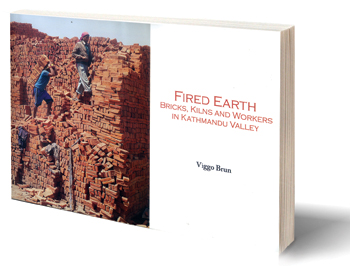
Fired Earth
Bricks, Kilns and Workers in Kathmandu Valley
By Viggo Brunn
Himal Books 2013
Price Rs 1100
102 pages