
The United Arab Emirates (UAE) is the world’s fifth largest exporter of oil, but its rulers have put it firmly on a path towards reducing its own carbon footprint with an aggressive push towards nuclear, wind and solar energy.
On the outskirts of Abu Dhabi, a vast new city has sprung up that will rely almost solely on its 22 hectare solar array for energy, recycle 80% of its water, and have mostly electric mass transit. Masdar City already hosts the headquarters of the International Renewable Energy Agency (IRENA) as well as the regional headquarters for Siemens, and is being put forth as a model of modern urban living.
Last week, the UAE held its annual Abu Dhabi Sustainability Week with a World Future Energy Summit and the UAE Energy Forum. By 2050, the Emirates aims to have one of the lowest domestic carbon footprints in the world, although that will not count its exports of fossil fuels. The country’s oil reserves will last another 93 years at present rates of extraction, unless it declares much of it unburnable to reduce global warming.
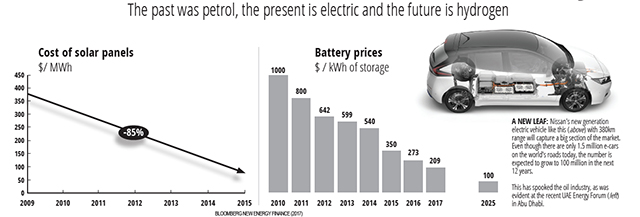
Given this strong focus on sustainability, it was perhaps not so surprising that he UAE Energy Forum held at the New York University Campus in Abu Dhabi last week had several panels discussing the impact of electric transportation on the oil industry. The conclusion: battery-powered cars do not yet represent a serious risk, but they will in the next three decades.
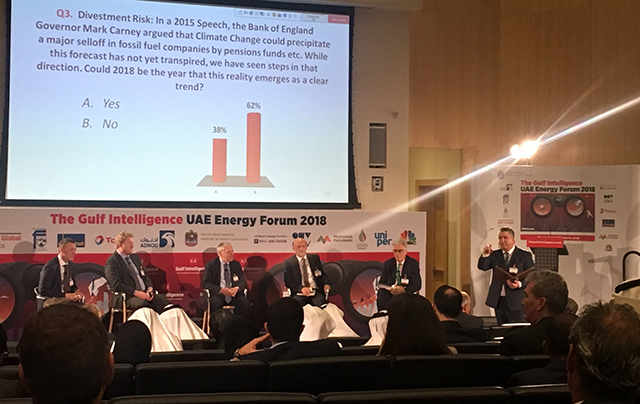 Photo: Kunda Dixit
Many of the speakers at the Forum were from industry-funded think tanks, bankers, oil company executives and government officials. Some of them saw the rapid popularity of electric vehicles as ‘threats’ or ‘risks’ to the future growth of the fossil fuel industry.
‘Climate action presents the fossil fuel industry with a new set of risks … reduced wealth and influence for fossil fuel exporting countries,’ wrote Jim Krane of Rice University in a Special Report for the quarterly Energy Outlook.
As countries draw up decarbonisation strategies to comply with the 2015 Paris Agreement target to limit global average temperatures to 1.5 Celsius or less, experts here expected the coal industry to be hit hardest. Crude oil production will not be affected and liquid petroleum gas, shale oil and fracking will actually benefit.
The world produces 96 billion barrels of oil per day, and 70% of that is used in transportation. Even if current surge in the sale of electric vehicles continues, projections show that oil demand will go down by only 2 billion barrels per year by 2023. The burning of coal, diesel and gas for electricity generation has in fact gone up. Despite pledges, the EU’s fossil energy use went down by only 0.2% last year, much lower than the minus 3% needed to meet Paris targets. Globally, carbon emissions, in fact, went up 2% in 2017 – mainly because of China’s growth.