
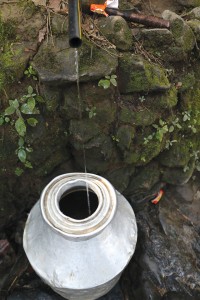
 Pic: Kumar Acharya
Sixty years ago, when Swiss geologist Toni Hagen walked across the length and breadth of Nepal he used to ask villagers what they wanted most. The reply was almost always: a footbridge. Rivers divided Nepal into an archipelago of isolated valleys, especially in the monsoon. Nepal’s trail bridge-building campaign is a success story which we will talk about some other time. But when Hagen returned to Nepal in the 1980s and again asked mountain dwellers what they wanted, the demand was for motorable roads.
Today there is scarcely a part of Nepal where an excavator isn’t in action digging a road. More roads have been built in the past ten years than in the last 60. Humla is the only district that is still not connected to the national highway network, and even that not for much longer.
If Toni Hagen were alive and once more asked villagers in the mid-hills of Nepal what is their most pressing need, it would most certainly be: water. The more arid western districts of Achham, Dailekh, Jajarkot, Pyuthan were always synonymous with water shortages. But in the past two decades areas never before associated with the lack of water like Ramechhap, Kavre and Dolakha are reeling under acute water scarcity.
As our reporter found out in a recent visit (page 14-15) water shortage continues to be the biggest worry in Nepal’s mountain villages. While erratic rainfall and drying up of perennial springs have had a severe impact on agriculture, water scarcity has also spurred out-migration from the mid-hills.
Entire villages are emptying as farmers sell their homesteads and move to Kathmandu, while city folk are migrating in the opposite direction buying up viewpoint property as investment. Many terraces are barren not just because there is no one to till them, but also due to the water shortage.
Most villages located along ridges have always suffered from lack of water as soon as the rainy season drew close to. This year, despite a healthy monsoon that ended late, even water sources located next to community forests have dried up. Desperate villagers (mostly women because the men have left) have to walk hours to fetch water. Vegetable patches have wilted. Children are dropping out of school to help carry water. Districts may have been declared open-defecation free, but there is no water in the latrines.