
In a democracy, you can’t threaten to kill people who hurt your feelings.
--
In an unfortunate confluence of events, last week’s anti-American violence across the Muslim world over a purportedly ‘blasphemous’ Youtube video coincided with the death threat by extremists in Nepal against an artist for paintings deemed sacrilegious.
By now, it is clear that the rage that first swept the streets of Benghazi, Cairo, Tunis and Jakarta was not so much about insults to the Prophet in some obscure voice-over of an internet video soundtrack, but an organised campaign to exploit religious sensitivities for political ends. It is a clash of the civilised versus the uncivilized, between secularism and fundamentalism, between open society and tyranny, between freedom and control.
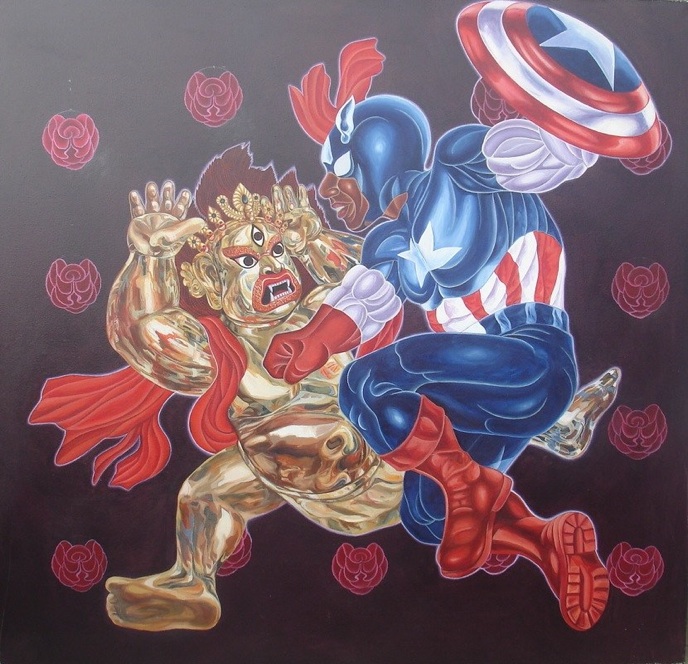
In Kathmandu last week activists of the World Hindu Federation manhandled and threatened to kill artist Manish Harijan for works displayed in the exhibition, ‘Rise of the Collateral’, at the Siddhartha Art Gallery. But instead of protecting the artist’s constitutionally-guaranteed freedom of expression, the Kathmandu district administration summoned Harijan and gallery owner, Sangita Thapa, forced them to agree to remove the paintings. Instead of shielding the gallery, they sealed it.
Harijan’s paintings are graphic and playful depictions of members of the Hindu pantheon as super heroes. The artist’s main intention seems to be to lampoon globalisation and its intersection with institutionalised religion. At most, one can fault Harijan for a lack of good taste in some of his paintings, but there is nothing there that doesn’t already exist in some of the more explicit examples of tantric religious objets d’art in this country. If Harijan’s paintings are offensive to the WHF, it should also go around demolishing the intricately carved struts and eaves of Kathmandu Valley temples.
We have seen time and time again in this country proof of the convergence of leftwing and rightwing forces to constrict the democratic middle space. During the Panchayat, the monarchy colluded with the communists to suppress democracy. During the conflict, the army-backed monarchy was negotiating behind-the-scenes with the Maoist rebels to sideline parliamentary parties. In fact, there is growing evidence that the so-called Maoist ‘revolution’ was originally a project of the extreme left and right to pull the rug from under the democratic parties.