PICS: KUNDA DIXIT
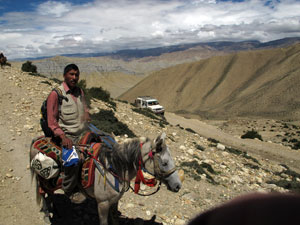
THE IRON HORSE: Tashi Wangel worries his horses will have no work now that the road has arrived in Lo Manthang. But the road could make side valleys like Drakmar's red cliffs more accessible and keep the horses occupied. |
Tashi Wangel leads his horses up to the 4,000m pass on Choya La and mutters a mantra at a cairn bedecked with colourful prayer flags fluttering in the wind.
There are eight horseback trekkers in this group, and he makes an average of six trips back and forth from Jomsom every year. Business has been good, and his customers have usually been generous with tips.
A jeep can be heard straining up the switchbacks, and soon arrives in a cloud of dust. This is the morning bus from Lo Manthang packed with traders, monks and porters headed down to Jomsom, and a noisy reminder that Mustang is experiencing the same transition from horses to automobiles that Europe went through during the industrial age.
"With the road there will be no need for my horses," says Wangel, adjusting the harness on a 10-year-old blue roan named Tomar. "This is the last of them, I will either sell them off or not replace them when they die."
GOOGLE EARTH |
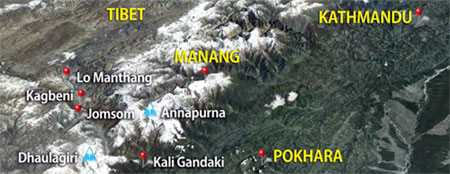
Horses, mules and donkeys have always been a part of Mustang's landscape and culture. Horses, in particular, have a prominent place in Tibetan lore and language, the animal not just a means of transport but also serving as a potent symbol of speed, certitude and good fortune. But all this is soon about to change with the arrival of the road from the south that will make it possible to drive from Pokhara to Lo Manthang in less than 12 hours, and connect to the road to the Chinese border at Kore La.
Along the old Kali Gandaki horse trail there is anticipation and apprehension about the new road, and what it will mean for Mustang's 'Restricted Area' status that limits tourism and requires every trekker to pay $650 for a 13-day permit. The Annapurna Conservation Area Project (ACAP) makes Rs 50 million a year from trekking royalties and is supposed to plough back a third of it into the Mustang economy, but there is simmering discontent here that much of that money vanishes in Kathmandu's bureaucratic sinkhole.
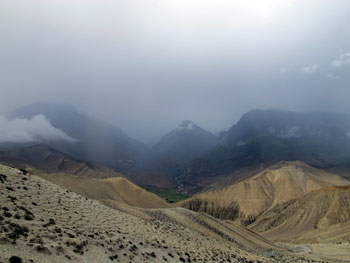
The Ghami Valley is veiled in rare rain. |
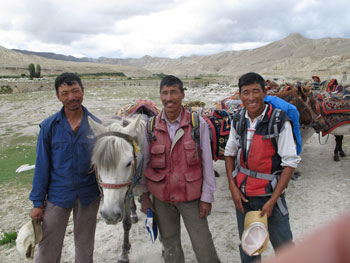
Lobsang Gyantso, Tasi Wangel and Gyatso Loba pose with their horses on the trail from Lo Manthang to the Chinese border. |
"When the road is opened, Mustang should also be opened, it can't be treated like a restricted area anymore," says Deb Gurung a member of the UML district committee. Indeed, most tourists along the trails are already put off by the limited vehicle traffic along a trail they had been promised was pristine.
But Lo Manthang's former VDC chairman Indra Bista fears that abolishing the $50 per day trekking fee and lifting restrictions will turn the fragile region "into another Thamel". Chatting with visitors at the gates to the walled town, Bista said: "If we open up Upper Mustang, cheap tourists will flood in and we will see a repeat of the Annapurna Circuit where trekkers bargain even at tea shops."
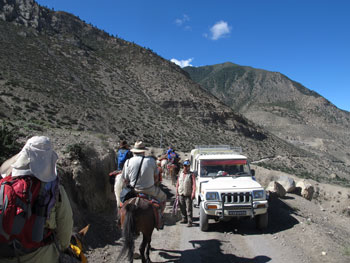
Tourists on horseback jostle for space on the trail. |
This ambivalence is repeated up and down the trail, with some worried that the road will destroy Mustang's delicate culture and environment, while others argue that the district isn't getting its share of tourism fees anyway and throwing it open would mean everyone can share in tourism benefits.
As a peripheral region of a peripheral country, Mustang became a part of Nepal almost by a historical fluke after Prithvi Narayan Shah conquered Jumla.
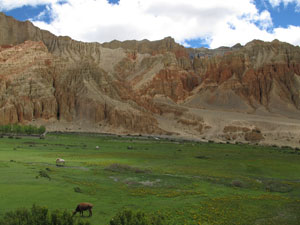
Horses graze in the meadows below the famous red cliffs of Drakmar. |
Mustang always fell between the cracks, although it briefly became the epicenter of Tibetan resistance to Chinese occupation in the 60s and 70s with the CIA-supported Khampa uprising. But after Richard Nixon opened ties with Beijing the US withdrew support, the Dalai Lama called on the fighters to lay down arms and the Nepal Army hunted down the last remaining Khampas.
The new democratic government in Kathmandu opened up the area to limited tourism in 1992, but access to the kingdom within a republic remains restricted. ACAP's fees and rules requiring trekking groups to carry their own kerosene and account for every tin can and plastic bag they take into Mustang now seem out of date and anachronistic.
Whatever happens to Mustang's restricted status, visitors already get vivid reminders of a district on the verge of momentous change. Tractors overtaking mule trains on the narrow trails, Applebee's Café has arrived and at Kagbeni, the ACAP office carefully checks to see if trekkers have brought back all their trash, and then tosses the day's collected garbage over the cliff into the Kali Gandaki.
In Kathmandu, as the debate continues about ACAP's own future (see box) no one is thinking and planning for the future of Mustang's tourism. Because Kathmandu couldn't care less, it is the Chinese who are distributing free rice and wheat, the Indians are equipping schools, and the Americans are helping restore monasteries.
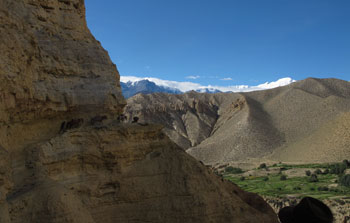
Horses negotiate the precarious trail on the road to Samar. |
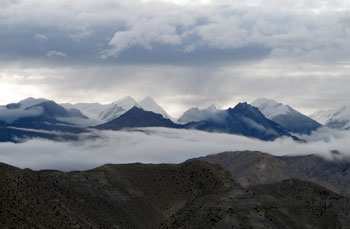
The mountains of eastern Mustang are obscured by
the few monsoon showers that drift into the trans-Himalayan rainshadow. |
Fifty years ago Mustang's families all contributed to sending donkeys down to Butwal or Pokhara to bring up a year's supply of essentials. Wool and salt went down, grain and cloth came up. Today there are no donkeys left. The mules will soon disappear as well.
As for the horses, Wangel thinks he will keep one just for old times' sake. "But with time, even that will be replaced by a motorcycle," he adds as he corrals his horses on the ground floor of his home in Lo Manthang.
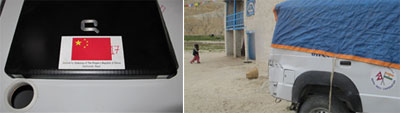
Mustang has once more become a geopolitical arena with the
Chinese equipping local schools with computers (left) and
the Indians donating vehicles (right). |
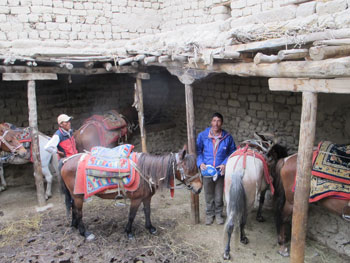
Tashi Wangel corrals his horses on the ground floor of his house in Lo Manthang after a five-day ride up from Jomsom. |
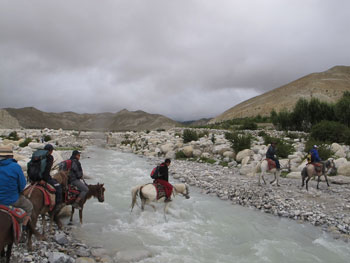
Horses ford the Kali Gandaki, swollen with rain, at Tsoshar on the road to the Chinese border. |
Others are not as pessimistic and say that despite the road, there are alternative high trails for trekking and horseback travel in Mustang. The road would make the trail through Tangbe, and Drakmar Valley and the Damodar Kunda treks more accessible for tourism.
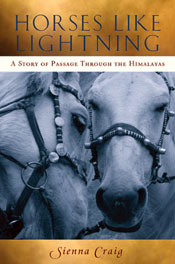
As much as possible, horses need to continue to be presented as viable and exciting modes of transport for tourists," says anthropologist Sienna Craig, author of Horses Like Lightning, a book about Mustang's horses.
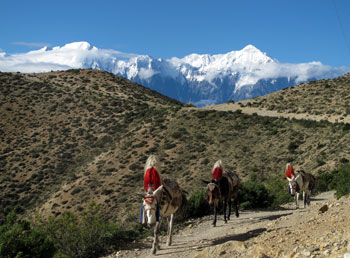
An empty muletrain travels up the trail towards Lo Manthang after dropping trekkig gear in Jomsom. |
The rugged, arid landscape of Mustang has ensured that the Lobas are hardy folk. They travel very winter to India and beyond to trade, and today every household has someone in Hong Kong, Seoul or in New York. The Mustangis are worldly-wise and cosmopolitan, they have taken in stride every challenge history has thrown their way. And if faraway Kathmandu helps them with resources and allows them to make their own decisions, they can come to terms with the road and make the best of it.
The world catches up
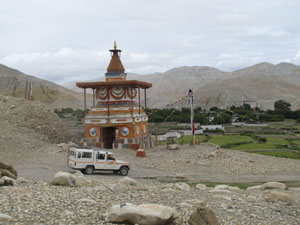
The daily jeep bus service from Geeling to
Lo Manthang passes the landmark chorten outside Tsarang. |
Looking down at the 360 degree view of Upper Mustang from a hilltop in Geeling, one understands why landscapes can be sacred. To the south are the Annapurnas and Nilgiri, to the north the pastel canyons of the Kali Gandaki under an inky blue sky, and to the west the dark, wet mountains veiled by a gauze of rain.
This is terrain textured by millennia of wind, rain and snow after being raised from the shores of the Tethys Sea 60 million years ago. It is hard to imagine that the multi-coloured organ pipe cliffs of Chhusang were once a sea coast, or that ammonite fossils on the banks of the Kali Gandaki 4,000m above sea level were once crustaceans that slithered on the ocean floor.
Mustang's terrain inspires awe and wonder, even if you don't know about the geology of its genesis, which is probably why this has been a place of such spiritual and cultural significance. This isn't just Tibet, it is proto-Tibet. This is what the Tibetan Plateau must have been like before Buddhism arrived, and before the Chinese came. From the neolithic caves carved into the soft vertical conglomerate walls of the canyons to the historic monasteries and sacred springs and lakes, this is a valley made holy by a primordial blend of geology and mythology.
The Hindu and Buddhist sages of the Himalaya all visited and meditated here. Milarepa the poet saint passed through. Guru Rinpoche, who brought Buddhism to Tibet, chased a demoness from the Samye monastery in Lhasa all the way to Mustang and finally slayed her here. It is her blood that is believed to have dyed the surrounding cliffs red. The exact spot where that happened 1,300 year ago is Lo Gekar, the oldest Tibetan Buddhist shrine in Nepal.
The kingdom of Mustang was established by Ame Pal 800 years ago, and the ruins of his imposing fortress overlooks Lo Manthang where his direct descendant, Jigme Prabal Bista, still rules 25 generations later. Now, with a new road from Pokhara snaking its way up to the trans-Himalayan plateau, Mustang's centuries-old way of life is bound to change as the rest of the world catches up.
Where horses grow swift
 |
An equestrian and anthropologist, Sienna Craig spent two years in Mustang in the early 1990s on a Fulbright studying how horses have shaped Mustangi culture and wrote the book, Horses Like Lightning: A Story of Passage Through the Himalayas. The book gets its name from a poem written by Tshampa, a horse medicine man whom Craig befriends in Jomsom that ends with the line: 'Horses, like lightning, move quickly in all directions.' Craig finds that for the Mustangis, horses aren't just a means of transport, but an integral part of their culture, economy and myths.
In ancient texts about Mustang's creation, Craig finds the following passage: 'Mustang is a centre of the sky, the middle of the earth …the head of all rivers where horses grow swift.'
Horses have seen their ups and downs in modern Mustangi history. The Chinese annexation of Tibet put an end to trade, grazing and even the import of horses from the grasslands of eastern Tibet. The mule trains started travelling south to Pokhara and Butwal to ferry supplies. When the Khampa guerrillas set up camps for raids on the Chinese Army, they used war horses to travel swiftly across the mountains. Horses were always a status symbol for the Mustangi aristocracy, rather like what SUVs are in Kathmandu for high ups, but this was 'democratised' with the political changes in 1990 in Nepal and Mustang was opened up for limited tourism. The Loba started keeping horses, to rent to tourists travelling from Jomsom to Lo Manthang and back. But now with the arrival of the road, big changes are afoot again. Already tourists on horseback have to compete for space on the narrow trails to give way for the jeeps and tractors going up and down.