
How can demagogues be prevented from hijacking democracy? This is a riddle as old as democracy itself. The ancient Athenians grappled with the question, and history is replete with examples of tyrants who exploited populism and stoked ultra-nationalism during economic crisis to get in power, often with disastrous results and wars that caused immense suffering to the people they led.
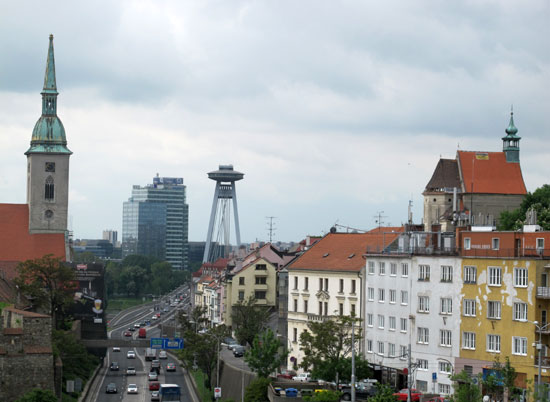
These thoughts rushed through my mind as we crossed from Austria over the swollen Danube to Bratislava recently. It was a trip back in time, having come here as a teenager in 1974 to the still united Czechoslovakia. The country was locked in the darkness of Stalinism following the tantalisingly brief Prague Spring that was crushed by Soviet tanks. It was a drab and depressing time, people weighed down by lies and the crushed hope of freedom.
What a contrast 35 years later to see a Skoda Octavia taxi with Slovak number plates picking me up at Vienna airport and to not even notice the former iron curtain as we whizzed along the autobahn past the checkpoint in Berg. Crossing this border in 1975 used to take two hours as the entire bus and its occupants were searched and questioned. And the strangest sight of all: election posters in Bratislava. Slovakians were nervously looking forward to elections and their young country’s first-ever participation in the World Cup (they beat Italy 3-2 on Thursday).
When communism collapsed in 1990, Czechoslovakia split up into two republics. But it wasn’t a brutal breakup as in the Balkans, where the distintegration of Yugoslavia plunged Europe into its first genocidal war since 1945. The Czechs and Slovaks prided themselves on their anti-communist Velvet Revolution and their peaceful breakup which showed them to be more civilised than their southern Slav cousins.
Yet the recent elections in Slovakia and Hungary show how easily Europe can still regress into the intolerance, racism and even fascism of its recent past. The economic crisis in Hungary (where the finance minister set off panic in the stock markets by just uttering the ‘G’ word for Greece) has caused a right shift in the political spectrum and raked up latent nostalgia for a Greater Hungary. The Slovak economy is doing better (it now produces one-third of all the cars in Europe) but the recession has hit the job market as well, and this in turn has pushed the ultra-nationalist parties to go for an extreme anti-Roma and anti-Hungarian election platform.
In both countries chauvinistic parties used the joblessness created by the recession to openly use racist slogans to garner votes. It worked in Hungary in April, as the ultra-nationalistic Fidesz party won. But it didn’t work in Slovakia this month, where the anti-Hungarian SNS (Slovak National Party) party barely managed the minimum of 5% votes to retain its position in parliament.
With elections just weeks away, journalists at the Sme newspaper in Bratislava were worried about where the country was headed. The editor has been sued multiple times by successive Slovak governments, and had just done an expose on an anti-Roma billboard portraying gypsies as lazy parasites. The SNS was a part of the pre-election coalition with the ruling Smer party and had pushed through legislation making it illegal to speak Hungarian in offices.
The problem now is that while the Slovaks are trying to forge a new coalition without a racist party in it, the Hungarians have Fidesz in a centre-right coalition that wants to offer dual citizenship to Slovakia’s Hungarian minority and a government that openly espouses unity of the pre-World War One Hungarian lands. With Hungarians comprising 10% of its 5.5 million population, Slovakia sees this as tantamount to a declaration of war.
The fur is already flying between Budapest and Bratislava with Slovak officials describing Hungary as the “exporter of the brown plague”: a reference to the fascist youth of World War Two. The Hungarians have retaliated by saying “we don’t care what the EU thinks”. Fidesz MPs openly goose-step about Budapest in paramilitary uniforms and give Heil salutes, and now want to wear those uniforms inside parliament. The rise of the ultra-nationalist racist right has been greeted with dismay in Brussels where Hungary is set to take over the EU presidency on January 1.
Democracy is messy, but it's the best we can do. It should by definition be inclusive, but often is not. Democracy is a work in progress and needs to be protected by its maximum application. But civil society and media have to guard against despots who have found a way to manipulate the electoral process to grab and retain power. In Nepal, the party that won the most votes in the 2008 elections started one by one to undermine the very institutions of an open society that got it elected in the first place. And we are paying for it now. The country is stuck between a ruling coalition led by a prime minister who lost in two constituencies and an opposition that can’t get enough votes in the assembly to oust the government and is therefore trying underhand ways to do so. The Nepali people are trapped in between, as rigor mortis sets in.