
The Golden Lion Tamarin is rescued from the brink of extinction in Brazil’s rainforest by protecting what is left of its habitat.
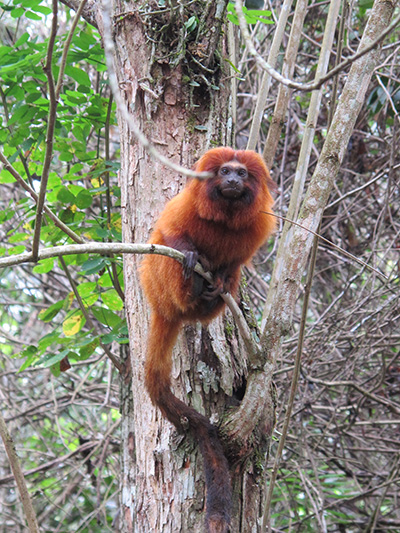
Deep in the rainforest of Brazil’s Atlantic coast, there is a sudden rustle in the canopy high above. There are flashes of orange in a golden blur against the dappled sky. They look like birds, but are actually a family of the endangered Golden Lion Tamarin monkeys foraging on the tops of the trees.
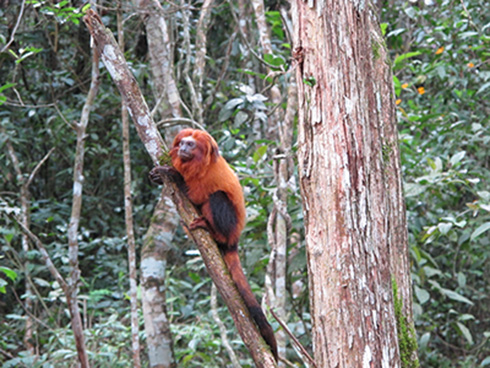 Golden Lion Tamarin
Luis Paulo Ferraz peers through a pair of binoculars and identifies the family, he knows the individual juveniles and their parents by name. As the Executive Secretary of the Golden Lion Tamarin Association, it is his responsibility to protect this marmoset species which has been rescued from the brink of extinction.
The frolicking Tamarins remind Ferraz, who spent three years in Nepal in the early 2000, of the red panda that are also canopy dwellers in the Langtang National Park. “There are similar challenges to saving them,” he says, “if you want to save the flagship species you have to save its habitat and in
doing so you preserve a lot of other living things.”
The tiny squirrel-sized animals are endemic to southeastern Brazil, but only 5 per cent of the Atlantic rainforest that used to be its habitat remains today. The species nearly became extinct, its numbers plummeting to less than 200 in the wild 30 years ago. Today, thanks to a model conservation effort, they have rebounded to 1,700 but cling to shrinking forests north of Rio de Janeiro. There are another 500 Tamarins in zoos around the world, and there is a program to reintroduce some of them back into the wild in Brazil.
The threat to the blonde monkeys isn’t as much from predators or poaching, but loss of habitat. What remains of the rainforest is fragmented, and the animal’s gene pool is shrinking. And while the Amazon gets all the attention and resources, funding to save the coastal jungles and the pressure on land is a serious problem.
“If it is so difficult to fundraise for the Tamarin, imagine what it must be like to raise money to save frogs,” says Ferraz, who says the monkey is an umbrella species who protection will help protect what is left of Brazil’s Atlantic rainforest.
The Tamarins are now on Brazil’s R$20 currency notes, and conservationists are lobbying to get the monkey nominated as the official mascot of the 2016 Rio Olympics.
The Association needs to generate awareness so that it can raise money to build migration corridors for the animals to connect the fragmented Atlantic forest. A new highway now threatens to cut the Poco des Antas Biodiversity Reserve in half, and there is a proposal to build forested bridges above the road so the Tamarins can pass.
That is a stopgap measure, but the real good news may be Rio state’s decision to plant millions of trees and save more of the Atlantic rainforest and the Tamarin’s habitat.
Says Ferraz: “In Brazil, and Nepal, the challenges are the same: how to use the celebrity status of the flagship species to save enough of the habitat to protect the ecosystem and preserve biodiversity.”
Watch video:
http://video.
goldenlion-kids/