
Rewinding to 1999 and the piece ‘Can the South Asian Toad Leapfrog’ was a sobering reminder of just how fast technology is moving forward, even in our part of the developing world. Himal Southasian carried this version in its online edition on 5 August, 2013.
It was nice joke 13 years ago to say: “90% of Indians are waiting for phones, and 5% are waiting for dial tones.” Look at where we are now: the number of Indians with mobile phones is about to cross the 1 billion mark. In November 2012, the number of people in India who accessed the Internet through their smart phones and tablets exceeded the number of people who accessed it through their PCs or laptops.
In that article in 1999, I poked fun at a minister who said India should graduate from making potato chips to making microchips. I ridiculed Bill Gates and his remark that India could “leapfrog” into the future by turning Bangalore into the digital sweatshop of the Internet age. Today, Gates himself has been left trailing behind by embarrassingly young internet billionaires who have adapted to the new mobility that the Internet has been provided with the spread of i-Phones, Androids and other smart phones.
When that article appeared in Himal in 1999, I was making a living being a cyber-sceptic. Before talking about levelling the playing field, I argued, it was important to ensure there was a playing field. Before sticking a computer into a classroom, we should first make sure it has a roof. Or electricity. Or text books. Or qualified teachers. Or that the school-children are not stunted because they don’t have enough to eat. We were being carried away by a technology that promised to set everything right overnight. We actually believed that convergence would change the world.
But the coming together of telephony, computers and television has actually changed the world, whether we like it or not. We may have doubts about whether the transformation in the way we communicate will make a difference, but the speed of the spread of communication technologies has metamorphosed society. The medium is the message, in a way Marshall McLuhan probably never imagined. It is the end of geography.
The moment of truth came to me in 2010 on a mountaintop in a remote part of northwestern Nepal, a week’s walk away from the nearest road. I had just got myself my first smartphone through which I took some fairly decent images of the stunning scenery of a crystal blue lake spread out below me with the snow mountain beyond. I could transmit that picture out immediately into the worldwide web through Twitter, Facebook and email. Suddenly, here was a technology that was immediate, and which could magnify and extend the journalists’ reach way beyond what old timers like me thought was possible.
Since that epiphany on the mount, I have become a born again proponent of the potential of the new information and communication technologies for transforming society. I am not yet fully convinced about where all this hype and obsession with bandwidth, speed, the breathlessness of social networking sites is going, and I doubt if it will solve problems of governance, equity and delivery of basic services to the poorest in poor countries. After all, the district of Mugu from where I transmitted that picture into the Net is still the poorest in Nepal where four times more children die before their fifth birth day than the national average. But it has telecom towers.
Even so, I am now convinced about the Internet’s ability to transform at least journalism. Indeed, it already has. There are examples from around the world that information can empower. Ease of communications opens up doors for business, cuts out middlemen, and lessens the transaction costs of trade. The vast corpus of knowledge stored and archived on the Net has also changed the way people around the world access knowledge. Crowdsourcing has made the whole process more participatory, with built-in capacity for self-correction. Falsehoods don’t have a long shelf-life in the Net, as the Wiki effect allows the public to correct mistakes.
The challenge now is to ensure that the information available on the Net is available to those who need it the most to catch up. Information does not necessarily spread knowledge, informed people are not necessarily wiser. The latest scientific information on tuberculosis is all over the Internet: how to prevent it, which therapies work, the antibiotics that bacilli have become resistant to. But this information needs to get where it is needed as cheaply as possible, it needs to be relevant to the needs of the people it is meant for, and it must be packaged so that it is easily understood. In South Asian countries, where most people die of communicable diseases the first line of defence must be communication of preventive measures, and awareness generation about causes. Is it absolutely necessary to spread that knowledge through Google search, or is old fashioned radio more effective?
To be useful, information must help people communicate, participate and allow them and their rulers to make informed choices. Recognition of the power of knowledge may be as old as civilisation, but what is different now is the speed and capacity to move that information. At present, this speed and capacity are concentrated in the same countries in which wealth and power are concentrated. The global spread of mobile phones has proved that the technology has the capacity to leapfrog, now we just have to make sure that the message we are communicating will help improve lives.
After all, the corporate and political structures that governed the current Knowledge Revolution are the same ones that governed the Industrial Revolution. The main impact of e-commerce, in fact, is felt in the same old consumerism, allowing access to digital mail-order catalogues with online payment and global home delivery. We have just added the ‘e-’ prefix to commerce.
In terms of numbers, it may not look bad. There are 540 million internet users in China, 130 million in India. But in terms of percentage of the population using the Internet, South Asia still falls far behind the rest of the world. The digital divide doesn’t just exist between the US and China, it is glaring between China and India, too. Nearly 80% of people in the US use the Net, 40% in China and 14% in India. (Alert: All these figures will be obsolete in a month or two.)
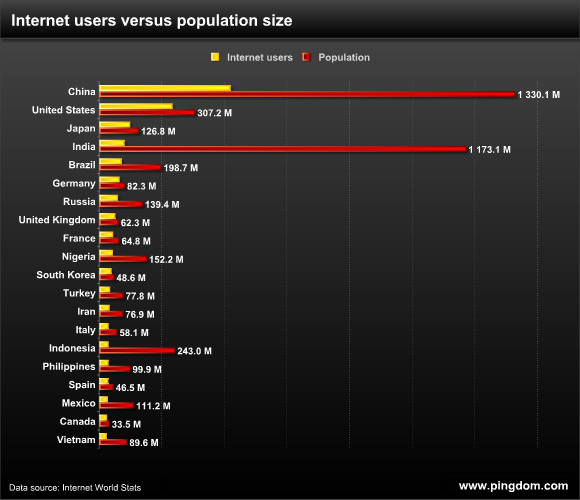
There even seems to be a digital divide between the US and Iceland, the only country in the world with nearly 100% penetration rate which must mean that even newborn babies in Iceland are Net savvy. The gap is narrowing between the US and China in terms of per capita Internet users, but it is growing between China and India. The proportion of people going online in India is growing fast, but in China it is growing faster. Even within the South Asia region, you see the gap in per capita Net usage. A proactive government policy on Internet literacy has made the Maldives surge ahead, but because of its sheer size things take longer to change in India.
But there is a game changer, and it is mobile telephony. India is set to cross the 1 billion mark in the total number of mobile phone users. Even though China is surging ahead, in India mobile penetration is reaching saturation and has collided with the poverty threshold. If Indian politicians were less greedy and let the real free market operate as it should, more and more of the phones will be smart and a spreading 3 and 4G network will boost mobile internet penetration.
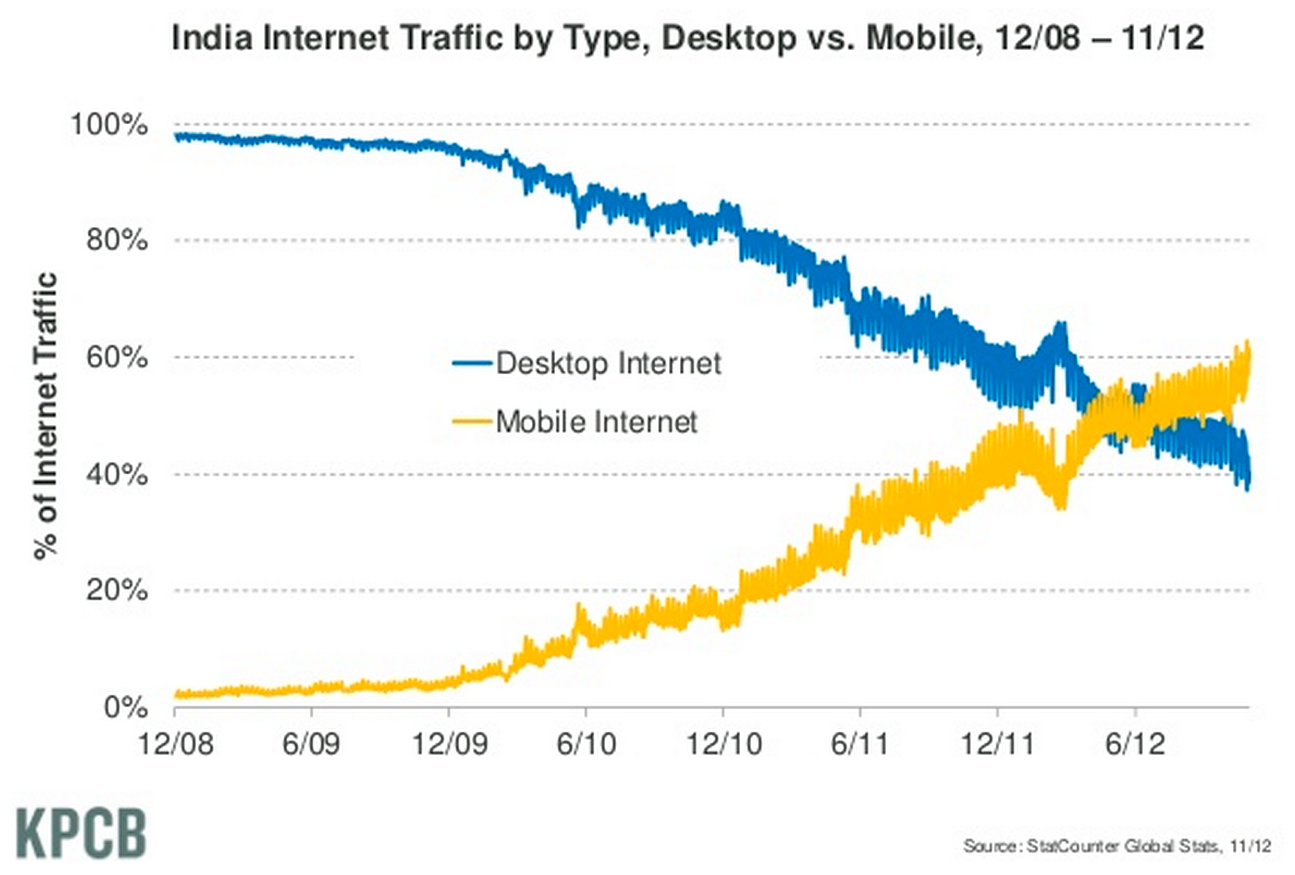
Only 20% of Indians also used mobiles to access the Internet two years ago, in the next two years it will shoot up to 80%. Who are the people already browsing on their mobiles? They are young, and for some reason mostly guys so far. What are they using their smart phones for? Mostly entertainment, to get breaking news on matches and to download videos and tunes: they are not reading the sports and celebrity sections of newspapers and magazines. The eye balls are moving, and sooner or later, advertisers will move with them.
This has happened elsewhere, of course, and we know what mistakes not to make. Here in the subcontinent we have a window period the old media isn’t dead yet, and the new media has just been born.
Just about every media conference I have attended in the last five years has flogged to death the debate between old media vs new media. But it’s not, shouldn’t be, a binary either/or. The two need to coexist and complement each other. Paper media will bring in the revenue to subsidise online, until online can generate its own income as it is beginning to do. That income will first come from advertising, and then from paywalls.
Still, we have to step back sometimes and make sure that our infatuation with delivery doesn’t make us lose sight of content. Are we communicating just for the sake of communicating? We are so obsessed with data speed, by penetration rates, numbers of followers and friends, by retweets and mentions, that we forget what it is we are communicating.
It brings us to that same debate about whether media should have a higher calling. Is it just another industry, or does the media have a public service role in a democracy? Freedom of expression and democracy are two sides of the same coin, one strengthens the other. But in a democracy it is not enough to be free to express ourselves, it is also important to use that freedom to solve society’s problems of inequity, injustice and deprivation.
In just about every country in the subcontinent today, freedom is threatened by the state, by extremists, by fascists, bigots and chauvinists, by demagogues masquerading as democrats, dictators who use the institutions of democracy and populism to get themselves elected, and then dismantle those very institutions when they get to power.
New media can be an ally in our struggle against the enemies of open society. Social media networks, citizen journalism and online media can help bypass mainstream media when it becomes inert due to inertia or commericalisation. When traditional media doesn’t do enough to uphold the citizen’s right to know, citizen journalists step in to get the information across. Convergence of technology is making online journalism possible, and it is filling the gap left by the mainstream media.
What is important is not the platform, it is content. And you determine the delivery mode depending on content: you chose the medium that best reaches the public that the message is meant for. Whether it is new media or old, there are still just two challenges:
- Enhance credibility
- Protect freedoms
Authoritarians and tyrants are also using the same technologies and networks, but for control, surveillance, and disinformation. It’s not just in dictatorships that there are enemies of press freedom, our democracies also have them (cut to Snowden, Wikileaks, the Indian police who arrested two young Facebook users for their postings).
We don’t just need a new media, we need a new Internet. The over-connected old Net fragments and compartmentalises public opinion with virtual thought ghettos populating cyberspace. Online media tends to be an echo chamber, hardening opinion, and working against the politics of compromise that is essential to make democracy work.
So let’s invest not just in the hardware of delivery, but also in the software of content. Let’s train practitioners so they can turn out more credible, relevant and agenda-setting content. After all, as someone said at a conference I attended recently: Content is still king, but delivery is King Kong.
The digital divide has not gone away, the real digital divide is between delivery and quality of content.