
|
|
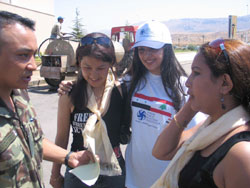
| Pema and Gori wearing khadas |
For the first time since the war began in Lebanon, this main road is deserted. Lebanese refugees who, until two days ago, poured over the border in thousands stopped crossing after recent Israeli air strikes made it too dangerous.
Pema Sherpa and Gori Karma stand under the hot sun at this southern Syria-Lebanon border crossing. This has been their home for the last twenty days. The dusty, dun-coloured landscape is a far cry from the mountains of Pema's village of Lumcha in Solu Khumbu, and Gori's lush hometown Dharan.
Pema and Gori had been working as maids in southern Beirut for a year-and-a-half when the war with Israel broke out. "The bombs were close to the house, near the airport . Our madam left with her family, telling us to stay and look after the house. We didn't want to die so we left as well," explains Gori. Despite being owed four months' salary each, the decision to leave was still easy, as the two women had been virtually enslaved by their employer.
They left with just their handbags and a small suitcase. By chance, they met some fleeing Sudanese and Ethiopians and shared a taxi to the Syrian border for $100 each. There they were safe from the bombs, but didn't have the papers to enter Syria.
Border officials told them to go back to Lebanon, but they refused and slept outside until they attracted the attention of the Syrian Public Relations Association, an NGO that has placed 2,000 Lebanese families in Syrian homes so far.
Pema and Gori's story is not uncommon. There are an estimated 4,000 Nepalis stranded in Lebanon at the moment, but nobody is sure of exact numbers. Now heading back to the safety of Kathmandu, Pema and Gori are happy to have been so lucky.
The women said they were well looked after by Syrian volunteers. They slept in a mosque and were given adequate free food. The only request they had was for new underwear and clothes. "We can't be fussy about the food we are given," said a pragmatic Pema.