
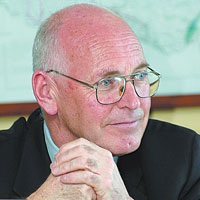
The head of Nepal's UN Office for the High Commissioner for Human Rights (OCHCR), Ian Martin, spoke to Nepali Times on how the UN can act beyond its fixed mandate towards the new political developments in Nepal.
|
|
Nepali Times: The role of the UN seems to be more challenging
now.
Ian Martin: There are clearly a number of areas that the UN
could assist if asked to do so beyond our human rights mandate, humanitarian and
development mandate but that is not so much for the UN to propose. That is up to
the government and their negotiations with the Maoists what they are looking
for. The assets we have got in the past year include effective engagement for
Maoists at different levels and also include the security forces whom we
criticised and we have a respectful relationship with both. The security forces
are interested in the UN's opinion of them. The political parties have also
appreciated our role in this movement as we visited most of them in detention.
So I think we have opportunities through those relationships to play a
constructive role in trying to make sure that tensions among them are kept under
control.
Do you think that the ceasefire this time will
last?
The main issue is that there should not just be a military
ceasefire but that civilians have nothing to fear. There needs to be a clear
discussion on what those modalities for the ceasefire are going to be, has to be
properly negotiated and what kind of monitoring goes with whatever agreement is
reached. The ceasefire has a military aspect and you have to be sure that the
RNA and PLA are not going to attack each other. Once the ceasefire is agreed,
the real risk is tensions among the different sectors of the population before
there is an opportunity to establish strong democratic local government.
Transitional justice seems to be a buzzword today
Our presence has significant effect on the actors in terms of
degree of deterrence in terms of committing violations but we haven't seen any
satisfactory progress towards accountability in ensuring that those who
committed abuses are effectively investigated and brought to justice.
There is clearly a strong demand in many sectors of the population, which is
focusing initially on recent deaths and injuries but already people are looking
beyond that to clarify the fate of long term disappeared and much broader
question to impunity and responsibility for human rights abuses for many years.
OCHCR is not about to tell Nepal what it should do in those areas, but what we
can do is make international experience available so that political and civil
society actors debating what they want to do can have access to our experience.
Maoist leaders have told us that they are open about a new
national army and ready to join if its formed and that they trust only the UN to
help in that.
El Salvador is one example where a part of the UN
negotiated peace agreement was in rehabilitation of the guerrilals. There are
two issues: one is downsizing of armed forces and a lot of places where the UN
is involved in demobilisation and reintegration of former combatants and the
separate issue is the establishment of a new security forces and what degree of
vetting takes place to exclude those who are unsuitable as they have been
responsible for human rights abuses. That is certainly the area of where the UN
has expertise to offer.
Are you positive now that the human
rights situation will improve?
Of course, there are opportunities
now. When this office opened, we were here first to monitor violations of
international humanitarian law of nearly 10-years of armed conflict. If we have
not just a mutual ceasefire but lasting peace, then that part of agenda will
have been addressed. But let us not be na?ve about how difficult this process is
going to be. There is enormous amount of hard work to institutionalise
human rights.