
|
|
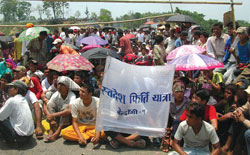
The Long March planned by Bhutani refugees in camps in Jhapa has been postponed again. Refugee leaders, who had planned to resume their thwarted journey back to Bhutan through India today, appear temporarily mollified by the seeming softening in India's position earlier this week.
The 10 June statement by India's minister for external affairs, Pranab Mukherejee, that the Bhutani refugee issue is an international problem was, on the surface, a sharp departure from India's previous position, that it was a bilateral problem between Nepal and Bhutan.
Yet, in the same statement Mukherjee also said that "if these 100,000 people enter Bhutan it would create a demographic imbalance"-a line regularly taken by Bhutani authorities and apologists for the expulsion of Bhutanis of Nepali origin. It seems unlikely, therefore, that India's new position includes being directly involved in or mediating talks between Nepal and Bhutan.
In the camps here, such statements are taken as an indication that India will again look away as Thimphu prepares to disenfranchise and expel the over 80,000 Bhutanis of Nepali origin still in Bhutan ('Replacement population', #348).
With the third-country resettlement option becoming a reality, the frame of reference of the repatriation argument has shifted from Bhutan's evasive excuses to India's refusal to accept responsibility for its role in the refugee crisis.
India, which shares a border with Bhutan, should have been the first country of exile for the refugees. Instead, "India loaded Bhutanese citizens onto trucks and buses and dropped them off in Kakarvitta," says Vidhyapati Mishra, general secretary of Association of Press Freedom Activists-Bhutan (APFA-Bhutan).