
|
|
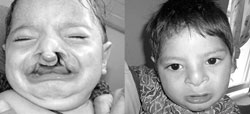
| BEFORE AND AFTER: A seven-month old Palpali girl before her operation, and the same child, at one-and-a-half years, with no visible scarring. |
Surely everyone loves Ganesh, the friendly-looking elephant-headed god of auspicious beginnings.
Well, apparently not. In many rural areas the arrival of a 'Ganesh' in the family is not a reason to celebrate, but something to fear, with the family facing ostracism in the village.
When Tirtha Magar was born to his family in Bhojpur, the first thing his father said to his mother was, "Go, dump this Ganesh in the fields."
Ganesh is the cruel nickname people often give to a baby born with a cleft lip, which they claim resembles an elephant's trunk.
It is not life-threatening but can affect the child's speech and cause dental and eating problems as well as attracting the sort of unwelcome attention facing anyone with an unattractive disfigurement.
Tirtha's father hated the child, ignoring him for long periods at a time, not really caring whether he lived or died, all because of a disfigurement. It was only after months of protest that he agreed to take Tirtha to the local hospital in Biratnagar.
Upon arrival, he saw that Tirtha wasn't the only Ganesh around. Many other children and even adults with cleft lips were present. A simple operation later, he was no longer a Ganesh, and there was no longer a reason for his father to hate him.
"There have been documented cases where fathers have left their families moments after they saw the deformed baby," said Kiran Nakarmi, a doctor at the Interplast Surgical Outreach Program (ISOP) which provides reconstructive surgery. "Mothers have been known to dump their babies in the fields." Health researchers estimate one Nepali child in every 700 has a cleft lip at birth, with at least 30,000 untreated cases across the country.