
 At a World Health Organisation (WHO) conference in Thailand last
year researchers said half the antibiotics in Nepal are prescribed unnecessarily
and 40 percent of money spent on medicines is wasted on inappropriate
prescriptions.
At a World Health Organisation (WHO) conference in Thailand last
year researchers said half the antibiotics in Nepal are prescribed unnecessarily
and 40 percent of money spent on medicines is wasted on inappropriate
prescriptions.
The International Network for Rational Drug Use (INRUD)
Nepal found that more than three-quarters of patients were being prescribed
antibiotics to treat common colds.
INRUD Nepal Coordinator Kumud Kumar
Kafle says such irrational drug use is common and is also seen in prescriptions
for children under five. For example, only 40 percent of diarrhoea cases in the
tarai and 36 percent in hill areas were being prescribed oral rehydration
solution, the standard treatment. "Doctors are prescribing antibiotics for
common colds and diarrhoea," says Kafle.
Over-prescription of drugs, inadequate treatment of severe
illness, self-medication using prescription drugs, misuse of anti-infective
drugs and premature interruption of treatment are all common.
Global
studies have found that poverty and lack of patient-doctor interaction are main
reasons for such abuse. Not all patients can afford to perform the tests doctors
recommend. Thus, sick people or patients in places with no doctors consult the
nearest pharmacist.
Irrational use of medicine in Nepal is common but no
one is documenting it. Sharad Onta at the department of community medicine at
Teaching Hospital says patients can't be blamed for the mess because the health
system doesn't give them a choice.
"Drug companies look for profits and
so do retailers," says Onta. "Consumers can't be blamed for going after the best
price in the market. Doctors need to work towards discouraging such
malpractices."
Rishi Kumar Kafle, president of the non-profit Health
Care Foundation, is not surprised pharmaceutical abuse is so common in Nepal.
"Doctor-patient relations are so impersonal," he says, "patients feel
uncomfortable asking questions during consultations."
All drugs sold in
Nepal have to be registered with the Department of Drug Administration, which
has classified the drugs available at pharmacies into three categories. The
first includes highly addictive drugs-opiates and narcotics-whose sale is
prohibited without prescription and for which pharmacies are required to keep a
copy of prescriptions.
Drugs in the second category, therapeutic
medicines like antibiotics, are also prescription drugs but the pharmacy does
not need to keep a record. The third group are over-the-counter drugs, mostly
antacids and mild pain killers.
Drugs in the second category, especially
antibiotics, are the most misused in Nepal. Not only do health workers prescribe
heavy doses but pharmacies also sell them without prescription.
Antibiotics have saved and improved many lives since they were
discovered in the 1930s, but their inappropriate use has caused global concern.
Prolonged and irrational uses of antibiotics have created 'super bugs' resistant
to some life-saving antibiotics.
A 1993 study in India showed that in 83
percent of the 500 typhoid cases sampled in Maharastra, the bacteria causing the
disease were resistant to chloramphenicol, an antibiotic that has been the
mainstay of typhoid treatment. It was later discovered that drug companies had
been promoting chloramphenicol in combination with an anti-diarrhoeal drugs
resulting in the typhus bacteria developing a resistance to it.
In
Nepal, irrational drug use includes unnecessary and expensive prescriptions of
vitamins, tonics and other spurious syrups to patients. Public health expert
Aruna Upreti explains, "Malnutrition is not solved by taking vitamin
supplements, but by eating an adequate, balanced diet." She adds, "Misuse of
vitamins also reinforces the misconception that there is a magic pill for all
ills and that supplements can replace food."
INRUD Nepal's Kafle says
many doctors don't give patients correct information about the drugs they
prescribe and why. Many poorer patients self-medicate or go to a pharmacy
because of the difficulty in getting cheap checkups. He says the solution is to
regulate doctors' fees and launch a health insurance system. "This would make
health services affordable and will also check misuse," he adds.
Onta
thinks some medicines for common illnesses have to be provided to Nepalis free
of cost by the state. He cites the successful anti-TB program which gives out
antibiotics free. "It is due to the national tuberculosis program that the rate
of misuse of TB drugs has come down dramatically," he says, adding that
hospitals need guidelines so that if an illness is suspected, patient s will go
through tests to pinpoint the cause before a drug is prescribed.
Substance abuse at the drug store
"Dai, I need
two strips of T. or Cl."
"Which would you like?"
"Is there much of a
difference?"
"T's milder, it's only 10 mg. C's a minimum dose of 25mg, it's
more effective."
"Okay, I have a feeling my grandmother will be needing the
one with the higher dose. Could you get 20 ready for me, I'll come back later? "
"Of course, no problem."
" Didi, two packs of I. and one tab of A. 10 please."
" Anxit 10? You
don't get those, bahini, you get them in .25 and .5-which do you want?"
"
Oh, okay, the .25 ones."
" There you go, nani. Twenty Rupees, 18, with the
discount."
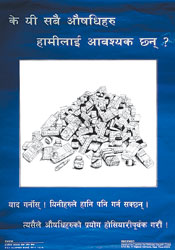 These aren't comic extracts from a junkie's biography. This is me in
medicine shops in the Valley. The medicines in question are sleeping tablets,
treatment for tachycardia and palpatations and anti-anxiety pills. And I got
them, no inconvenience, without a confirmation call to my doctor (or my
grandmother's, for that matter) without even having to show a prescription.
These aren't comic extracts from a junkie's biography. This is me in
medicine shops in the Valley. The medicines in question are sleeping tablets,
treatment for tachycardia and palpatations and anti-anxiety pills. And I got
them, no inconvenience, without a confirmation call to my doctor (or my
grandmother's, for that matter) without even having to show a prescription.
Since the turn of the last century, the use of drugs for medicinal
purposes has become a topic under constant, heated debate. Many popular opiates
and stimulants have been declared addictive, some illegal. Heroin in cough
syrup, morphine in infant pacifiers, cocaine as a cure for depression have all
been replaced.
But legal nicotine isn't less addictive than the illegal
heroin, it is just available outside the black market. Addictions aren't just
physical, they are psychological and prescribed medication requires verification
because the medicines being supplied are still drugs. They can cause major
withdrawal symptoms and many of them are highly addictive.
It may be
entirely up to individuals if they want to become addicted. But 90 percent of
Nepal's population is still under the poverty threshold, half are illiterate.
Health facilities, when available, are rarely accessible and there is a lack of
awareness in the general population that puts a lot of citizens entirely at the
mercy of their doctors and pharmacists. People don't check expiry dates. They
can't take their own temperature. They don't get check-ups regularly, they see
doctors only after their health has deteriorated significantly, and they stop
treatment as soon as superficial symptoms seem to go.
When people don't
know that painkillers are not substitutes for paracetamols, how can figures of
authority allow them to decide, on their own, what their dose of sleeping
tablets should be? How can they give an adolescent (who evidently doesn't know
the constituents of the medicine she is buying) two strips of anti-anxiety
pills, no questions asked?
What makes this availability more frightening
is that many 'educated' people are abusing medicine for recreational purposes.
Teenagers down bottles of cough syrup, boys take oestrogen pills for a high,
exhausted workaholics are hooked on anti-depressants. There are hypochondriacs
who swear they haven't been able to sleep for the past 20 years without sleeping
pills.
We have come a long way since Hippocrates and his theories on
mania, melancholia, and phrenitis. Disorders, both somatoform and psychological,
are being studied, so they can be treated and not just controlled. To abuse
scientific findings that have cost plenty in terms of time, effort and lives, is
to jeopardise a future. A jeopardy that may not have a remedy.
Tracy McGray