
 |
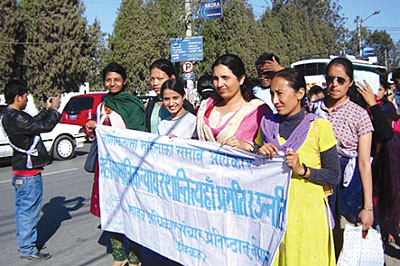
Has the high-level task force of the seven political parties, formed to settle disputes on the new constitution, erred in its decision of 4 November on citizenship?
I would like to believe that it was an uninformed error. For if it was deliberate, then none of the seven individuals on the high-profile panel deserve to hold public posts of any kind.
The panel has six communists (ok, one of them is an ex-communist) who fiercely project themselves as 'progressive'; the seventh member belongs to a centrist party. The panel had the opportunity to right the existing wrong in our laws, which do not treat a Nepali woman as equal to her male counterpart. But all it ended up doing was reinforcing age-old male chauvinist beliefs on treating women as inferior (and less nationalist).
Worse, they have even overturned far more progressive provisions in the Citizenship Act of 2006 and the Interim Constitution of 2007.
Take a closer look. The Citizenship Act says, "Any person born at the time of when his father or mother is a citizen of Nepal, shall be a citizen of Nepal by descent"(emphasis mine). Ditto the Interim Constitution, which says that a person is deemed to be a citizen of Nepal by descent "whose father or mother was a citizen of Nepal at his or her birth"(emphasis mine).
Now compare this with what the task force came up with on 4 November. To acquire citizenship by descent, "both (a person's) father and mother have to be citizens of Nepal" (emphasis mine).
The nonsense doesn't end here. In an attempt, ostensibly, to provide naturalised citizenship to foreigners marrying Nepalis, the task force has given continuity to what is clearly discrimination against Nepali women.
A foreign man marrying a Nepali national has to stay in Nepal for at least 15 years on a regular basis if he wants Nepali citizenship, the panel proposed. However, a foreign woman marrying a Nepali citizen can acquire Nepali citizenship as soon as she produces evidence that she has started the process of relinquishing her existing citizenship.