
|
|
| RED STAR OVER EVEREST: Maoist deputy commander Nanda Kishore Pun poses in front a banner at his office in Rolpa in March. |
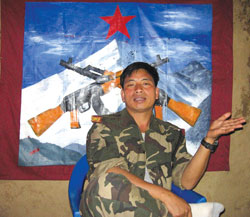
He sits on a chair in front of a flag depicting two AK47s flanking a mountain with a red star over the summit. He is among the more reclusive Maoist commanders and this is a rare interview. Nanda Kishor Pun, Comrade Pasang, agrees to meet me in an office-like house in the small valley of Kureli in Rolpa and the meeting lasts five hours.
He is one of the four deputy-commanders of the Maoist 'People's Liberation Army' and is directly under Prachanda who is the supreme commander. Pun, 40, was born in Rangsi in northwestern Ropla as the fourth among seven siblings. By the time he was in fourth grade, he was already a communist and actively involved in student politics becoming a member of the first district committee of the CPN (Unity Centre). He led a cultural group during the first general election campaign after 1990 and became the first district president of the newly-formed Young Communist League. This was an armed front of the Unity Centre formed to counter activities of the then ruling NC which was filing cases against their party.
This YCL was transformed into Ladak u Dal (Fighting Force) which was a precursor to the PLA.
Thirty-five members (including two women) of four Ladaku Dals launched the 'People's War' by attacking a police post in Holeri on the night of 13 February 1996. Pun took part as an assistant commander under Ananta.
When the Maoists formed squads in Rolpa made up of members of the Ladaku Dal in May 1996 Pun was made in-charge. And when the PLA was formed in September 2001, he was made commander of the first battalion. When new formations- company, battalion, brigade or division-were formed, Pun always led them.
He took part in most of the major Maoist attacks in western Nepal, from the first action on security forces at the Jhimpe communication tower in Salyan in January 1999 to the battle for Beni in March 2004. It wasn't always easy, he says.