
 KIRAN PANDAY |
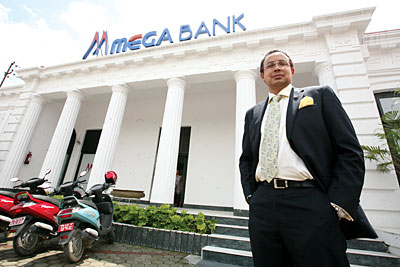
Some banks outgrow their CEOs. But Anil Shah is the kind who outgrows banks. In the last ten years he has been in and out of big banks like Standard Chartered and Nabil, and he now heads the newly established Mega Bank.
"I need change, and I need challenges," says Shah in his well-appointed new office in the former British Council building on Kantipath. With its rural banking focus, Mega offers Anil Shah both of these.
Mega has 1,220 middle-class Nepalis from all over the country as promoters, and 14 partners. This is a bank with attitude: its ideology is to promote 'financial inclusion' among the three fourths of Nepalis who are not banking at present. The promoters are divided into six clusters named after Nepal's mountains and they elect directors to the board.
"People often ask me who owns Mega Bank, and my answer is: the people," says Shah. "With so many promoters and partners no one can say 'it's mine'."
Mega Bank is zeroing in on small and medium-scale enterprises (SMEs) as part of its mission to promote self-sufficiency and job creation, and bring value-chain dynamics into the economy. It all sounds too goody-goody to be true, but Shah is deadly serious and says a country like Nepal must have this banking model.
"All the stakeholders – the bankers, development bankers, Rastra Bank, the World Bank, IMF– have to get together and decide once and for all what the strategic goal of the financial sector in Nepal should be. Is it only to make money and share dividends among shareholders, or is there a higher calling?" It is clear he has made up his mind about what the real answer is.
"It can't only be about profit," he continues, warming to his theme. "Of course you have to make money, but there has to be a nation-level goal of wealth creation by enlarging the pie through long-term economic growth. Just making money isn't enough for us."