
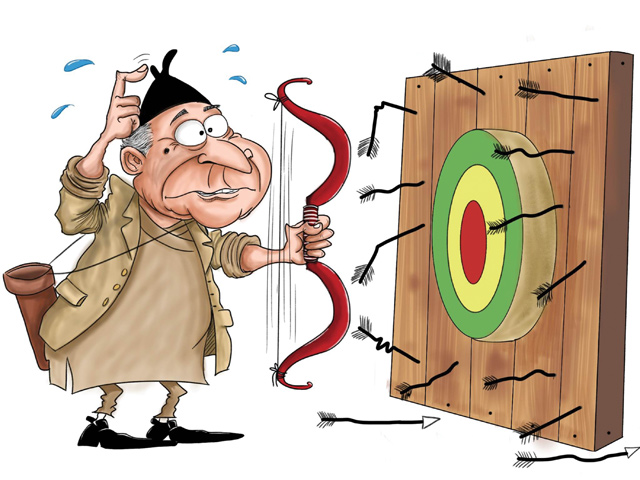
Pic: Diwakar Chettri
The whirlwind of the Nepali Congress General Convention and the election for a new party leadership has finally come to an end. The general sentiment seems to be that under Sher Bahadur Deuba’s stewardship the likelihood of addressing grievances is higher. There is also talk of a great ‘balance’ in the party brought forward by the Deuba-Shashank Koirala team.
Even before the election, an image of Deuba as the ‘progressive’ leader for the party and the likes of Paudel and Koirala as a ‘regressive’, and the Sitaula alliance as the ‘Indian hand’ were more or less established.
But if past records are anything to go by, whichever ‘camp’ is leading is unlikely to make any difference except among supporters and patrons who will now cash in on the new leadership. The idea that a Deuba-led party would somehow be more amenable to the Madhesi cause, for example, seems almost baseless. A cursory look at his past premierships and his positions on the undivided Far West should be proof enough. Instead of giving him support, Madhesi pundits should be raising eyebrows.
Perhaps the Madhesi Front trusts Deuba more because he may well be the ‘most lenient’ in the NC leadership to agree to whatever demands come his way, so long as he gets his seat in power. Ram Chandra Poudel, whom Deuba defeated, lags only a few steps behind in this respect.
But at this point, every leader in every political party will pretty much do anything for power, signing on to whatever comes their way to ensure two things: sustained power and the inevitable and unhindered loot of the coffers. In real terms, it should be evident to all Nepalis that there is no real difference between Deuba and Paudel, between the NC and UML and the Prachanda-led Maoists. Even Chitra Bahadur KC’s Jana Morcha and Kamal Thapa’s RPPN seem to have bartered ideology for power. In reality, differences are exaggerated during times of political sensitivity like it was during the convention, but they mean very little beyond those days and weeks. Now you can hardly tell one leader or party from another Major political parties in Nepal are all, in theory, left of centre. In practice none of them have a substantial binding political ideology aside, of course, from an entrenched belief in malpractice and corruption. They carry policies and actions which are simultaneously neo-liberal, conservative, socialist, fascist, nationalist and everything in between, so long as the actions yield results in their political – and thus economic -- favour.