
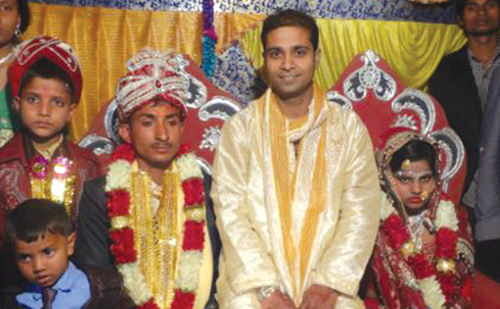
I am a Muslim. He is a Hindu. Nearly 25 years ago, when our society was more conservative than it is today, our grandmothers tied the knot of life-long friendship, referred to as miteri saino in Nepal, between us.
At that time, neither I nor he knew the difference between Islam and Hinduism. It was not my choice to be a Muslim, nor was it his choice to be a Hindu. We grew up together, and we still celebrate our friendship free of any religious prejudices. But when I read or hear about sectarian violence, I wonder why people following separate religions cannot be friends like us.
I and my friend, Ram Narayan Gupta, looked somewhat similar when we were children. That was why our grandmothers made us friends. We always valued our friendship beyond religion.
I came to Kathmandu for higher education, but I still visit my friend in the village at least twice a year to celebrate Eid and Holi. Some Hindus do not drink water touched by their Muslim neighbours. Some Muslims do not drink water in Hindu households. But Ram Narayan and me eat together, without fearing religious consequences. My Eid is joyless without my Hindu friend. His Holi is joyless without me, a Muslim. He always cooks halal meat whenever I visit him.
A few months ago, my friend invited me to his marriage ceremony. I took leave from my office to attend his wedding in Bisrampur of Parsa district. I reached home, dropped my bags, and went to my friend’s house. He had bought me a sherwani, his relatives wanted to apply henna on my hand. I felt shy, but they insisted. And I had to comply.